
Blade Application Guides / Application Guide / Industrial tape converting
Filament Tape Slitting Through Reinforcing Fibers
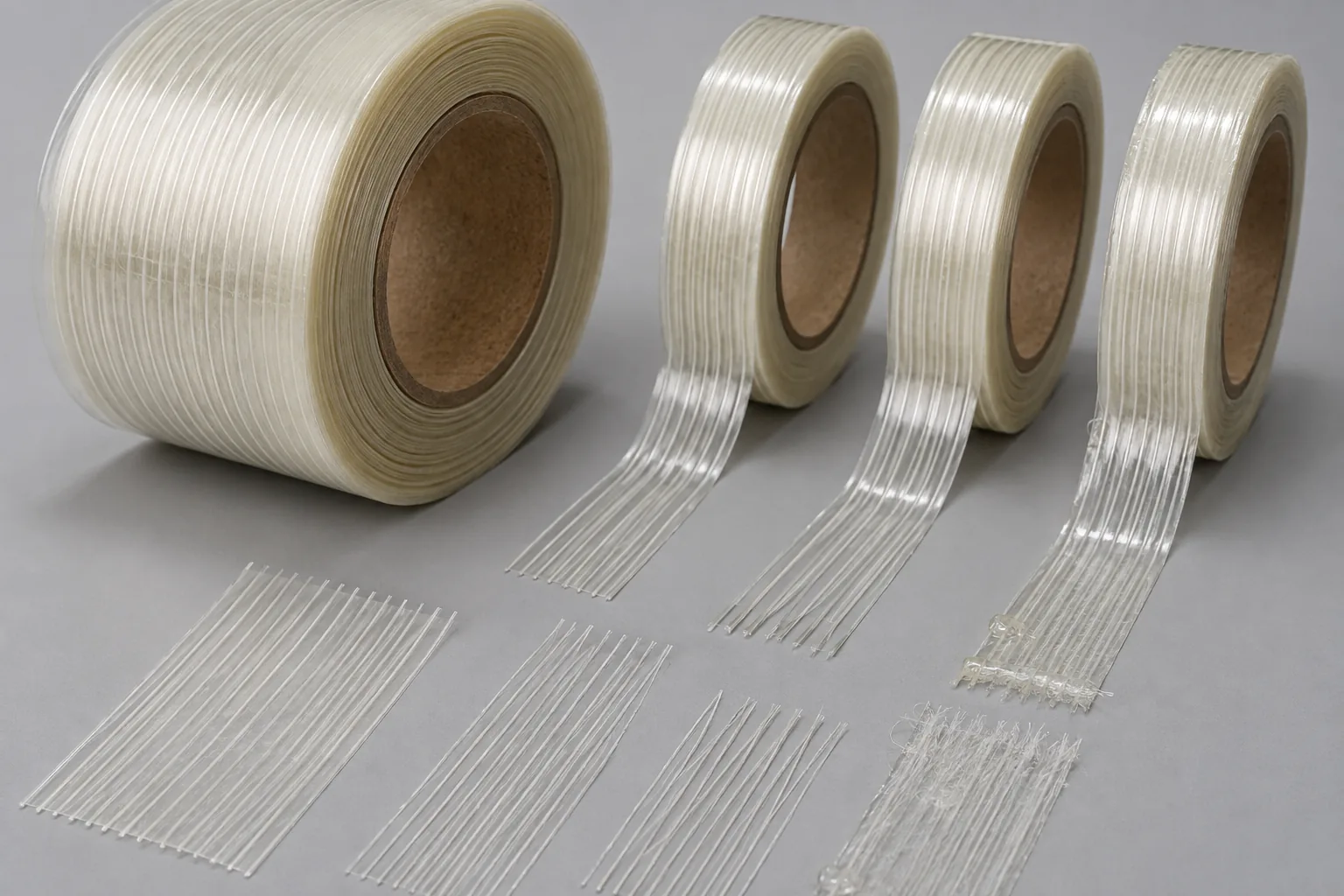
Filament tape contains high-strength yarns embedded in adhesive beneath a film backing. The slit must sever backing, adhesive, and reinforcement together; otherwise projecting filaments can bridge lanes, disturb winding, or snag during dispensing.
Updated
Where This Cutting Application Appears
Longitudinal filament tape conversion
Parallel reinforcement tapes are slit along narrow lanes for bundling and palletizing, where every filament at the edge must separate.
Cross-weave reinforced tape sizing
Woven or cross-filament constructions are width-converted while transverse yarns create repeated interrupted cuts.
Heavy-duty strapping tape roll preparation
High-tensile tape is converted into machine or hand-dispensing reels with controlled edge projection and winding alignment.
Slitting process boundary
slitting for reinforced filament tape is planned around longitudinal width conversion of a moving roll, web, sheet or strip into controlled lanes or daughter rolls; it is not transverse length cutting, profile formation or removal of only a narrow damaged margin.
Slitting setup checkpoint
For reinforced filament tape, confirm unwind and rewind tension, lane widths, knife positions, edge guidance, core alignment, trim removal and discharge behavior.
Slitting acceptance checkpoint
For reinforced filament tape, evaluate lane width, edge condition, camber or wandering, debris, telescoping, interleaving and stable winding or downstream transfer.
Define the Required Cut Result
- Sever reinforcement yarns without leaving bridges between lanes
- Limit frayed filaments that snag during unwind
- Keep adhesive from collecting around exposed fiber ends
- Wind narrow reinforced reels with aligned, stable faces
Problems to Diagnose Before Changing the Knife
Uncut filaments bridge adjacent slit lanes
Identify yarn material, diameter, count, orientation, tension, cut location, and whether bridging follows a specific reinforcement band.
Frayed fibers project from the tape edge
Review fiber type, bundle construction, backing support, cutting direction, side load, wear pattern, and accepted projection limit.
Adhesive and fiber bundles form hard deposits
Check adhesive rheology, web temperature, glass or polyester debris, cleaning interval, speed, and deposit location.
Reinforced narrow reels wind unevenly
Compare lane tension, reinforcement distribution, core alignment, differential winding, slit width, and edge thickness buildup.
Knife Forms That May Be Considered
| Possible knife form | When it may be considered | What must be confirmed |
|---|---|---|
| Circular shear slitting | Consider where reinforcement needs a supported shear action through backing and adhesive. | Confirm yarn direction, overlap, side load, holder rigidity, rotation, and actual reinforced tape samples. |
| Serrated slitting form | Consider only where the installed equipment provides a compatible motion and the tooth action does not pull the reinforcement. | Confirm tooth profile, pitch, direction, web support, fiber response, and approved interface drawing. |
Information to Send for Technical Review
You do not need to know the exact blade name. Send the available workpiece, machine, current-knife and cut-result information so the application can be reviewed against a drawing or sample.
- Backing film type, thickness, and tensile properties
- Reinforcement material, yarn diameter, count, and orientation
- Parallel-filament or cross-weave construction
- Adhesive chemistry, coat weight, temperature, and laminate age
- Master width, reinforcement-band layout, and required slit widths
- Line speed, web tension, winding method, and core dimensions
- Accepted limits for fiber projection, adhesive smear, and lane bridging
- Existing slitting sample, holder interface, wear map, cleaning cycle, and volume
Questions About This Cutting Application
Why do some reinforcement bands separate while others bridge?
Yarn count, position, local tension, adhesive wetting, and slit alignment may vary across the web. Map every bridge against the reinforcement layout.
How should frayed filament projection be inspected?
Agree on a maximum projection and sampling method, then inspect both reel faces under consistent lighting without pulling fibers by hand before measurement.
Does cross-weave tape require a different review from parallel filament tape?
Yes. Transverse yarns create repeated interrupted cutting, while longitudinal yarns may track beside the slit. Provide the exact reinforcement orientation.
What causes hard deposits in reinforced-tape slitting?
Adhesive can bind glass or polymer fiber debris into a compact deposit. Record temperature, run length, cleaning method, and deposit composition if known.
Can a tape width and fiber count define the cutting specification?
No. Backing, adhesive, yarn orientation, web tension, winding, holder interface, and accepted edge samples must also be confirmed.
Related product and service information
- Cutting Fiberglass Chopped-Strand Mat - fiberglass chopped-strand mat · sheet cutting and trimming
- Double-Sided Tape Slitting With Release-Liner Control - double-sided adhesive tape · slitting
- Electronics Glass-Fiber Prepreg Cutting - electronics-grade glass-fiber prepreg · prepreg panel cutting
Request a Custom Cutting-Knife Review
Send the workpiece details, machine or holder information, current knife photos or sample, required quantity and examples of the present cut problem. Final dimensions, material, edge geometry and tolerances are confirmed from the approved requirements.