
Blade Technology / Application Guide / Adhesive material converting
Double-Sided Tape Slitting With Release-Liner Control
Double-sided tape may contain two adhesive layers, a film, tissue or foam carrier, and one or two liners. Slitting behavior changes when those layers have different stiffness, release levels, tension, or thermal history.
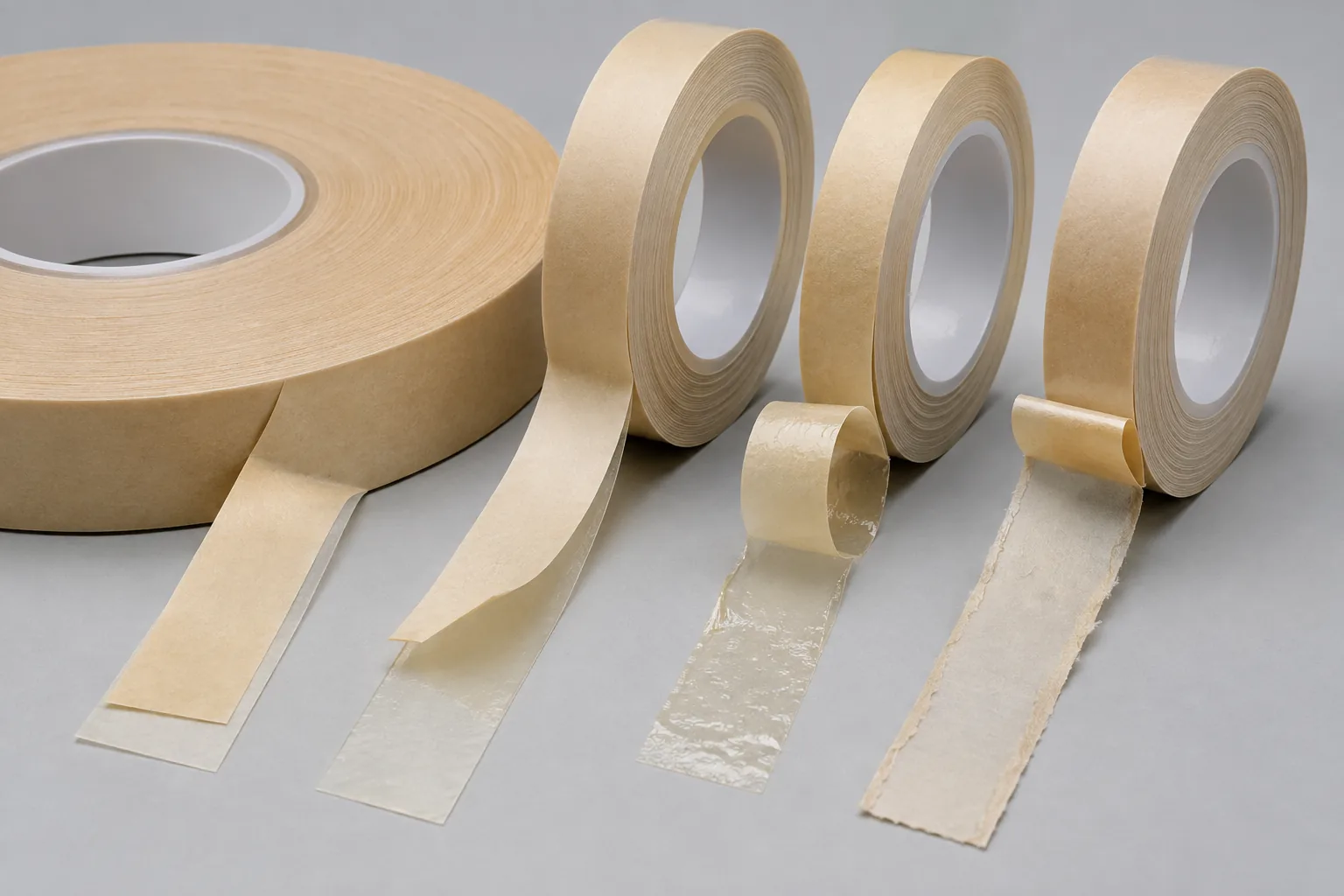
Where This Cutting Application Appears
Tissue-carrier tape width conversion
Conformable tissue tapes are slit for laminating and assembly, with both adhesive edges and the paper carrier kept aligned.
Film-carrier bonding tape preparation
PET or other film-supported tapes are converted into precise narrow reels for electronic, automotive, or general industrial bonding.
Transfer and differential tape conversion
Carrierless or differentially coated constructions are slit while liner support and release direction govern handling.
Common Ways to Describe This Cutting Problem
- double sided adhesive tape slitting
- release liner shift on double sided tape
- double sided tape sticky reel edge
- tissue carrier tape slitting problem
- pet carrier transfer tape slitting
- narrow double sided tape roll winding
- adhesive transfer during tape slitting
- double sided tape cutter review
Define the Required Cut Result
- Align both adhesive layers with the carrier and liner edges
- Prevent liner migration as narrow lanes separate
- Keep reel faces free of adhesive blocking during storage
- Maintain the width needed for downstream laminating or die cutting
Problems to Diagnose Before Changing the Knife
Release liner shifts beyond the adhesive edge
Review liner tension, release level, laminate balance, coated-side path, narrow width, winding direction, and core alignment.
Both reel faces become sticky or blocked
Identify adhesive flow, edge pressure, temperature, roll hardness, storage time, side contact, and protective packaging.
Tissue carrier tears inside the laminate
Compare carrier basis weight, moisture, adhesive penetration, tension, splice condition, cutting support, and tear origin.
Film carrier stretches and changes slit width
Check film gauge and modulus, web tension, lateral load, heat, winding pull, measurement timing, and relaxation.
Knife Forms That May Be Considered
| Possible knife form | When it may be considered | What must be confirmed |
|---|---|---|
| Circular shear slitting | Consider for supported laminate separation with controlled side load and accurate narrow widths. | Confirm both adhesive layers, carrier, liner, overlap, rotation, web path, and approved holder drawing. |
| Score slitting | Consider only if the anvil and penetration can separate the stack without excessive adhesive squeeze or liner fracture. | Confirm total construction, liner condition, penetration, temperature, tension, and finished-reel samples. |
Information to Send for Technical Review
You do not need to know the exact blade name. Send the available workpiece, machine, current-knife and cut-result information so the application can be reviewed against a drawing or sample.
- Adhesive chemistry and coat weight on each side
- Carrier type, thickness, tensile properties, or carrierless construction
- Number of liners, liner materials, calipers, and release levels
- Laminate age, storage temperature, and conditioning before slitting
- Master dimensions, slit widths, cores, and finished reel diameters
- Web path, coated-side orientation, tension, winding, and line speed
- Photos of liner shift, blocking, carrier tear, and edge transfer
- Existing slitting interface, downstream lamination method, and acceptance criteria
Questions About This Cutting Application
Why does only one liner shift during slitting?
The liners may have different release, stiffness, tension, or contact paths. Mark liner materials and orientations and track the shift by lane and roll diameter.
How should a sticky double-sided reel face be inspected?
Check immediately and after normal storage for blocking, adhesive transfer, edge squeeze, unwind behavior, temperature history, and packaging contact.
What changes between tissue and PET carriers?
Tissue can tear or absorb adhesive, while PET can stretch, generate static, or retain tension. Each carrier needs its actual adhesive and liner combination reviewed.
Can transfer tape be slit like a supported double-sided tape?
Do not assume so. Carrierless constructions rely heavily on the liner for dimensional support and may respond differently to pressure and winding.
Which dimensions are needed for a replacement slitting part?
Provide the existing part or approved holder drawing, bore, width, thickness, bevel, rotation, spacing, and overlap or penetration together with material samples.
Request a Custom Cutting-Knife Review
Send the workpiece details, machine or holder information, current knife photos or sample, required quantity and examples of the present cut problem. Final dimensions, material, edge geometry and tolerances are confirmed from the approved requirements.