
Blade Application Guides / Application Guide / aluminum processing
Trimming Aluminum Sheet Edges
Aluminum sheet is easy to deform but its cutting behavior changes sharply with alloy, temper and surface condition. Side trim should remove unstable mill edges without pulling the strip sideways, rolling a sharp burr onto the face or embedding aluminum on the knife land.
Updated
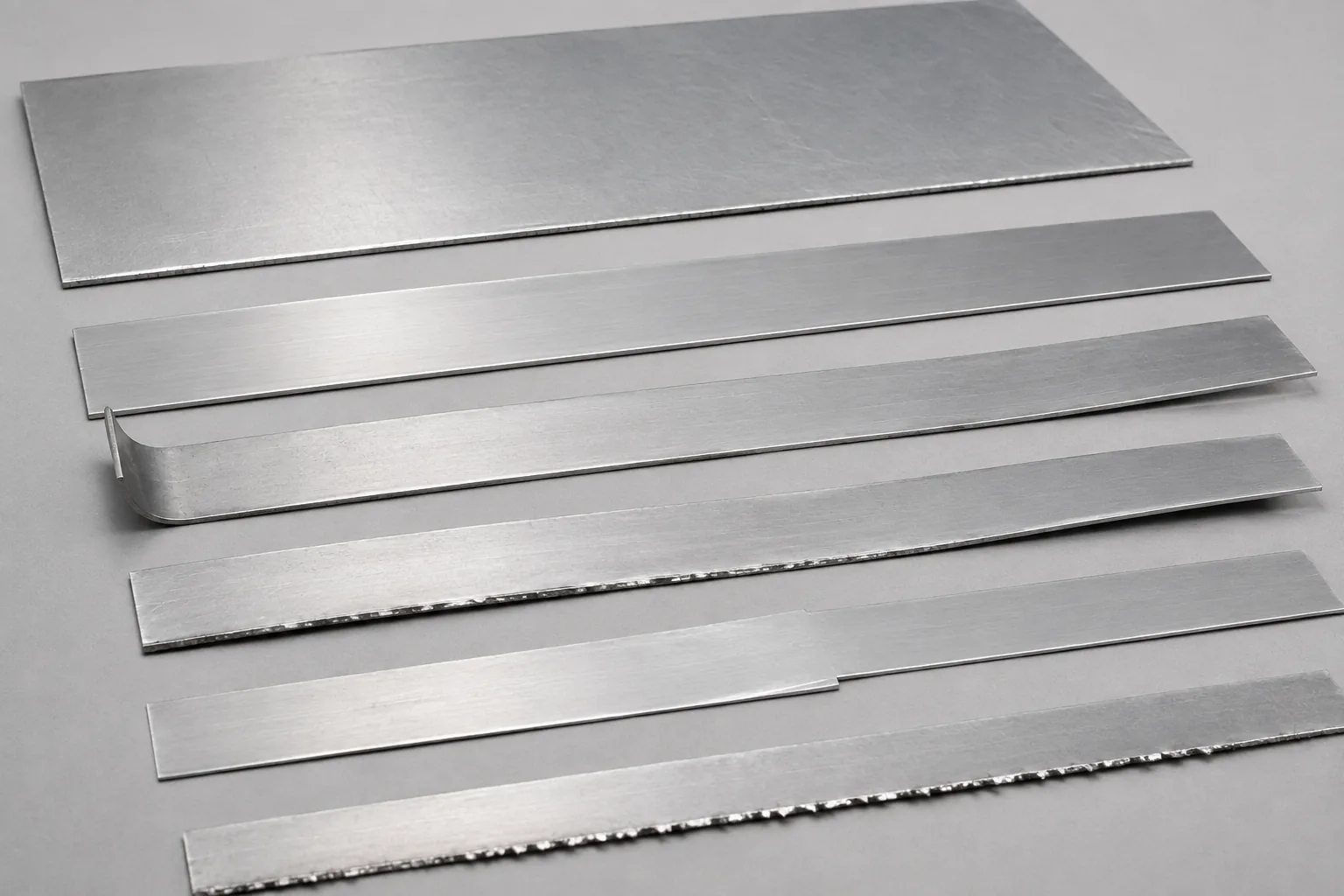
Where This Cutting Application Appears
Coil-line side trimming
Removes damaged or irregular mill edges before leveling, recoiling or downstream slitting.
Sheet-width finishing
Produces parallel edges for panels and fabricated blanks where squareness and burr direction are specified.
Surface-sensitive alloy conversion
Trims anodized, coated or bright stock while contact points are controlled to avoid visible marking.
Edge Trimming process boundary
Edge trimming removes a narrow irregular, damaged or excess margin to finish an existing edge; it does not divide the full workpiece into several production widths.
Edge Trimming setup checkpoint
Define the trim allowance, reference edge, support close to the cut and a waste path that prevents the narrow offcut from re-entering the product.
Edge Trimming acceptance checkpoint
Inspect the finished edge for straightness, local tearing or crushing, surface scuffing and continuity from the start to the end of the trim.
Define the Required Cut Result
- Parallel finished edges
- Low burr and rollover
- Minimal edge curl or strip camber
- No aluminum pickup or surface marking
Problems to Diagnose Before Changing the Knife
Edge curl
- Check clearance and knife penetration
- Compare top and bottom residual stress
- Review trim width and strip support
Aluminum pickup
- Inspect knife-face finish
- Check lubricant and surface coating
- Record pressure and heat at the cutting pair
Width drift
- Verify strip guiding and datum
- Measure arbor runout and spacer condition
- Check thermal growth during long runs
Sharp intermittent burr
- Map burr to knife rotation
- Inspect localized edge damage
- Check bearing play and material thickness variation
Knife Forms That May Be Considered
| Possible knife form | When it may be considered | What must be confirmed |
|---|---|---|
| circular side-trim knives | Paired rotary knives suit continuous edge removal when trim width, overlap and scrap handling remain stable. | Confirm the final geometry and mounting from the aluminum side-trim arbor, an unworn sample or an approved drawing before manufacture. |
| dished rotary trim knives | Relieved faces may limit contact with a sensitive finished edge on machinery designed to support this geometry. | Confirm the final geometry and mounting from the dished aluminum trim head, an unworn sample or an approved drawing before manufacture. |
| straight shear knives | May suit indexed sheet-width correction with rigid hold-down and a matched lower knife. | Confirm the final geometry and mounting from the aluminum sheet shear, an unworn sample or an approved drawing before manufacture. |
Information to Send for Technical Review
You do not need to know the exact blade name. Send the available workpiece, machine, current-knife and cut-result information so the application can be reviewed against a drawing or sample.
- Trim-line or shear manufacturer and model
- Aluminum alloy, temper and thickness range
- Surface finish, coating or protective film
- Incoming and finished widths with tolerance
- Line speed, tension and strip support
- Clearance, overlap and current knife dimensions
- Marked burr, curl, pickup and camber samples
- Knife quantity, destination and required date
Questions About This Cutting Application
Why does aluminum transfer onto the knife?
Adhesive contact can increase with rough faces, high side pressure, heat or poor lubrication; determine where pickup begins.
What causes a trimmed edge to curl?
Unequal plastic deformation, residual stress, excessive penetration or narrow unsupported trim can bend the edge.
Can a wider scrap trim improve edge quality?
It may remove more unstable material, but width, scrap stiffness and guiding must fit the line; test the proposed trim allowance.
Should burr be checked immediately after trimming?
Yes, and again after handling if edge contact can fold or detach it; record the inspection method.
Does anodized sheet need a different review?
The harder surface layer and cosmetic requirements can alter wear, chipping and handling risks.
Related product and service information
- Slitting Carbon Steel Coil - carbon steel coil · coil slitting
- Slitting Stainless Steel Strip - stainless steel strip · coil slitting
- Trimming Copper and Brass Strip - copper and brass strip · edge trimming and width control
Request a Custom Cutting-Knife Review
Send the workpiece details, machine or holder information, current knife photos or sample, required quantity and examples of the present cut problem. Final dimensions, material, edge geometry and tolerances are confirmed from the approved requirements.