
Blade Application Guides / Application Guide / Paper converting
Silicone Release Paper Edge Trimming: Width Control Without Coating Damage
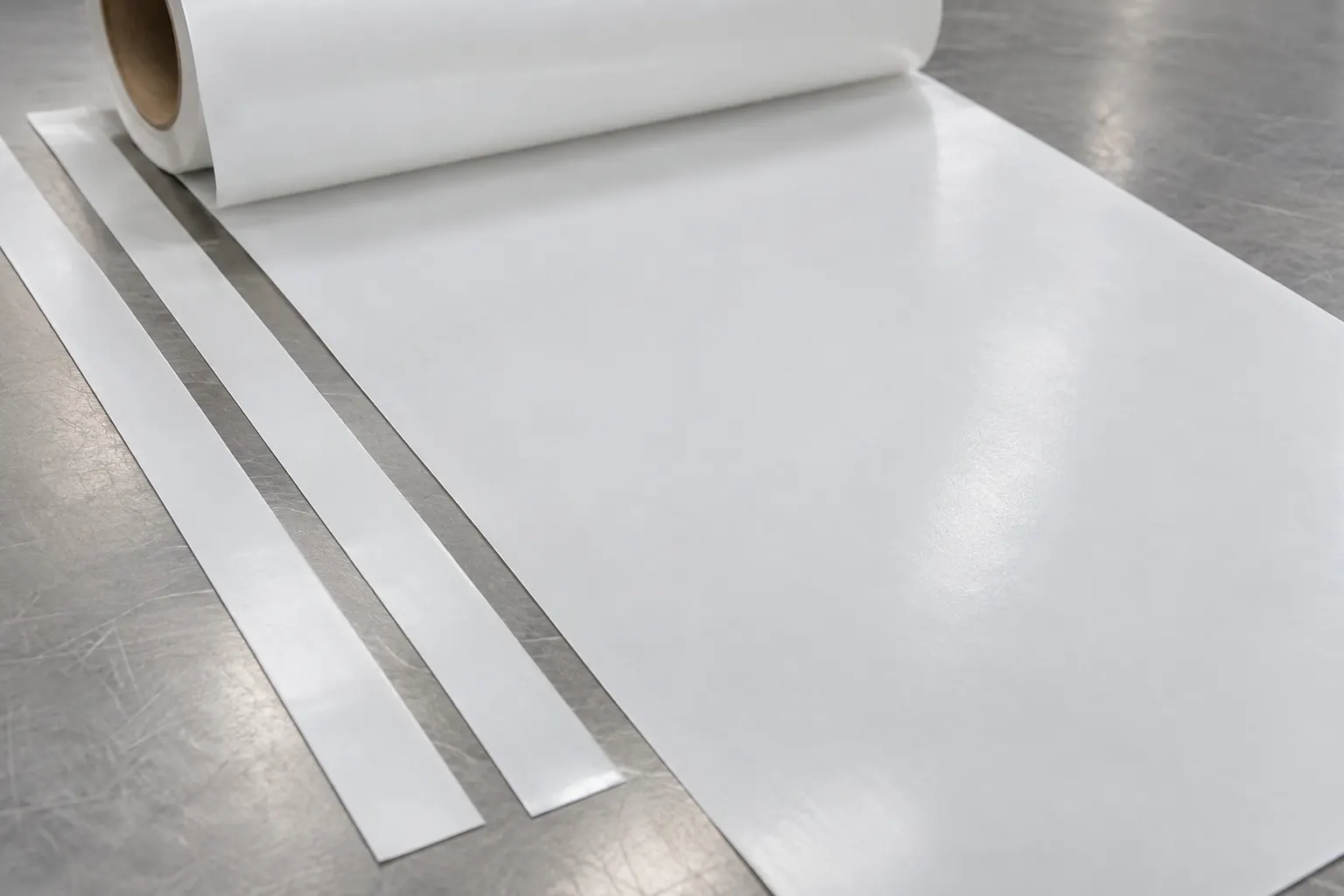
Edge trimming removes coated or uneven deckle zones before release paper enters laminating or converting. Because narrow trim can break, wrap or carry silicone residue, the review must include edge quality, trim extraction, web guidance and coating-side contact rather than treating nominal width as the only target.
Updated
Where This Cutting Application Appears
Release-liner coating lines
Deckle or coating-edge regions are removed to establish a usable web width before winding and inspection.
Adhesive laminate preparation
Liner edges are trimmed before adhesive film or labelstock lamination so edge contamination does not enter the finished construction.
Rewinding and roll finishing
Damaged transport edges are removed during final rewinding to improve reel appearance and downstream tracking.
Width Edge Trimming process boundary
Width edge trimming removes controlled side margins to establish parallel finished edges and final web width; it is not a transverse length cut.
Width Edge Trimming setup checkpoint
Define both finished edge positions, centerline control, side guidance, trim width and reliable removal of the two continuous edge strips.
Width Edge Trimming acceptance checkpoint
Measure finished width across the run and inspect parallelism, camber, burr or fray, surface damage and trim-break frequency.
Define the Required Cut Result
- Maintain a straight finished web edge and usable width
- Create continuous trim strips that can be extracted reliably
- Minimize fiber dust and silicone residue
- Avoid edge curl, web steering and coating scratches
Problems to Diagnose Before Changing the Knife
Narrow trim strip repeatedly breaks
Review trim width, paper strength, moisture, coating level, tension, extraction angle, vacuum flow and whether the strip oscillates before failure.
Residue accumulates at the trimmed edge
Compare coating cure, edge bead, web temperature, cutting contact, trim path and cleaning interval across accepted and rejected runs.
Finished web width wanders
Check edge-guide reference, sensor cleanliness, unwind alignment, lateral roll movement, holder stability and measurement location.
Trimmed edge curls or turns upward
Review coating asymmetry, moisture, residual roll set, support near the cut, tension and trim-removal direction.
Knife Forms That May Be Considered
| Possible knife form | When it may be considered | What must be confirmed |
|---|---|---|
| Circular shear edge trimming | Consider where paired rotary edges already trim both web margins. | Confirm rotary dimensions, overlap, side load, holder orientation and edge geometry from installed equipment and approved samples. |
| Supported razor edge trimming | Consider only where the line is designed for a stationary edge with suitable web support and guarding. | Confirm holder, exposure, support path, material condition and safety requirements from the converter; do not infer dimensions from the web name. |
Information to Send for Technical Review
You do not need to know the exact blade name. Send the available workpiece, machine, current-knife and cut-result information so the application can be reviewed against a drawing or sample.
- Base-paper grade, strength, basis weight and moisture range
- Coating type, coated side, cure and edge-bead condition
- Incoming width, finished width and trim-strip width per side
- Line speed, tension and web-guiding arrangement
- Trim extraction route, vacuum level and disposal method
- Current edge-trim action, mounting interface and support geometry
- Photos showing breaks, residue, curl and width variation
- Acceptance limits and downstream laminating or rewinding step
Questions About This Cutting Application
Why does a very narrow release-paper trim break more often?
A narrow strip has less tensile margin and reacts strongly to edge flaws, tension spikes, moisture variation, extraction angle and vacuum pulsation. The whole trim path should be reviewed.
Can edge guidance correct every width variation?
No. Guidance cannot fully compensate for lateral roll movement, unstable holders, web wrinkles, shaft runout or an inconsistent measurement datum.
Should trim quality be judged before or after extraction?
Both. Inspect the fresh edge at the cutting point and again after extraction and winding because contact or tension can enlarge a small defect.
Does silicone coating require a specific knife material?
The coating name alone does not determine material. Residue, base-paper abrasiveness, speed, cleaning practice and the existing cutting geometry must be confirmed first.
What should be sent for an edge-trim quotation?
Provide material samples, both widths, speed and tension ranges, trim-path details, current part or drawing, defect photographs and an accepted finished-edge sample.
Related product and service information
- Water-Based Coated Poster Paper Slitting: Surface and Reel Quality - water-based coated poster paper · roll slitting
- Glassine Liner Paper Edge Trimming: Straight Edges and Unbroken Trim - glassine liner paper · width edge trimming
- Clay-Coated Label Paper Edge Trimming: Clean Margins and Stable Width - clay-coated label paper · width edge trimming
Request a Custom Cutting-Knife Review
Send the workpiece details, machine or holder information, current knife photos or sample, required quantity and examples of the present cut problem. Final dimensions, material, edge geometry and tolerances are confirmed from the approved requirements.