
Blade Application Guides / Application Guide / Paper converting
Glassine Liner Paper Edge Trimming: Straight Edges and Unbroken Trim
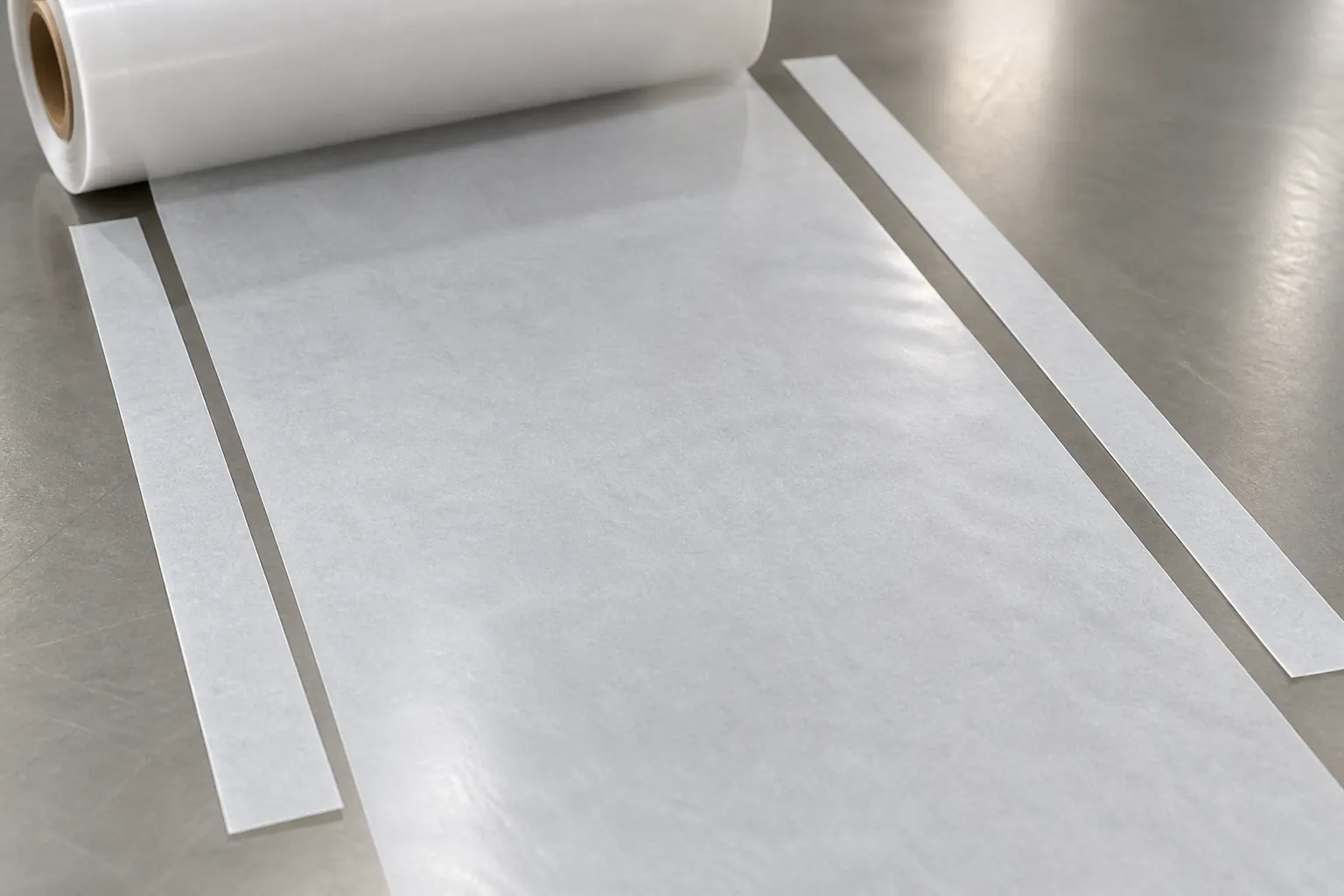
Glassine edge trim is often narrow, dense and relatively brittle, making it vulnerable to repeated breaks between the cutting point and extraction system. Technical evaluation should connect trim-strip strength and edge condition with web guidance, static, extraction geometry and the actual support at both margins.
Updated
Where This Cutting Application Appears
Glassine coating-width finishing
Uneven deckle and coating margins are removed before the roll is released for adhesive conversion.
Labelstock laminating lines
Glassine liner is trimmed to match facestock or adhesive width while narrow waste strips are continuously extracted.
Final reel inspection and salvage
Transport-damaged or contaminated margins are removed during rewinding to recover a consistent usable web.
Width Edge Trimming process boundary
Width edge trimming removes controlled side margins to establish parallel finished edges and final web width; it is not a transverse length cut.
Width Edge Trimming setup checkpoint
Define both finished edge positions, centerline control, side guidance, trim width and reliable removal of the two continuous edge strips.
Width Edge Trimming acceptance checkpoint
Measure finished width across the run and inspect parallelism, camber, burr or fray, surface damage and trim-break frequency.
Define the Required Cut Result
- Form continuous trim strips without brittle breaks
- Maintain parallel finished edges and specified web width
- Reduce compact dust and edge chips
- Keep the glassine surface free from trim contact scratches
Problems to Diagnose Before Changing the Knife
Trim strip snaps at regular intervals
Check recurring base-paper defects, roll edges, extraction pulsation, static discharge, support runout and repeating equipment positions.
Edge develops small brittle notches
Review glassine moisture, density, web support, cutting contact, vibration and whether notches occur on the coated or uncoated side.
Trim wraps around downstream components
Evaluate extraction angle, vacuum capacity, static, strip curl, guide surfaces and the distance from cut to pickup.
Usable width changes during the roll
Check edge sensor reference, roll wander, unwind alignment, lateral holder position and width measurements over time.
Knife Forms That May Be Considered
| Possible knife form | When it may be considered | What must be confirmed |
|---|---|---|
| Circular shear edge trimming | Consider where paired rotary cutters are installed at the glassine web margins. | Confirm all dimensions, overlap, side force, rotation and holder arrangement from line records and an approved drawing. |
| Supported stationary edge trimming | Consider only if the machine is designed for a stationary cutting edge and controlled web support. | Confirm exposure, holder, support geometry, guarding and acceptable trial edge before any specification is fixed. |
Information to Send for Technical Review
You do not need to know the exact blade name. Send the available workpiece, machine, current-knife and cut-result information so the application can be reviewed against a drawing or sample.
- Glassine grade, density, basis weight, moisture and coating
- Incoming edge condition and damaged-margin width
- Finished web width, tolerance and trim width on each side
- Line speed, web tension, roll diameter and unwind alignment
- Trim extraction angle, vacuum flow, guides and disposal route
- Current cutting form, holder interface and support details
- Photographs and retained samples from trim breaks or chipping
- Downstream laminate width and edge acceptance standard
Questions About This Cutting Application
Why is glassine trim more likely to snap than wider web material?
Its dense structure and narrow section leave little tolerance for notches, tension spikes, static or extraction misalignment. Strip width and the full removal path both matter.
Can more vacuum solve trim wrapping?
Not always. Excess or unstable airflow can make a light strip oscillate. Pickup distance, angle, static, guides and strip curl should be reviewed together.
How should trim-break frequency be recorded?
Record time, roll position, side, speed, tension and break location, then retain the strip ends to distinguish tensile failure from an edge-initiated notch.
Is a clean edge enough to accept the process?
No. Finished width, trim continuity, particle level, surface condition and downstream tracking should also meet agreed criteria.
Can dimensions be copied from another glassine line?
Only after confirming identical interfaces and operating motion. Final dimensions must come from the actual holder, sample part or approved machine drawing.
Related product and service information
- Kraft Interleaving Paper Roll Slitting: Low Dust and Stable Reels - kraft interleaving paper · roll slitting
- Silicone Release Paper Edge Trimming: Width Control Without Coating Damage - silicone release paper · width edge trimming
- Clay-Coated Label Paper Edge Trimming: Clean Margins and Stable Width - clay-coated label paper · width edge trimming
Request a Custom Cutting-Knife Review
Send the workpiece details, machine or holder information, current knife photos or sample, required quantity and examples of the present cut problem. Final dimensions, material, edge geometry and tolerances are confirmed from the approved requirements.