
Blade Application Guides / Application Guide / Paper converting
Clay-Coated Label Paper Edge Trimming: Clean Margins and Stable Width
Edge trimming clay-coated label paper removes coating beads, damaged roll edges and print margins, but the mineral layer can chip while narrow waste strips carry abrasive debris. Finished width, visual margin and extraction reliability should therefore be specified as separate but connected outcomes.
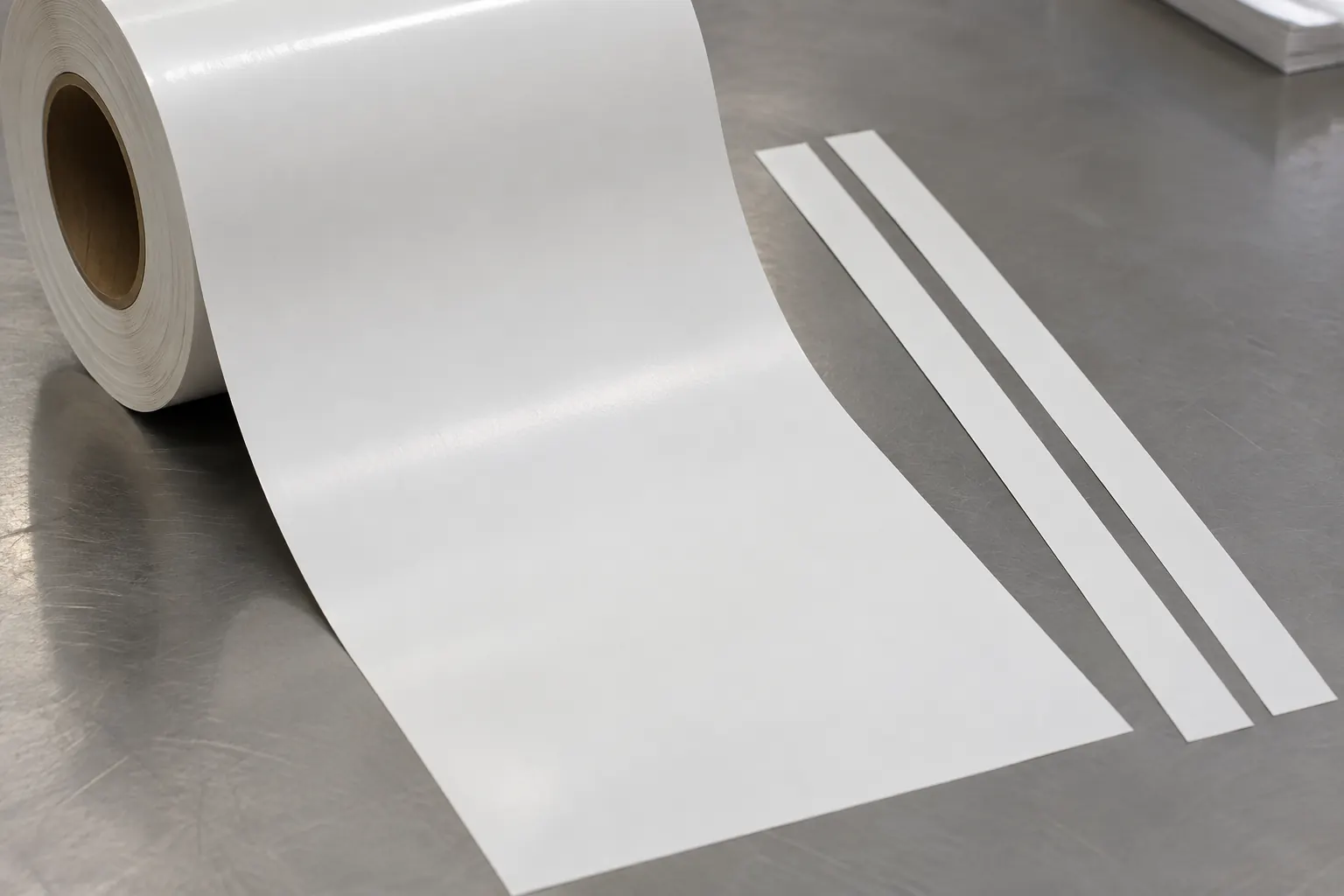
Where This Cutting Application Appears
Post-coating deckle removal
Coating beads and uneven margins are removed to establish a saleable label-paper width.
Printed-web margin finishing
Registration bars and damaged outer print zones are trimmed before rewinding or downstream label conversion.
Lamination width matching
Coated paper edges are finished to align with adhesive or liner webs while maintaining a continuous trim path.
Common Ways to Describe This Cutting Problem
- clay-coated label paper edge-trimming blades
- coated label web margin trimming
- printed label roll edge trim accuracy
- clay-coated paper trim dust reduction
- labelstock trim strip extraction problem
- coating bead removal from label paper
- stable width edge finishing for label webs
- custom edge trim RFQ for coated labels
Define the Required Cut Result
- Remove coating beads without propagating surface chips
- Hold the finished edge relative to the print datum
- Maintain continuous trim extraction with low dust
- Prevent debris from scratching or marking the web
Problems to Diagnose Before Changing the Knife
Coating edge breaks into short flakes
Review coat thickness at the margin, cure, base-paper support, trim width, cutting contact, speed and extraction load.
Printed margin becomes uneven
Check print-to-web alignment, edge-guide sensor datum, roll wander, holder position and whether artwork registration itself varies.
Waste strip blocks the extraction duct
Evaluate strip stiffness, curl, coating debris, duct geometry, airflow, static and the transition from cut to pickup.
Finished web surface shows scratch tracks
Inspect loose flakes, trim contact, guide cleanliness, web flutter and winding nip for trapped particles.
Knife Forms That May Be Considered
| Possible knife form | When it may be considered | What must be confirmed |
|---|---|---|
| Circular shear edge trimming | Consider for paired rotary margin trimming on coated-paper webs. | Confirm dimensions, overlap, contact force, rotation, holder stiffness and finish from the installed line and accepted trials. |
| Supported stationary edge trimming | Consider only where the equipment provides suitable support, holder control and guarding. | Confirm exposure, edge form, support, trim angle and safety requirements from verified equipment documentation. |
Information to Send for Technical Review
You do not need to know the exact blade name. Send the available workpiece, machine, current-knife and cut-result information so the application can be reviewed against a drawing or sample.
- Base paper and clay-coating construction at the roll margin
- Print layout, registration datum, varnish and cure condition
- Incoming, finished and trim-strip widths for both sides
- Line speed, tension, web guide and unwind alignment
- Trim pickup position, extraction airflow and disposal route
- Existing edge-trim form, holders and mounting dimensions
- Samples of coating flakes, blocked trim and scratched web
- Finished-edge, visual-margin and cleanliness acceptance limits
Questions About This Cutting Application
Why does a coating bead make edge trimming unstable?
The bead changes local thickness and stiffness, which can alter support and fracture behavior. Measure the edge profile and show where flaking begins.
Should finished width reference the web edge or printed image?
The order should define the controlling datum. If print position varies independently, both physical width and visual margin need separate tolerances.
Can trim dust scratch the coated face?
Yes. Hard mineral particles can become trapped at guides or winding nips. Review extraction and web cleaning as well as edge formation.
What is needed to assess a trim-extraction blockage?
Provide strip width and stiffness, break or blockage location, duct and pickup dimensions, airflow, static conditions, speed and photographs of accumulated waste.
Can a generic label-paper edge tool be selected?
No. The actual coating, print, trim width, installed holder, support and accepted edge must be confirmed before final specification.
Request a Custom Cutting-Knife Review
Send the workpiece details, machine or holder information, current knife photos or sample, required quantity and examples of the present cut problem. Final dimensions, material, edge geometry and tolerances are confirmed from the approved requirements.