
Blade Application Guides / Application Guide / Paperboard converting
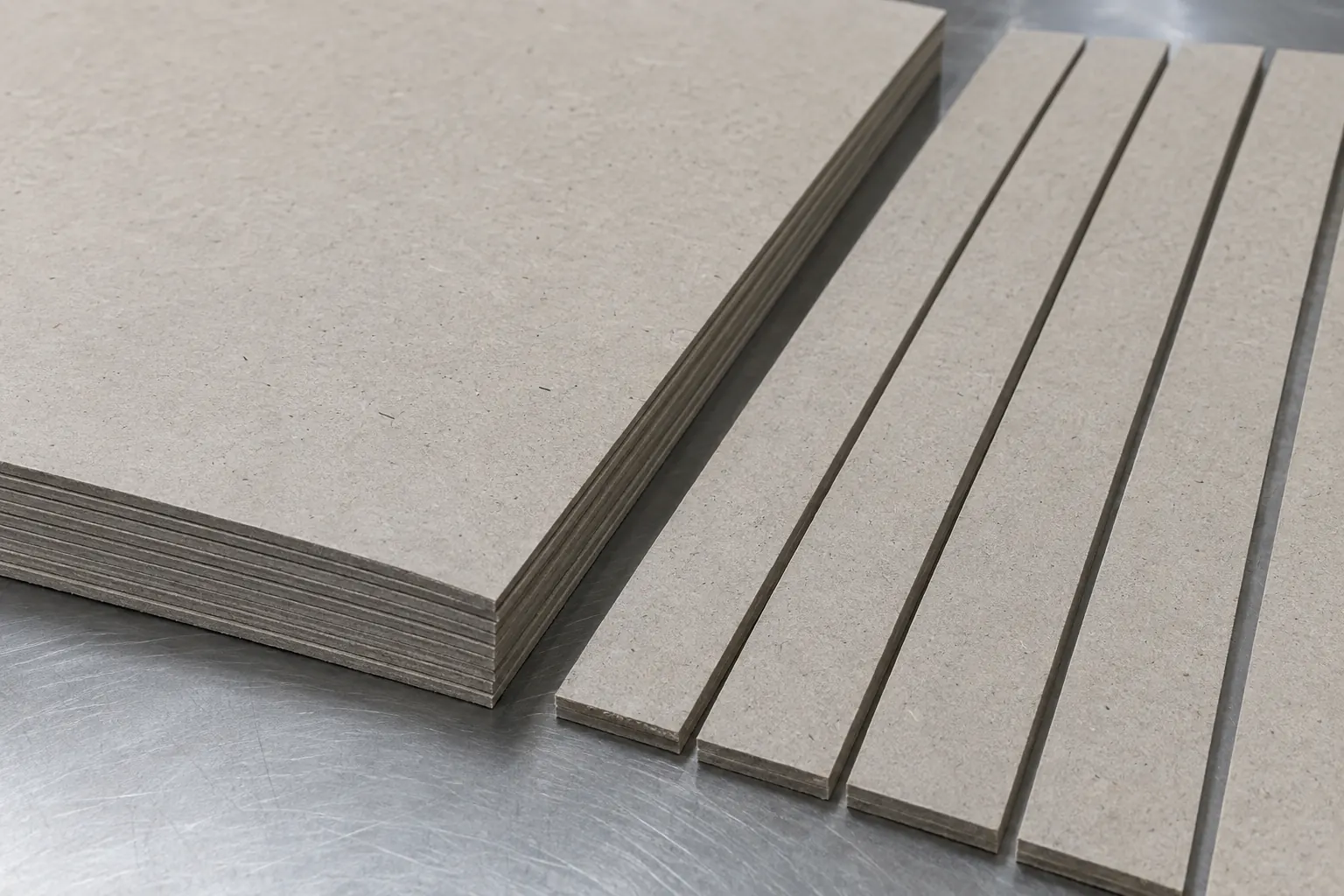
Recycled Grey Chipboard Sheet-Slitting Blades
Recycled grey chipboard can contain variable fiber lengths, fillers and dense inclusions, while its caliper and moisture may change by batch. Sheet slitting should therefore be reviewed with representative lots, supported feed conditions and an agreed method for evaluating dust and edge squareness.
Updated
Where This Cutting Application Appears
Book-cover board strips
Slits large greyboard sheets into controlled widths for case making and binding preparation.
Rigid-box component sizing
Produces sidewall and insert strips that require consistent width and clean laminating edges.
Protective divider conversion
Cuts sheet stock into narrow separators for packaging and material handling.
Sheet Slitting process boundary
Sheet slitting divides sheet stock along parallel longitudinal lines to create strips; it is not final rectangular sizing or a shaped profile cut.
Sheet Slitting setup checkpoint
Confirm sheet support, parallel guide references, blade-line spacing and how narrow strips leave the cutting zone without rotating or overlapping.
Sheet Slitting acceptance checkpoint
Inspect strip width at several positions, edge straightness, surface marking and whether the strips remain flat enough for the next operation.
Define the Required Cut Result
- Consistent strip width from leading to trailing edge
- Low loose-fiber and filler dust
- Straight edges without crushing or polished bands
- Reliable separation of single sheets or declared stacks
Problems to Diagnose Before Changing the Knife
Dust and loose fibers increase within one batch
- Compare recycled furnish, ash content and moisture
- Inspect dense specks at defect locations
- Record stack height and edge condition
Strip width tapers along the sheet
- Check sheet alignment and feed skew
- Review lateral support and guide position
- Measure both incoming and finished sheet geometry
Edges crush instead of separating cleanly
- Compare board density and caliper
- Inspect support and engagement
- Review whether compressed edges recover after conditioning
Lower sheets remain connected in a stack
- Confirm actual compressed stack thickness
- Inspect bottom support and sheet slip
- Map incomplete separation across the cutting width
Knife Forms That May Be Considered
| Possible knife form | When it may be considered | What must be confirmed |
|---|---|---|
| rotary sheet-slitting arrangement | May suit continuous or indexed sheet feed where rotary guidance and support are built into the line. | Confirm rotation, mounting, spacing, support, sheet path and allowable stack from actual equipment information. |
| straight shear-slitting arrangement | May suit indexed sheets or strips where a guided linear action is provided. | Confirm cutting length, stroke, clearance, hold-down, interface and approved edge samples before selecting geometry. |
Information to Send for Technical Review
You do not need to know the exact blade name. Send the available workpiece, machine, current-knife and cut-result information so the application can be reviewed against a drawing or sample.
- Greyboard grade, recycled content and supplier lots
- Caliper, density, moisture and sheet dimensions
- Single-sheet or stack presentation
- Required strip widths and tolerances
- Feed direction, speed and alignment method
- Current cutting motion, support and mounting
- Accepted and rejected dust, crush and taper samples
- Production volume, inspection and packing requirements
Questions About This Cutting Application
Why does recycled chipboard cutting vary by delivery?
Recovered-fiber mix, fillers, density and moisture can vary, so representative production lots matter during review.
Can stacked sheets be treated as one thick sheet?
Not reliably. Interlayer slip, trapped air, compression and bottom support affect full-depth separation.
How should edge dust be compared?
Use the same board lot, stack, cut length and collection method, and compare defined positions along the cut.
Why does a strip become tapered?
Feed skew, sheet misalignment, lateral movement or incoming sheet geometry can all create apparent width drift.
What sample best supports a quotation?
Provide uncut board plus accepted and rejected strips, together with dimensions and equipment interface information.
Related product and service information
- Solid Bleached Sulfate Board Cut-to-Size Blades - solid bleached sulfate board · cut to size
- Honeycomb Paper Panel Sheet-Slitting Blades - honeycomb paper panel · sheet slitting
- Recycled Grey Chipboard Cut-to-Size Blades - recycled grey chipboard · cut to size
Request a Custom Cutting-Knife Review
Send the workpiece details, machine or holder information, current knife photos or sample, required quantity and examples of the present cut problem. Final dimensions, material, edge geometry and tolerances are confirmed from the approved requirements.