
Blade Application Guides / Application Guide / Paperboard converting
Recycled Grey Chipboard Cut-to-Size Blades
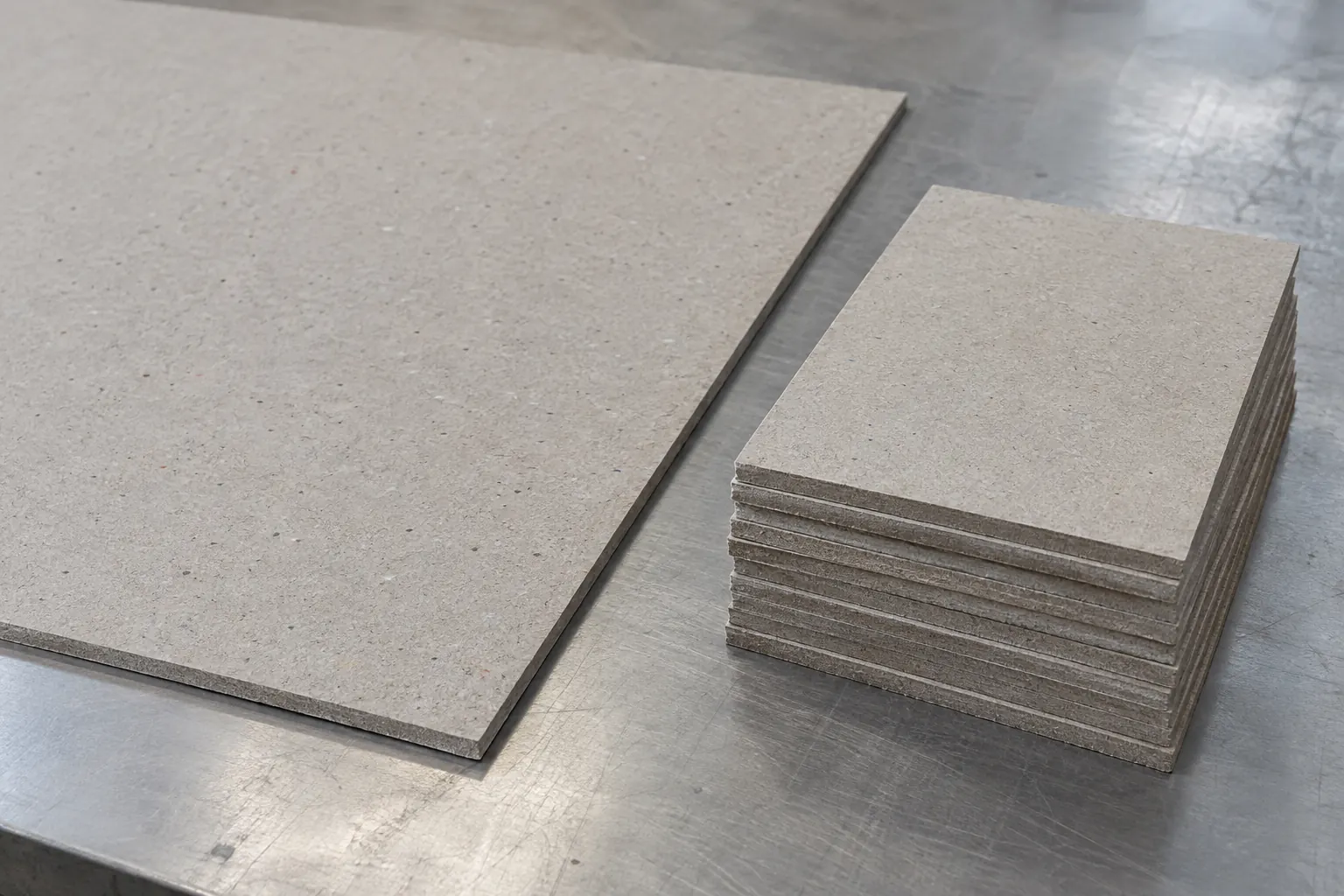
Cut-to-size operations prepare recycled grey chipboard panels for rigid boxes, books and protective structures. Variable density and compressibility can alter cutting load, while poorly controlled registration or hold-down can produce skewed pieces even when the cut edge appears acceptable.
Updated
Where This Cutting Application Appears
Rigid-box panel production
Sizes lid, base and wall components before wrapping or assembly.
Book and binder board preparation
Cuts cover boards to controlled dimensions and square corners for casing operations.
Protective pad conversion
Produces flat pads and separators from economical recycled board stock.
Cut To Size process boundary
Cut to size establishes final straight-sided length and width dimensions; it is different from following a shaped profile or removing only a narrow edge allowance.
Cut To Size setup checkpoint
Confirm both finished dimensions, datum edges, squareness method, hold-down arrangement and the sequence used when length and width require separate cuts.
Cut To Size acceptance checkpoint
Measure length, width, diagonal or squareness as applicable, then inspect corner damage, edge compression and post-cut dimensional recovery.
Define the Required Cut Result
- Length and width within the agreed dimensional tolerance
- Square corners and parallel opposing edges
- Limited dust, feathering and edge compression
- Complete separation through the declared stack
Problems to Diagnose Before Changing the Knife
Panels are out of square
- Compare guide datum and sheet alignment
- Measure diagonals after the board relaxes
- Check whether stacks shift during hold-down
Cut edge develops a compressed dark band
- Review density, moisture and support
- Compare top and bottom cut faces
- Inspect cutting condition across the full length
Dimensions vary after wrapping
- Confirm conditioning and measurement method
- Record board moisture and grain direction
- Separate cut-size error from adhesive or wrap tension
Bottom sheets tear rather than separate
- Inspect stack compression and backing
- Map incomplete areas across the cut
- Check sheet slip and debris beneath the stack
Knife Forms That May Be Considered
| Possible knife form | When it may be considered | What must be confirmed |
|---|---|---|
| guillotine sizing arrangement | May suit square and rectangular sheet sizing where controlled hold-down and support are available. | Confirm cutting width, stack build, stroke, clamp sequence, mounting and clearance from the actual cutter and approved drawing. |
| rotary cutoff arrangement | May suit continuous board feed when the installation synchronizes speed and cutoff length. | Confirm feed, rotation, cylinder interface, mating surface and board presentation; final dimensions cannot be inferred from material alone. |
Information to Send for Technical Review
You do not need to know the exact blade name. Send the available workpiece, machine, current-knife and cut-result information so the application can be reviewed against a drawing or sample.
- Board grade, density, caliper and moisture range
- Sheet size and fiber direction
- Single-sheet or compressed stack thickness
- Finished dimensions, squareness and tolerance
- Feed, back-gauge, hold-down and support arrangement
- Current cutting motion and mounting details
- Accepted panels and examples of crush, dust or incomplete cuts
- Downstream wrapping use, quantity and inspection method
Questions About This Cutting Application
Why can a square cut become out of square in a stack?
Sheets may skew or creep during feeding and hold-down, so stack alignment and clamp sequence must be checked.
Does a darker edge always mean burning?
No. Dense recycled board may polish or compress, and contamination should be distinguished from thermal discoloration.
When should finished dimensions be measured?
Use an agreed conditioning period because moisture and compression recovery can influence measurements.
Can maximum stack height be estimated from caliper?
It should be confirmed by the equipment capacity, board density, hold-down and trial results rather than caliper alone.
What downstream information matters?
Wrapping, laminating or binding requirements help define acceptable squareness, dust and edge compression.
Related product and service information
- Recycled Grey Chipboard Sheet-Slitting Blades - recycled grey chipboard · sheet slitting
- Liquid Packaging Board Cut-to-Size Blades - liquid packaging board · cut to size
- Solid Bleached Sulfate Board Cut-to-Size Blades - solid bleached sulfate board · cut to size
Request a Custom Cutting-Knife Review
Send the workpiece details, machine or holder information, current knife photos or sample, required quantity and examples of the present cut problem. Final dimensions, material, edge geometry and tolerances are confirmed from the approved requirements.