
Blade Application Guides / Application Guide / Paperboard converting
Honeycomb Paper Panel Sheet-Slitting Blades
Honeycomb paper panels combine thin facing sheets with an expanded cellular core. During longitudinal sheet slitting, load must be managed across hollow and bonded regions; otherwise the facing can tear ahead of the core or the cells can collapse and leave an uneven edge.
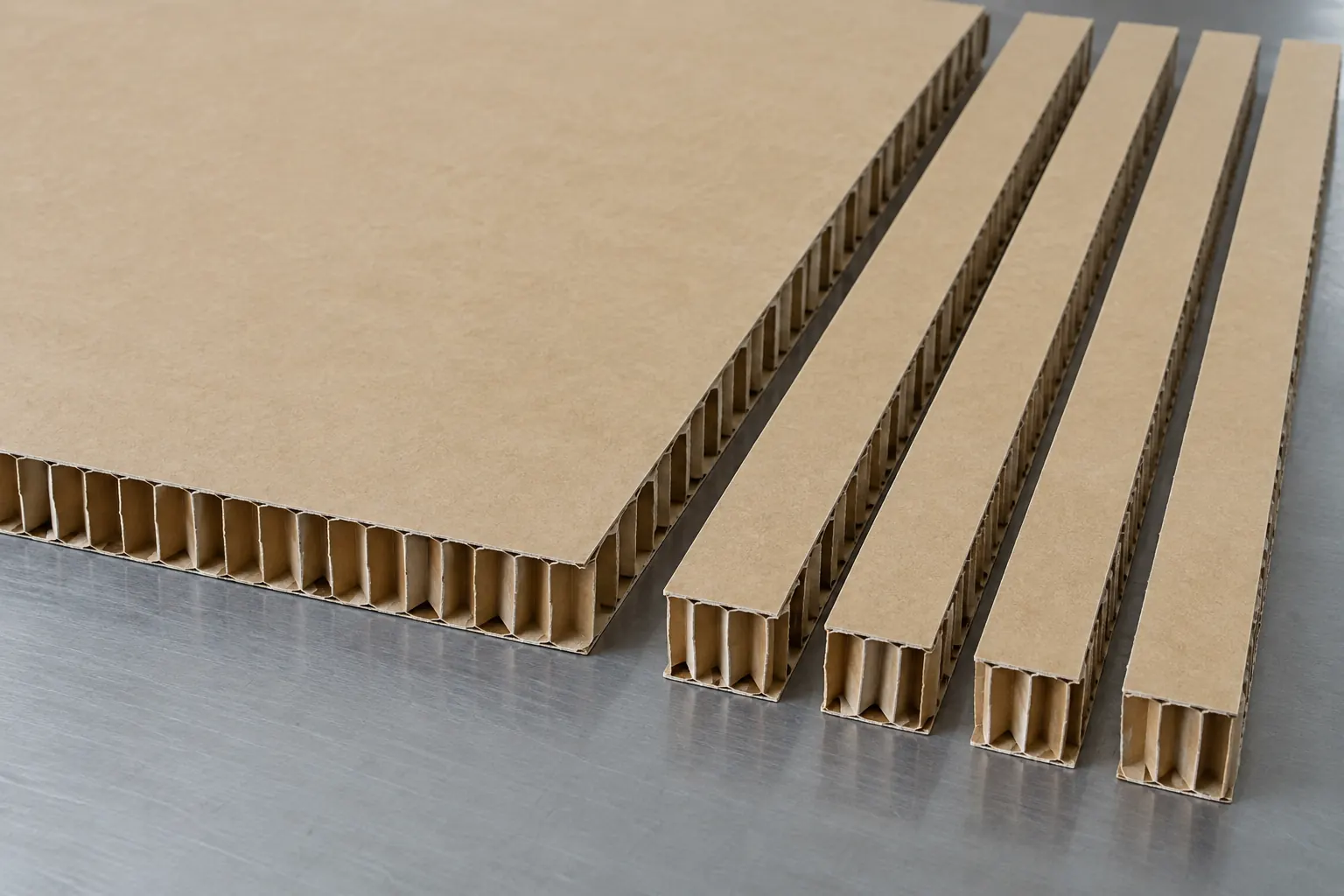
Where This Cutting Application Appears
Protective-packaging rails
Slits panels into narrow supports and spacers used around packed products.
Paper-pallet component preparation
Produces consistent-width panel elements for lightweight transport structures.
Furniture and display infill strips
Converts large panels into cellular inserts for laminated assemblies.
Common Ways to Describe This Cutting Problem
- honeycomb paper panel sheet slitting blades
- paper honeycomb board strip cutter
- cellular paper panel longitudinal cutting
- honeycomb core facing tear solution
- protective honeycomb board width slitting
- paper pallet panel strip cutting
- honeycomb sheet collapsed edge defect
- custom slitter for paper honeycomb panels
Define the Required Cut Result
- Uniform strip width along the panel
- Facing sheets cut flush with the cellular core
- Limited cell collapse and loose core fragments
- Straight edge suitable for bonding or covering
Problems to Diagnose Before Changing the Knife
Top facing tears before the core separates
- Identify facing weight and adhesive pattern
- Inspect cutting direction relative to cells
- Review top-face restraint and panel flatness
Cells crush along the finished edge
- Compare core cell size, density and panel thickness
- Inspect lateral clamping and support
- Determine whether crushing occurs during cutting or handling
Core fragments remain attached
- Map adhesive nodes and cell orientation
- Inspect full-depth completion
- Compare entry and exit faces
Strip width varies as the panel feeds
- Check panel squareness and guide contact
- Review compression against guides
- Measure bow and thickness variation
Knife Forms That May Be Considered
| Possible knife form | When it may be considered | What must be confirmed |
|---|---|---|
| guided straight slitting arrangement | May suit indexed panels where full-depth support and controlled linear travel are available. | Confirm panel build, cutting depth, stroke, support, hold-down and mounting from the actual equipment. |
| serrated straight cutting arrangement | May be evaluated for selected thick cellular panels where progressive engagement limits drag. | Confirm tooth form only through representative trials, approved edge criteria and the existing holder; no tooth specification is assumed. |
| rotary panel-slitting arrangement | May suit continuously fed compatible panels when the line supports thickness and guides the cut. | Confirm diameter, interface, rotation, support and maximum panel construction from line data. |
Information to Send for Technical Review
You do not need to know the exact blade name. Send the available workpiece, machine, current-knife and cut-result information so the application can be reviewed against a drawing or sample.
- Facing paper grade, weight and coating
- Core paper, cell size, orientation and density
- Panel thickness, width, length and flatness
- Required strip widths and tolerances
- Feed orientation, speed and panel support
- Current cutting motion, hold-down and mounting
- Accepted edges and facing-tear or core-crush samples
- Downstream bonding, covering and load requirement
Questions About This Cutting Application
Why does the facing separate before the core?
Facing strength, adhesive pattern, cell support and cutting direction can make the layers fracture at different times.
Can compressed cells recover after slitting?
Some deformation may recover, but broken bonds and permanently folded cell walls will not.
Does cell orientation affect the cut?
Yes. The edge crosses different numbers of walls and adhesive nodes depending on panel direction.
How should edge acceptance be defined?
Specify facing tear, loose cells, crush depth, width tolerance and suitability for the next bonding or covering step.
Can panel thickness alone select a cutting form?
No. Facing, core, support, feed and equipment motion are equally important.
Request a Custom Cutting-Knife Review
Send the workpiece details, machine or holder information, current knife photos or sample, required quantity and examples of the present cut problem. Final dimensions, material, edge geometry and tolerances are confirmed from the approved requirements.