
Blade Application Guides / Application Guide / textile recycling
Post-Industrial Textile Waste Cutting
Post-industrial textile waste may arrive as clean selvage, layered garment offcuts, coated fabric or tangled yarn rather than a uniform web. Effective opening and cutting depend on how the feed is presented and captured, while stretch fibers and seams can wrap or shock-load the cutting system.
Updated
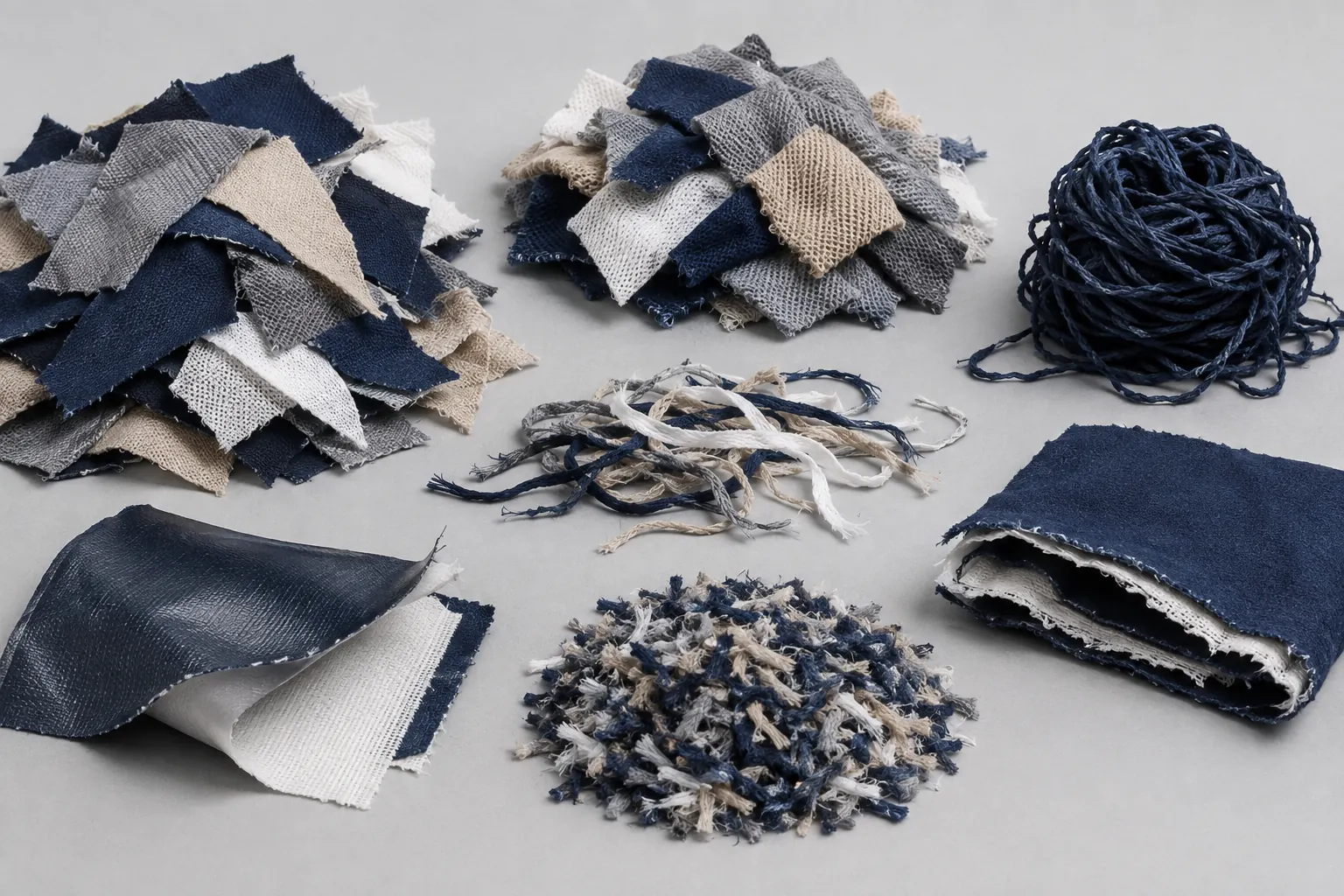
Where This Cutting Application Appears
Reducing woven and knitted offcuts
Cut production trim and rejected panels into pieces that can enter opening, blending or further recycling stages.
Processing selvage and yarn waste
Shorten long narrow strands that otherwise bridge the feed or wrap rotating components.
Cutting coated or laminated textile scrap
Handle declared foam, film or adhesive layers whose behavior differs from the base fabric.
Fiber Opening And Cutting process boundary
fiber opening and cutting for post-industrial textile waste is a linked sequence: the output condition and datum from each operation become the controlled input for the next. It should not be evaluated as one generic cut or accepted only by the final dimension.
Fiber Opening And Cutting setup checkpoint
For post-industrial textile waste, define the operation order, intermediate dimensions, registration transfer, material support, web or part handling and waste route for every stage of fiber opening and cutting.
Fiber Opening And Cutting acceptance checkpoint
Verify both intermediate and final results from fiber opening and cutting, including dimensions, registration, edge or feature quality, material damage, waste separation and stable transfer between stages.
Define the Required Cut Result
- Reliable capture of light, flexible scrap
- Controlled fiber length for the downstream opening process
- Limited wrapping around shafts and rotor ends
- Stable cutting through seams and declared layered regions
Problems to Diagnose Before Changing the Knife
Long fibers wrap around rotating parts
Review input length, feed compaction, rotor engagement, counter-edge clearance and guards at shaft ends.
Fabric folds through the gap uncut
Check edge overlap, hold-down, feed density, stretch and whether air entrainment prevents stable presentation.
Seams cause intermittent impact damage
Identify thread, fastener and multilayer seam content; correlate damage locations with feed inspection.
Coated scrap smears on knife faces
Review coating polymer, temperature, frictional heat, recirculation and cleaning method.
Knife Forms That May Be Considered
| Possible knife form | When it may be considered | What must be confirmed |
|---|---|---|
| rotary fiber cutter blade | A rotating cutter may suit continuous tow, selvage or prepared textile feed when the machine controls strand presentation. | Confirm rotor, blade seat, cutting circle, rotation, counter-edge and maximum feed bundle from equipment data. |
| straight bed knife | A fixed counter-edge can complete the shear and determine whether fabric cuts or folds through the gap. | Confirm length, section, datum, adjustment, clearance range and relationship to the moving cutter. |
Information to Send for Technical Review
You do not need to know the exact blade name. Send the available workpiece, machine, current-knife and cut-result information so the application can be reviewed against a drawing or sample.
- Fiber types and proportion of stretch yarn
- Woven, knitted, nonwoven or mixed construction
- Coatings, laminates, adhesives, seams or fasteners
- Offcut dimensions and feed-bundle density
- Required output length for the next recycling stage
- Feed conveyor, rotor, bed knife and screen drawings
- Operating speed, measured clearance and cleaning routine
- Samples showing wrap, fold-through, smear or impact damage
Questions About This Cutting Application
Why does knitted waste wrap more readily than woven scrap?
Stretch and loop structure can let long pieces follow rotating parts. Feed length, capture and counter-edge shear must be reviewed.
Can all clean factory textile waste use one setup?
No. Fiber, knit or weave, coatings and seam content change cutting behavior even without dirt.
What causes fabric to pass as long folded strips?
Flexible pieces may avoid the shear gap when feed density, edge overlap or counter-edge support is inadequate.
Should zippers or metal fasteners be accepted as normal feed?
Their presence must be declared and controlled. Hard inclusions can create impacts outside the intended textile-cutting duty.
What should a textile-recycling RFQ include?
Provide separated feed samples, construction and coatings, input and target size, machine drawings, settings and worn tools.
Related product and service information
- Chopping Synthetic Staple Fiber Tow - synthetic staple fiber tow · high-frequency chopping
- Electrical Cable Jacket Cutting - electrical cable jackets · jacket stripping and scoring
- Corrugated Board Scrap Cutting - corrugated board scrap · sheet shredding
Request a Custom Cutting-Knife Review
Send the workpiece details, machine or holder information, current knife photos or sample, required quantity and examples of the present cut problem. Final dimensions, material, edge geometry and tolerances are confirmed from the approved requirements.