
Blade Application Guides / Application Guide / paper recycling
Corrugated Board Scrap Cutting
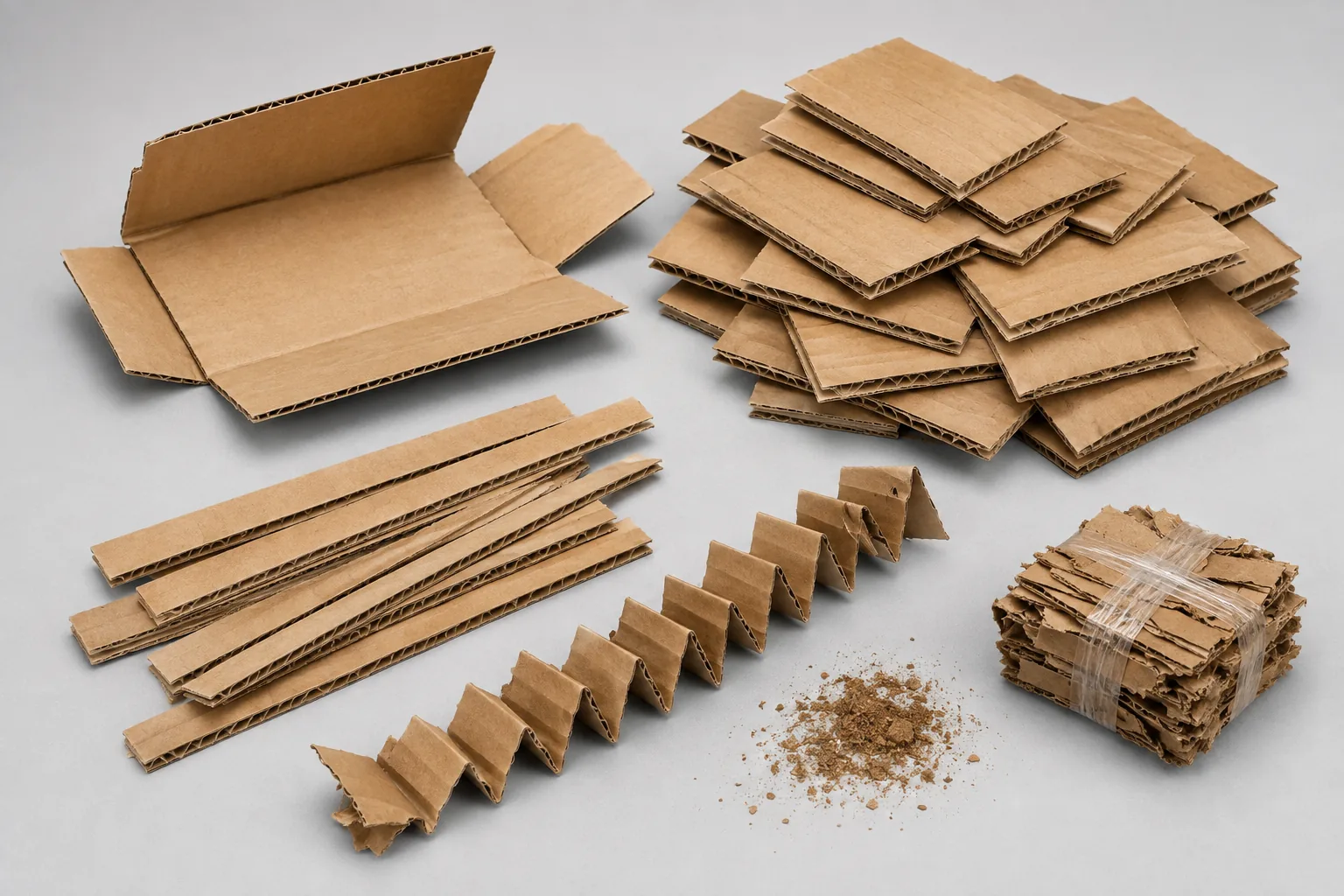
Corrugated scrap is lightweight but structurally layered, and boxes often enter a recycling cutter folded, flattened or nested. Flutes can collapse and sheets can bridge the chamber, so effective size reduction depends on feed presentation, counter-edge engagement and screen flow as much as sharpness.
Updated
Where This Cutting Application Appears
Reducing box-plant trim
Cut clean corrugated skeletons and edge strips before baling, pulping or controlled collection.
Shredding flattened cartons
Break down post-use boxes whose folds and taped seams change how material enters the cut.
Processing nested corrugated sheets
Separate layered or telescoped scrap that otherwise bridges conveyors and hoppers.
Sheet Shredding process boundary
sheet shredding for corrugated board scrap is planned around controlled feed-size reduction, with the required output range and downstream separation step defined before equipment selection; it is not a finished-dimension cut or an unspecified one-stage crushing operation.
Sheet Shredding setup checkpoint
For corrugated board scrap, confirm incoming form and maximum size, contamination, target particle range, throughput, heat control and the screen or classification route.
Sheet Shredding acceptance checkpoint
For corrugated board scrap, evaluate output-size distribution, oversize return, fines, contamination release, temperature, throughput stability and suitability for the next recovery stage.
Define the Required Cut Result
- Reliable draw-in of flat and folded board
- Controlled piece size without long connected strips
- Limited dust and fines for the downstream process
- Stable cutting through tape and declared paper labels
Problems to Diagnose Before Changing the Knife
Sheets bridge above the cutting zone
Review hopper geometry, sheet dimensions, fold stiffness, feed agitation and rotor engagement.
Long accordion-like strips pass through
Check knife overlap, counter-edge clearance, flute direction, screen and whether folds shield layers.
Paper dust increases rapidly
Inspect edge wear, repeated circulation, brittle dry board, rotor speed and extraction.
Tape winds around shafts
Identify tape type and placement, shaft-end protection, feed size and cleaning access.
Knife Forms That May Be Considered
| Possible knife form | When it may be considered | What must be confirmed |
|---|---|---|
| shredder knife | A profiled shredder knife may capture folded sheets for primary reduction where the chamber contains the feed. | Confirm rotor or shaft interface, profile, cutting circle, counter-tools, screen and largest incoming carton. |
| serrated shear knife | Progressive teeth may help engage layered board in equipment built around a moving and fixed shear. | Confirm tooth direction, pitch, holder, clearance, stroke and tolerance for dust or torn edges. |
Information to Send for Technical Review
You do not need to know the exact blade name. Send the available workpiece, machine, current-knife and cut-result information so the application can be reviewed against a drawing or sample.
- Board grade, flute types and number of walls
- Dry, damp, waxed, coated or food-soiled condition
- Typical sheet, box and folded-feed dimensions
- Tape, label, staple or other inclusion controls
- Required output size and downstream pulping or baling step
- Feed hopper, rotor, counter-knife and screen drawings
- Operating speed, clearance and current wear distribution
- Samples showing bridging, long strips, dust or wrapped tape
Questions About This Cutting Application
Why does flattened cardboard still bridge a shredder?
Large sheets and stiff folds can span the hopper or chamber. Feed presentation and capture geometry must be reviewed.
Does flute direction affect cutting?
It can change bending and tear paths. Include samples cut both along and across the flutes.
Can a smaller screen eliminate long strips?
Not if folded material avoids the shear. It may only increase circulation and dust.
How do taped seams affect knives?
Tape may stretch, foul edges or wrap shafts. State its type and proportion instead of treating all cartons as bare board.
What machine data is needed?
Provide feed opening, rotor, counter-knife, screen, clearances, speed and representative whole incoming scrap.
Related product and service information
- Discarded Carpet Roll Cutting - discarded carpet rolls · roll splitting and shredding
- Discarded Fishing Net Cutting - discarded fishing nets · net cutting and shredding
- Tobacco Leaf and Sheet Cutting - tobacco leaf and reconstituted sheet · leaf and sheet cutting
Request a Custom Cutting-Knife Review
Send the workpiece details, machine or holder information, current knife photos or sample, required quantity and examples of the present cut problem. Final dimensions, material, edge geometry and tolerances are confirmed from the approved requirements.