
Blade Application Guides / Application Guide / Pouch-cell packaging material converting
Lithium-Ion Battery Pouch Film Slitting Blades
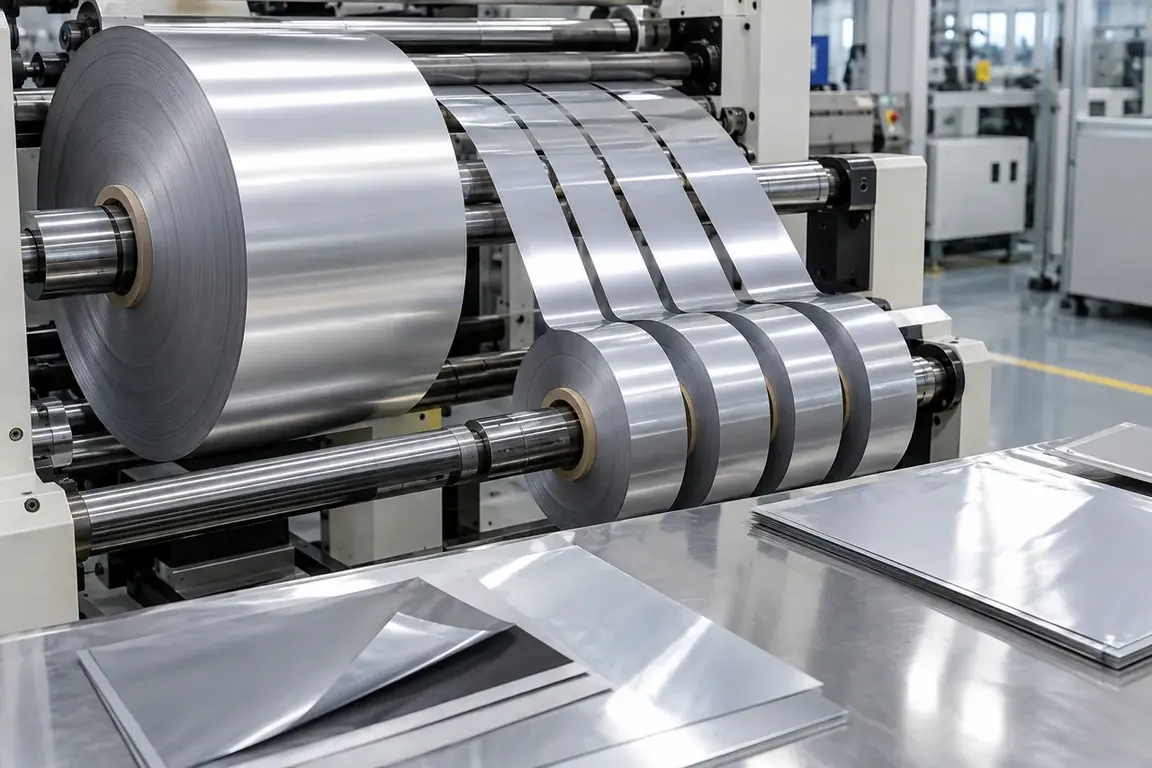
Lithium-ion battery pouch film slitting blades convert aluminum-plastic laminate master rolls into widths used for pouch forming and cell-packaging preparation. Unlike ordinary single-layer film, the supplied laminate may combine polymer, adhesive and metal layers whose edge behavior must be reviewed together. The project should define the actual layer stack, functional surfaces, web path, trim handling, accepted edge condition and finished-roll requirements.
Updated
Where This Cutting Application Appears
Master-roll width conversion
Wide battery pouch laminate is slit into planned roll widths for forming, qualification or downstream packaging operations.
Functional edge trimming
Damaged or irregular outer edges are removed while the usable laminate surface and layer stack are protected.
Finished-roll preparation
Slit lanes are separated and rewound according to the approved lane plan, surface orientation and roll-handling method.
Roll Slitting And Edge Trimming process boundary
Roll slitting and edge trimming for Lithium-ion battery aluminum-plastic pouch laminate film is a linked sequence: the output condition and datum from each operation become the controlled input for the next. It should not be evaluated as one generic cut or accepted only by the final dimension.
Roll Slitting And Edge Trimming setup checkpoint
For Lithium-ion battery aluminum-plastic pouch laminate film, define the operation order, intermediate dimensions, registration transfer, material support, web or part handling and waste route for every stage of Roll slitting and edge trimming.
Roll Slitting And Edge Trimming acceptance checkpoint
Verify both intermediate and final results from Roll slitting and edge trimming, including dimensions, registration, edge or feature quality, material damage, waste separation and stable transfer between stages.
Define the Required Cut Result
- Continuous laminate edges without visible layer separation, attached strands or local tearing.
- Controlled metal-layer edge condition without avoidable rollover or distortion.
- Stable slit width and web tracking across the approved production lane plan.
- Uniform finished rolls with protected functional surfaces and aligned roll faces.
Problems to Diagnose Before Changing the Knife
Laminate layers separate at the slit edge
- Document the supplied layer sequence without assuming unidentified films or adhesives.
- Inspect which interface first opens and whether the condition changes by roll side.
- Compare freshly slit edges with edges after normal rewinding and handling.
Metal layer rolls over or forms an irregular edge
- Inspect both sides of the slit edge using the customer's normal evaluation method.
- Compare edge direction with web travel and the orientation of the layer stack.
- Review web support and movement immediately before and after the cut.
Web wrinkles or wanders through the slitting station
- Confirm whether the condition enters the station or develops after lane separation.
- Review unwind alignment, roller contact and the complete web path.
- Compare lane behavior at stable running, start-up and stopping conditions.
Finished rolls telescope or show uneven faces
- Compare individual rewind positions and lane widths on the same master roll.
- Inspect roll faces and selected unwound sections using the approved method.
- Review lane separation, winding alignment and later roll handling together.
Knife Forms That May Be Considered
| Possible knife form | When it may be considered | What must be confirmed |
|---|---|---|
| Machine-matched rotary slitting arrangement | For continuous width conversion of pouch laminate master rolls on an existing rotary station. | Machine interface, web support, lane widths, roll condition, rewind layout and accepted edge sample. |
| Shear slitting arrangement for layered film | When the customer's machine and laminate behavior support a coordinated upper-and-lower cutting action. | Layer stack, tool interfaces, overlap control method, web path, edge inspection and finished-roll requirement. |
| Supported edge-trim arrangement | When outside laminate edges must be removed before usable lanes are rewound. | Trim width, support position, waste path, functional-side orientation and downstream winding sequence. |
Information to Send for Technical Review
You do not need to know the exact blade name. Send the available workpiece, machine, current-knife and cut-result information so the application can be reviewed against a drawing or sample.
- Battery pouch laminate product description and representative master-roll sample.
- Confirmed layer order, functional-side identification and supplier handling information.
- Master-roll format, finished widths, lane count and edge-trim plan.
- Machine slitting position, holder interface, web path and rewind arrangement.
- Close photographs of accepted and rejected laminate edges from both sides.
- Examples of delamination, rollover, wrinkles or finished-roll defects.
- Inspection, surface-contact, cleanliness and packaging requirements.
- Trial quantity, production pattern and current tooling details if available.
Questions About This Cutting Application
How does battery pouch film slitting differ from ordinary packaging-film slitting?
The metal-polymer laminate edge, functional surfaces and downstream pouch-forming requirements must be evaluated as one system.
Why is the confirmed layer stack required?
Different layers can stretch, separate or deform differently, and the first affected interface helps identify the cutting problem.
Should slit edges be inspected again after rewinding?
Yes. Rewinding and later roll handling can expose separation or deformation that is not obvious immediately after cutting.
Can a blade be selected from the name aluminum-plastic film alone?
No. Actual samples, the verified laminate structure, machine interface and accepted edge result are required.
What finished-roll information should be supplied?
Provide the lane plan, winding orientation, roll-face acceptance method and downstream handling or forming requirements.
Related product and service information
- Redox Flow Battery Carbon Felt Cutting Blades - Redox flow battery carbon and graphite felt electrodes · Roll-to-sheet cutting and profile sizing
- Fuel Cell Proton Exchange Membrane Slitting Blades - Fuel cell proton exchange membrane · Roll slitting
- Fuel Cell Gas Diffusion Layer Cutting Blades - Fuel cell gas diffusion layer · Sheet cutting and edge trimming
Request a Custom Cutting-Knife Review
Send the workpiece details, machine or holder information, current knife photos or sample, required quantity and examples of the present cut problem. Final dimensions, material, edge geometry and tolerances are confirmed from the approved requirements.