
Blade Application Guides / Application Guide / Fuel cell manufacturing
Fuel Cell Proton Exchange Membrane Slitting Blades
Fuel cell proton exchange membrane slitting blades are used when continuous membrane material must be converted to the width required by the next fuel-cell manufacturing step. A useful project review starts with the membrane construction, carrier layers, roll condition and required cut result rather than an assumed blade specification.
Updated
Where This Cutting Application Appears
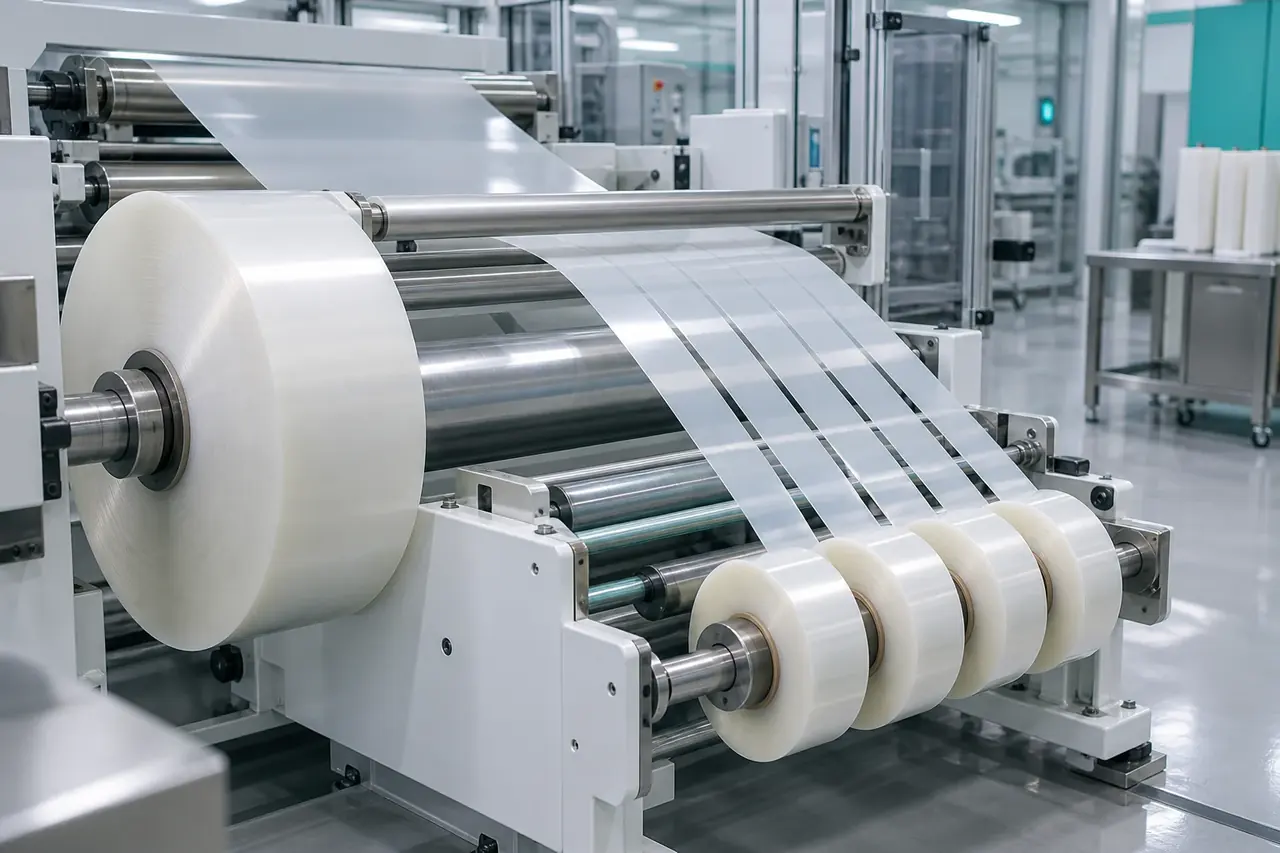
Roll-to-roll membrane converting
A wide membrane web is unwound, guided and rewound as narrower rolls for controlled downstream handling.
Width preparation
The converted roll width must match the next production step, fixture or material layout defined by the manufacturer.
Edge preparation before assembly
Cut edges are reviewed for visible damage, contamination and deformation before the material continues to later processing.
Roll Slitting process boundary
Roll slitting for Fuel cell proton exchange membrane is planned around longitudinal width conversion of a moving roll, web, sheet or strip into controlled lanes or daughter rolls; it is not transverse length cutting, profile formation or removal of only a narrow damaged margin.
Roll Slitting setup checkpoint
For Fuel cell proton exchange membrane, confirm unwind and rewind tension, lane widths, knife positions, edge guidance, core alignment, trim removal and discharge behavior.
Roll Slitting acceptance checkpoint
For Fuel cell proton exchange membrane, evaluate lane width, edge condition, camber or wandering, debris, telescoping, interleaving and stable winding or downstream transfer.
Define the Required Cut Result
- Consistent finished width based on the approved production requirement.
- Continuous edges without visible tearing, notches or loose fragments.
- Stable web tracking with no new wrinkles introduced during converting.
- Neat, clean winding without telescoping, uneven roll faces, trapped debris or avoidable surface contamination.
Problems to Diagnose Before Changing the Knife
Edge tearing or local notches
- Confirm the membrane construction and any carrier or liner layers.
- Review web support, alignment and the position where the defect first appears.
- Compare acceptable and defective edge samples under the same inspection method.
Width variation
- Confirm the finished-width measuring method and accepted tolerance.
- Check roll alignment and web movement through the cutting position.
- Record whether variation is continuous or occurs during acceleration and stopping.
Wrinkles or tension marks
- Record unwind and rewind condition and the complete web path.
- Confirm whether the membrane arrives flat before the cutting position.
- Review roller contact and any change made before the defect appeared.
Dust or surface contamination
- Identify whether particles originate from cutting, handling, liners or rollers.
- Document the cleaning and inspection method used for the trial.
- Confirm the customer's restrictions for membrane contact and cleanliness.
Knife Forms That May Be Considered
| Possible knife form | When it may be considered | What must be confirmed |
|---|---|---|
| Machine-matched rotary slitting arrangement | For continuous roll-to-roll width conversion where the existing machine uses a rotary cutting station. | Machine position, holder interface, web support, material layers, finished widths and accepted edge sample. |
| Supported-web slitting arrangement | When the membrane and its carrier or liner require controlled support through the cutting position. | Layer structure, support condition, web path, tension condition and contamination limits. |
| Cross-cut or sheet-converting arrangement | When the membrane is supplied or prepared as sheets rather than rewound as narrow rolls. | Sheet size, stack or single-sheet handling, cut sequence, fixture details and required edge condition. |
Information to Send for Technical Review
You do not need to know the exact blade name. Send the available workpiece, machine, current-knife and cut-result information so the application can be reviewed against a drawing or sample.
- Membrane name, construction, carrier or liner information and a representative sample.
- Master-roll width, finished widths, number of lanes and roll photographs.
- Machine position, holder area, web path and available drawings.
- Current cutting result, close-up edge photographs and rejected examples.
- Required quantity, trial plan and repeat-production expectation.
- Required edge condition, inspection method and examples of an accepted result.
- Any cleanliness, contact or packaging restrictions for the membrane material.
- Current knife or holder photographs, if available, without estimating unknown specifications.
Questions About This Cutting Application
Can proton exchange membrane slitting blades be selected from the material name alone?
No. The material construction, liner or carrier, machine position, finished width and accepted edge result should be reviewed together.
What photographs are most useful for a first review?
Send the full roll, web path, cutting position, finished roll face and close-up photographs of both acceptable and defective edges.
Should unknown thickness or process data be estimated?
No. Mark unknown values as unconfirmed and provide a sample or drawing when possible.
Why should the carrier or liner be included in the project review?
The membrane may be handled and cut together with supporting layers. Their arrangement can change web support, edge behavior and the information needed for a useful trial.
What should be compared during an initial slitting trial?
Compare finished width, edge condition, web tracking, winding quality and visible contamination using the customer-approved inspection method.
Related product and service information
- Lithium Metal Anode Foil Punching Blades - Lithium metal foil for battery anodes · Precision blanking, punching and cut-to-length
- Fuel Cell Gas Diffusion Layer Cutting Blades - Fuel cell gas diffusion layer · Sheet cutting and edge trimming
- Solid-State Battery Electrolyte Sheet Cutting Blades - Solid-state battery electrolyte sheet · Sheet sizing and profile cutting
Request a Custom Cutting-Knife Review
Send the workpiece details, machine or holder information, current knife photos or sample, required quantity and examples of the present cut problem. Final dimensions, material, edge geometry and tolerances are confirmed from the approved requirements.