
Blade Application Guides / Application Guide / Redox flow battery stack manufacturing
Redox Flow Battery Carbon Felt Cutting Blades
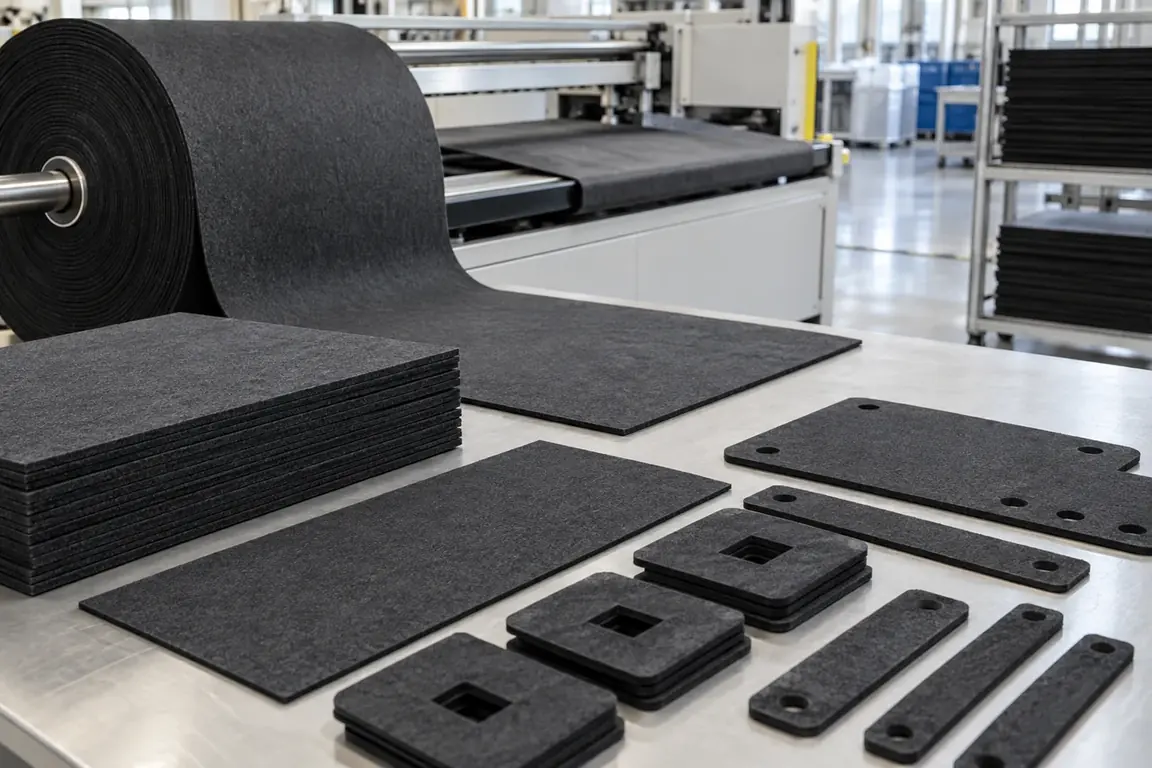
Redox flow battery carbon felt cutting blades convert supplied carbon or graphite felt into electrode sheets and stack-specific profiles. The cutting review should identify the actual felt grade and supplied condition, roll direction, required outline, compression during support, edge-particle acceptance and collection method because a dimensionally correct part may still be rejected for fiber pullout, distortion or contamination.
Updated
Where This Cutting Application Appears
Electrode sheet preparation
Felt roll stock is cut into rectangular sheets for inspection and subsequent flow-battery stack assembly.
Stack-specific electrode profiling
Outer contours, corners and specified openings are prepared according to the controlled electrode drawing.
Development sample conversion
Representative felt pieces are prepared for process trials while preserving orientation and traceability.
Roll-To-Sheet Cutting And Profile Sizing process boundary
Roll-to-sheet cutting and profile sizing for Redox flow battery carbon and graphite felt electrodes is a linked sequence: the output condition and datum from each operation become the controlled input for the next. It should not be evaluated as one generic cut or accepted only by the final dimension.
Roll-To-Sheet Cutting And Profile Sizing setup checkpoint
For Redox flow battery carbon and graphite felt electrodes, define the operation order, intermediate dimensions, registration transfer, material support, web or part handling and waste route for every stage of Roll-to-sheet cutting and profile sizing.
Roll-To-Sheet Cutting And Profile Sizing acceptance checkpoint
Verify both intermediate and final results from Roll-to-sheet cutting and profile sizing, including dimensions, registration, edge or feature quality, material damage, waste separation and stable transfer between stages.
Define the Required Cut Result
- Continuous cut edges with controlled loose fibers, pullout and localized tearing.
- Stable electrode geometry after the felt is released from normal cutting support.
- Managed compression without permanent edge crushing or thickness distortion.
- Clean collection and packaging that do not return loose carbon fibers to finished parts.
Problems to Diagnose Before Changing the Knife
Loose fibers or ragged felt edges
- Confirm the supplied felt product, surface condition and roll orientation.
- Compare edge behavior along and across the main fiber or roll direction.
- Inspect support and material movement at the location where fiber pullout begins.
Electrode profile changes after release
- Record how the felt is supported and compressed during cutting and measurement.
- Measure the same part in the customer-defined inspection condition.
- Separate temporary compression recovery from permanent stretching or tearing.
Corners or openings remain connected
- Map incomplete separation around each corner, transition and internal opening.
- Compare the condition with felt orientation and profile placement.
- Review hold-down, support and waste removal using actual production material.
Carbon particles remain on finished electrodes
- Determine whether particles originate at the cut edge, support surface or collection step.
- Document the cleaning and inspection sequence used for the trial.
- Review stacking and packaging contact for transfer between finished pieces.
Knife Forms That May Be Considered
| Possible knife form | When it may be considered | What must be confirmed |
|---|---|---|
| Supported straight-cut arrangement | For roll-to-sheet or sheet-sizing operations producing rectangular electrode pieces. | Felt condition, cut direction, support area, sheet layout, collection method and accepted edge result. |
| Custom profile cutting arrangement | When the electrode requires a defined outer contour, corner form or functional opening. | Controlled drawing, material orientation, profile nesting, hold-down, waste removal and relaxed-part inspection. |
| Roll-fed cross-cutting arrangement | For repeated electrode lengths prepared directly from continuous felt roll stock. | Web path, feed reference, roll condition, cross-cut position, downstream transfer and finished-sheet handling. |
Information to Send for Technical Review
You do not need to know the exact blade name. Send the available workpiece, machine, current-knife and cut-result information so the application can be reviewed against a drawing or sample.
- Carbon or graphite felt product description and representative material samples.
- Roll or sheet format, material orientation and identification of both surfaces.
- Finished electrode drawing, profile layout and current revision.
- Machine station, feed path, support method and available interface details.
- Accepted and rejected edge samples showing fibers, tears and connected areas.
- Customer inspection condition for dimensions, particles and edge quality.
- Collection, cleaning, stacking and packaging requirements.
- Trial quantity, production sequence and current cutting method if available.
Questions About This Cutting Application
Can carbon felt cutting blades be reviewed using a generic felt name?
No. The actual felt product, supplied condition, orientation, finished geometry and accepted edge sample are needed.
Why should felt orientation be marked on samples?
Fiber structure and roll direction can change edge behavior, dimensional recovery and the repeatability of trial comparisons.
When should a finished carbon felt electrode be measured?
Use the customer's defined inspection condition and record whether the part is supported, compressed or freely relaxed.
What defects should close-up photographs show?
Show loose fibers, tears, crushed zones, connected corners and particle deposits together with the full part orientation.
Why is collection part of the blade review?
Loose fibers generated or transferred during stacking can affect the usable result even when the initial cut is complete.
Related product and service information
- Solid-State Battery Electrolyte Sheet Cutting Blades - Solid-state battery electrolyte sheet · Sheet sizing and profile cutting
- Fuel Cell Proton Exchange Membrane Slitting Blades - Fuel cell proton exchange membrane · Roll slitting
- Fuel Cell Gas Diffusion Layer Cutting Blades - Fuel cell gas diffusion layer · Sheet cutting and edge trimming
Request a Custom Cutting-Knife Review
Send the workpiece details, machine or holder information, current knife photos or sample, required quantity and examples of the present cut problem. Final dimensions, material, edge geometry and tolerances are confirmed from the approved requirements.