
Blade Application Guides / Application Guide / Closure liner and cap-seal packaging
Induction Seal Liner Wad Punching Blades
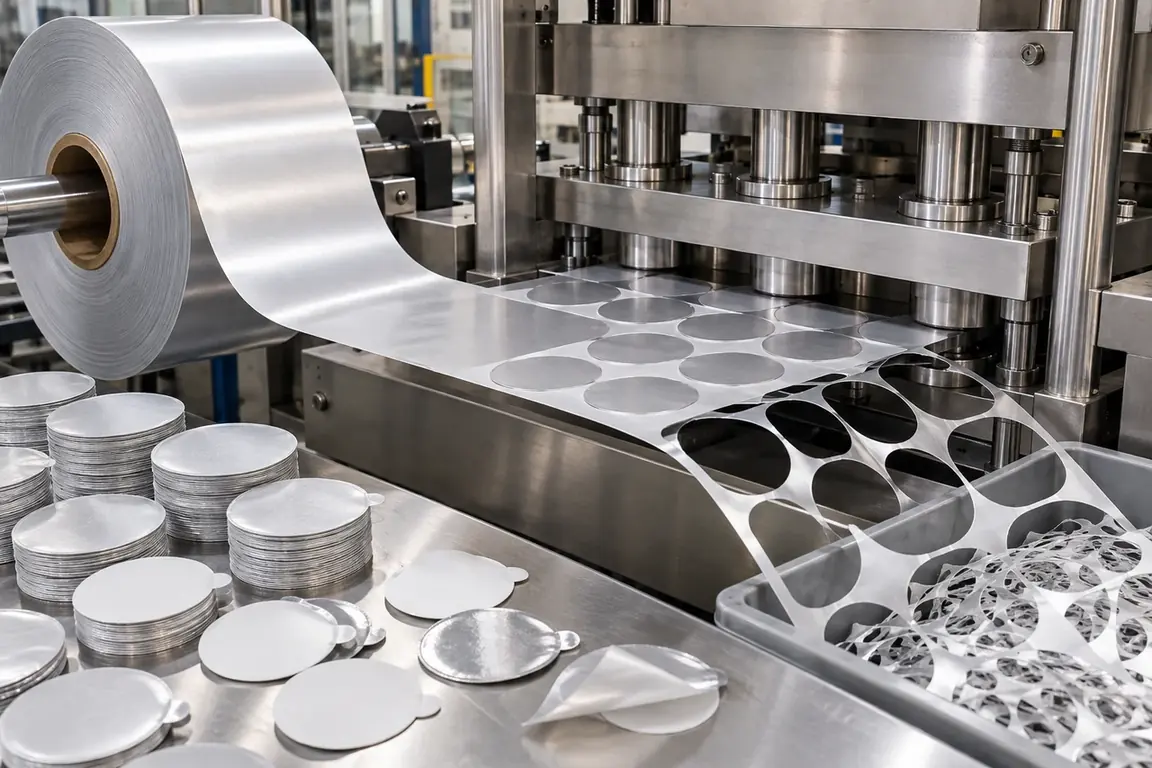
Induction seal liner wad punching blades separate round, shaped or tabbed closure liners from rollstock combining foil, heat-seal layers, foam, paperboard or polymer film. Review should define the actual construction, finished wad drawing, sealing face, tab orientation, nesting layout, ejection method and acceptable edge condition instead of assuming every cap liner behaves as a single foil sheet.
Updated
Where This Cutting Application Appears
Round closure-liner blanking
Circular wads are separated from roll-fed laminate for insertion into compatible caps or closure assemblies.
Tabbed easy-open liner production
Pull-tab profiles are cut while preserving laminate bond and approved gripping geometry.
Special-shape container seals
Noncircular liners and locating features are prepared to the controlled closure interface drawing.
Roll-Fed Blanking And Profile Punching process boundary
Roll-fed blanking and profile punching for Induction heat-seal liner laminate rollstock is a linked sequence: the output condition and datum from each operation become the controlled input for the next. It should not be evaluated as one generic cut or accepted only by the final dimension.
Roll-Fed Blanking And Profile Punching setup checkpoint
For Induction heat-seal liner laminate rollstock, define the operation order, intermediate dimensions, registration transfer, material support, web or part handling and waste route for every stage of Roll-fed blanking and profile punching.
Roll-Fed Blanking And Profile Punching acceptance checkpoint
Verify both intermediate and final results from Roll-fed blanking and profile punching, including dimensions, registration, edge or feature quality, material damage, waste separation and stable transfer between stages.
Define the Required Cut Result
- Complete perimeter separation without foil whiskers, attached fibers or uncut bridges.
- Finished wad geometry matched to the controlled closure-liner drawing.
- Preserved bond between functional layers around the seal face and opening tab.
- Reliable part and skeleton separation without bending or contaminating usable liners.
Problems to Diagnose Before Changing the Knife
Foil burrs or laminate tags remain on the perimeter
- Identify which layer remains connected and where it occurs.
- Inspect support and clearance condition for wear, contamination or movement.
- Compare accepted and rejected edges under the customer inspection method.
Layers separate near the punched edge
- Document layer order, bond system and sealing-side orientation.
- Determine whether separation begins during punching, ejection or handling.
- Review tab roots, tight radii and transitions that concentrate deformation.
Tabbed liners tear or deform during ejection
- Confirm tab geometry, orientation and part-release direction.
- Inspect whether waste or stripper components trap the tab.
- Compare support beneath the sealing face and tab during ejection.
Wads remain attached to the waste skeleton
- Map attachment points against nesting bridges and transitions.
- Review part retention, stripping and collection sequence.
- Check for adhesive, coating or heat-seal residue at the cutting interface.
Knife Forms That May Be Considered
| Possible knife form | When it may be considered | What must be confirmed |
|---|---|---|
| Matched punch-and-die wad cutting arrangement | For repeated round or shaped liners requiring controlled separation and ejection. | Finished drawing, laminate stack, machine fit, support, clearance control and ejection. |
| Rotary profile die-cutting arrangement | For continuous roll-fed liner conversion with nested repeated profiles. | Web width, layout, feed direction, roll support, waste path and accepted samples. |
| Compound tabbed-liner cutting arrangement | When a wad includes an opening tab or coordinated features. | Tab-root geometry, layer orientation, feature relationship, retention and insertion method. |
Information to Send for Technical Review
You do not need to know the exact blade name. Send the available workpiece, machine, current-knife and cut-result information so the application can be reviewed against a drawing or sample.
- Complete liner laminate description and representative rollstock.
- Finished wad drawing, closure reference and revision.
- Layer order, sealing side, coatings, foam and adhesive locations.
- Roll width, feed direction, profile pitch and nesting layout.
- Machine model, station, tooling interface and support details.
- Part-ejection, waste-stripping, stacking and collection sequence.
- Accepted and rejected wads showing edge, tab and layer condition.
- Inspection, cleanliness, packaging and trial-quantity requirements.
Questions About This Cutting Application
Why must the full liner construction be provided?
Foil, foam, paper and heat-seal layers can fail differently through the same profile.
Is cap diameter enough to specify the punching blade?
No; the controlled drawing, laminate, machine interface and ejection process are also needed.
What can cause foil whiskers?
Possible factors include local connections, support, wear, contamination and laminate movement.
How should a pull tab be evaluated?
Check geometry, layer bond, root condition, ejection behavior and use in the approved closure.
Can one arrangement suit every induction-seal laminate?
No; layer stack, profile, equipment and finished-edge requirement must be confirmed.
Related product and service information
- RFID Smart Label Inlay Registered Die-Cutting Blades - Laminated RFID smart label web with embedded inlays · Registered rotary die-cutting and kiss-cutting
- Folding Carton Die Cutting and Crease-Area Integrity - folding carton blanks · die cutting
- Solid Board Guillotine Cutting for Square Stacks - solid paperboard sheets · guillotine cutting
Request a Custom Cutting-Knife Review
Send the workpiece details, machine or holder information, current knife photos or sample, required quantity and examples of the present cut problem. Final dimensions, material, edge geometry and tolerances are confirmed from the approved requirements.