
Blade Application Guides / Application Guide / Decorative foil converting
Hot-Stamping Foil Roll Slitting Without Edge Flaking
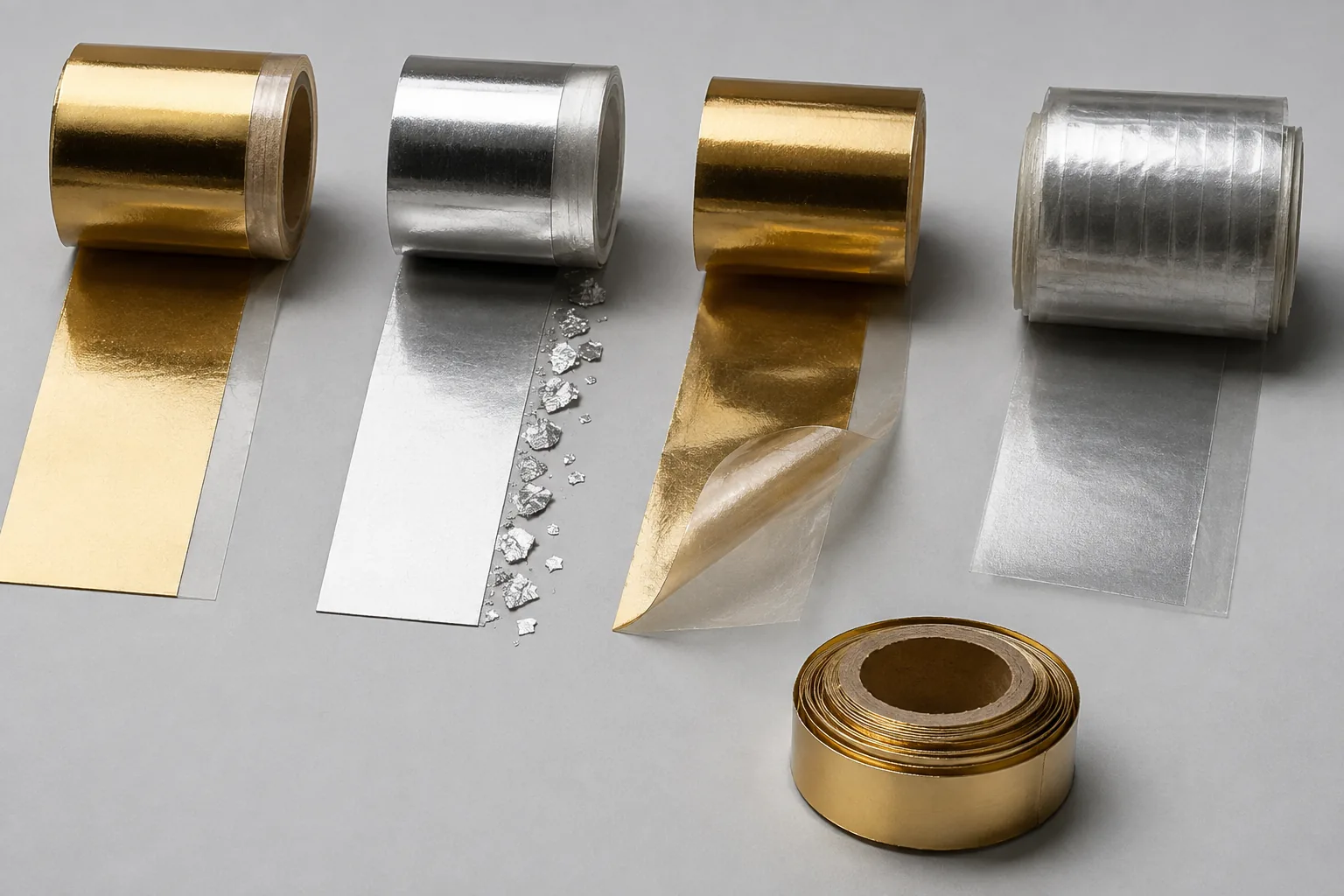
Hot-stamping foil combines a thin carrier film with release, decorative, and adhesive layers that may react differently at a slit edge. A useful conversion review follows the actual layer stack, foil face, lane width, tension, and rewind behavior so edge flakes or damaged carrier film are not mistaken for a single knife issue.
Updated
Where This Cutting Application Appears
Carton and label stamping-foil width conversion
Wide decorative foil stock is divided into reel widths matched to the stamping area and the approved foil-feed arrangement.
Pigment and metallic foil reel preparation
Colored, metallic, or patterned transfer foils are slit while the coated face is protected from scuffing and loose edge fragments.
Narrow rolls for repeated foil indexing
Slit lanes are rewound onto specified cores so the carrier tracks evenly and unwinds without edge drag during short-pitch feeding.
Roll Slitting And Rewinding process boundary
roll slitting and rewinding for hot-stamping foil on carrier film is a linked sequence: the output condition and datum from each operation become the controlled input for the next. It should not be evaluated as one generic cut or accepted only by the final dimension.
Roll Slitting And Rewinding setup checkpoint
For hot-stamping foil on carrier film, define the operation order, intermediate dimensions, registration transfer, material support, web or part handling and waste route for every stage of roll slitting and rewinding.
Roll Slitting And Rewinding acceptance checkpoint
Verify both intermediate and final results from roll slitting and rewinding, including dimensions, registration, edge or feature quality, material damage, waste separation and stable transfer between stages.
Define the Required Cut Result
- Separate the carrier film without lifting or chipping the transferable layer
- Keep foil rolls within the specified width while preserving usable edge zones
- Build straight reels that release freely instead of telescoping or blocking
- Limit decorative coating dust that could mark the foil face during rewind
Problems to Diagnose Before Changing the Knife
Metallic or pigment layers flake along the slit edge
Compare layer-stack construction, coating brittleness, foil temperature, cut action, edge support, speed, knife condition, and which face enters the cut.
The carrier film stretches, curls, or tears beside the cut
Review carrier thickness, web tension, unsupported span, penetration or overlap, side load, heat, roll alignment, and any pre-existing edge nick.
Narrow foil reels telescope or develop dished sides
Check tension taper, winding torque, core concentricity, lay-on pressure, lane width, coating build, roll hardness, and handling after conversion.
Foil edges block together or resist smooth unwind
Examine slit-edge heat, adhesive exposure, winding pressure, storage conditions, edge offset, coating transfer, and whether loose fragments bridge adjacent wraps.
Knife Forms That May Be Considered
| Possible knife form | When it may be considered | What must be confirmed |
|---|---|---|
| Circular shear slitting | Consider where the carrier and coating stack need supported separation with controlled edge loading. | Confirm layer sequence, carrier thickness, foil face, overlap or clearance, side load, rotation, holder interface, and trial edge criteria. |
| Supported razor slitting | Consider for suitable thin carrier constructions when production trials show clean coating edges and stable tracking. | Confirm blade angle, support position, web tension, speed, coated-face protection, dust collection, and production-equivalent foil samples. |
Information to Send for Technical Review
You do not need to know the exact blade name. Send the available workpiece, machine, current-knife and cut-result information so the application can be reviewed against a drawing or sample.
- Carrier-film material and thickness, plus the full release, decorative, and adhesive layer sequence
- Foil type, coated-face orientation, finish, color, and any patterned or registered feature
- Master-roll width, diameter, core size, winding direction, and incoming edge condition
- Required lane widths, trim allowances, width tolerance, and minimum usable edge zone
- Line speed, web-tension range, guiding method, support span, and slitting station drawing
- Rewind core, finished diameter, tension taper, lay-on method, and acceptable roll hardness
- Samples or close images of flaking, carrier tears, blocking, telescoping, and the side where each defect occurs
- Downstream stamping feed direction, unwind arrangement, foil indexing pattern, and edge acceptance method
Questions About This Cutting Application
Why can the coating flake even when the carrier film is cut through?
The polymer carrier and transferable coating fracture differently. A carrier cut can look continuous while a brittle decorative layer chips because of support, angle, edge load, speed, or layer condition.
Should the coated face run toward or away from the knife holder?
There is no universal orientation. Compare the actual layer stack, current web path, contact surfaces, cut direction, and defect side, then confirm orientation with production foil.
What makes a narrow hot-stamping foil roll difficult to unwind?
Telescoping, excess roll hardness, exposed adhesive, edge blocking, coating debris, damaged cores, or edge contact with a flange can all interrupt feeding.
How should a slitting trial for decorative foil be inspected?
Inspect both reel edges, the carrier and coating faces, loose fragments, width, roll build, and unwind behavior. Record the foil lot, lane, direction, speed, and tension used.
Can one setup cover metallic, pigment, and patterned foils?
Not by foil category alone. Carrier gauge, release behavior, coating brittleness, total stack, lane width, and winding requirements may require different confirmed settings.
Related product and service information
- Laminated Packaging Web Slitting Across Bonded Layers - laminated flexible packaging webs · web slitting
- BOPP Film Slitting With Stable Edges and Tension - BOPP film webs · web slitting
- PET Film Slitting for Clean Narrow Reels - PET film webs · precision slitting
Request a Custom Cutting-Knife Review
Send the workpiece details, machine or holder information, current knife photos or sample, required quantity and examples of the present cut problem. Final dimensions, material, edge geometry and tolerances are confirmed from the approved requirements.