
Blade Application Guides / Application Guide / pasta production
Fresh Noodle and Pasta Sheet Cutting
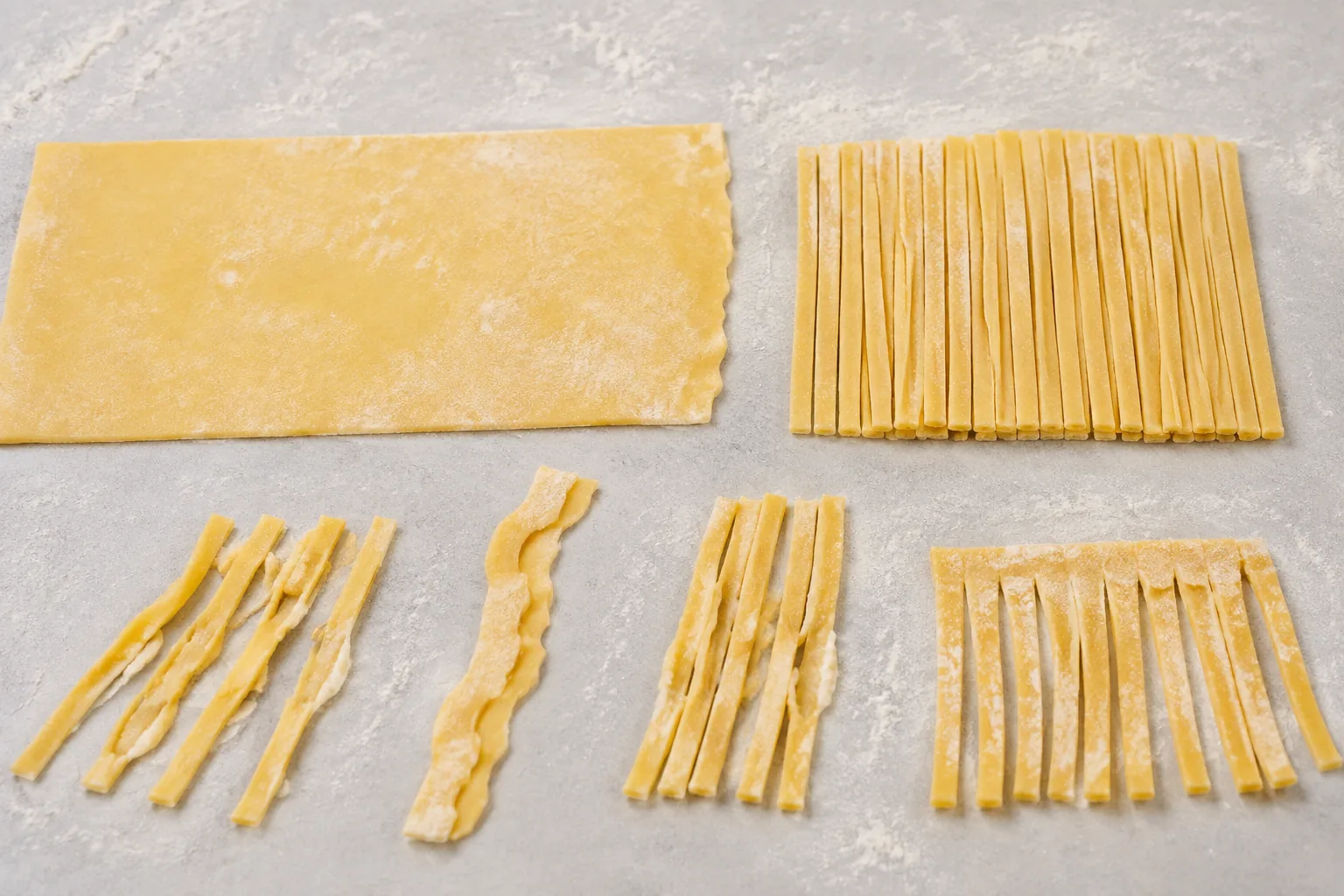
Fresh pasta is a soft, moisture-sensitive dough sheet that can stretch, close behind the cut or adhere to nearby surfaces. Strand cutting and outer-edge trimming require different geometry decisions, with flour application, sheet thickness and downstream separation all affecting the result.
Updated
Where This Cutting Application Appears
Dividing pasta sheets into strands
Create noodles of defined width while keeping adjacent strands separated for dusting, portioning or drying.
Trimming sheet edges before forming
Remove irregular margins so the usable web enters folding, filling or strand-cutting equipment consistently.
Cross-cutting fresh noodles to length
Separate moving strands or sheeted portions at a timed cutoff station without pulling the dough.
Strand Cutting And Sheet Trimming process boundary
strand cutting and sheet trimming for fresh noodles and pasta sheets is a linked sequence: the output condition and datum from each operation become the controlled input for the next. It should not be evaluated as one generic cut or accepted only by the final dimension.
Strand Cutting And Sheet Trimming setup checkpoint
For fresh noodles and pasta sheets, define the operation order, intermediate dimensions, registration transfer, material support, web or part handling and waste route for every stage of strand cutting and sheet trimming.
Strand Cutting And Sheet Trimming acceptance checkpoint
Verify both intermediate and final results from strand cutting and sheet trimming, including dimensions, registration, edge or feature quality, material damage, waste separation and stable transfer between stages.
Define the Required Cut Result
- Uniform strand width without closed or bridged cuts
- Clean sheet edges with limited stretching
- Complete cross-cut separation at the target length
- Controlled dough and flour buildup around the cutting zone
Problems to Diagnose Before Changing the Knife
Fresh strands rejoin after cutting
Review dough moisture, cut penetration, strand spacing, flour application and how strands are separated immediately downstream.
Sheet edges stretch out of line
Check web tension, roller tracking, blade drag, dough temperature and support next to the trim.
Dough packs into cutter spaces
Inspect clearance, tooth or disc spacing, surface condition, flour dust and the cleaning interval.
Cross-cut lengths vary
Compare feed speed and cutoff timing, then inspect strand slip, product accumulation and incomplete separation.
Knife Forms That May Be Considered
| Possible knife form | When it may be considered | What must be confirmed |
|---|---|---|
| rotary noodle cutter | Intermeshing or profiled rotary cutters may suit continuous strand formation when the machine defines the matched geometry. | Confirm shaft centers, cutter width, groove or tooth profile, rotation and spacer arrangement from equipment data or a matched sample set. |
| circular slitter | A circular knife may suit edge trimming or wider strip cutting on a supported pasta sheet. | Confirm diameter, bore, thickness, bevel, backing surface, web direction and the allowed level of compression. |
| straight cutoff knife | A timed straight knife can suit length cutting when strands are supported and feed stops or synchronizes with the stroke. | Confirm cutting width, stroke, mounting, counter-surface and timing range with actual product trials. |
Information to Send for Technical Review
You do not need to know the exact blade name. Send the available workpiece, machine, current-knife and cut-result information so the application can be reviewed against a drawing or sample.
- Dough formulation category and moisture condition
- Sheet thickness and variation across the web
- Target strand widths, spacing and cut length
- Flour or oil application before and after cutting
- Continuous speed, indexed feed or batch mode
- Machine shafts, holder, spacers and counter-surface drawings
- Current cutter set and areas where dough accumulates
- Samples showing rejoined strands, stretched edges or incomplete cutoffs
Questions About This Cutting Application
Why do noodle strands stick together after a complete cut?
Moist surfaces can close again if strands are not separated or dusted promptly. Review downstream handling as well as penetration.
Does more flour always reduce cutter buildup?
No. Excess flour can pack into clearances and alter traction. Record the application point and actual amount used in the process.
Can a worn cutter set be copied?
It can support identification, but wear may hide the intended clearance and profile. Confirm shaft geometry and approve a controlled drawing.
What causes one side of a pasta sheet to trim wider?
Possible causes include sheet tracking, uneven tension, shaft runout or axial knife movement. Measure the web path before changing edge geometry.
Are strand cutters and length-cutoff knives interchangeable?
No. Strand formation is usually continuous and profile-dependent, while cutoff is timed across the product flow; specify each station separately.
Related product and service information
- Carbon Cloth Gas Diffusion Layer Edge Trimming Blades - carbon cloth gas diffusion layer · edge trimming
- Decorative Veneer Roll Slitting - decorative veneer rolls · continuous veneer slitting
- Medical Mask Nonwoven Web Cutting - medical mask nonwoven webs · web slitting and cutoff
Request a Custom Cutting-Knife Review
Send the workpiece details, machine or holder information, current knife photos or sample, required quantity and examples of the present cut problem. Final dimensions, material, edge geometry and tolerances are confirmed from the approved requirements.