
Blade Application Guides / Application Guide / medical disposables
Medical Mask Nonwoven Web Cutting
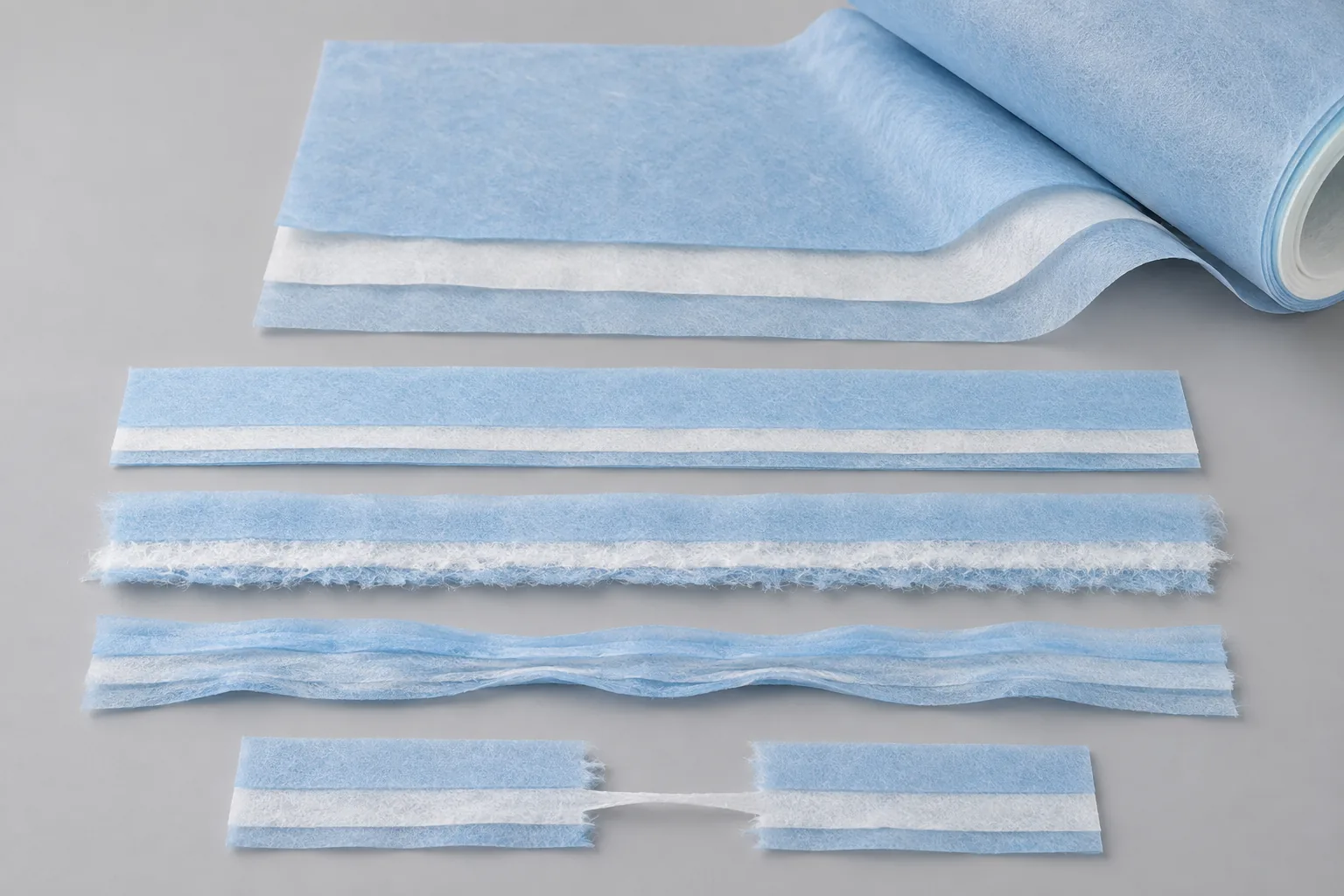
Mask webs are lightweight porous nonwovens that may be processed as separate spunbond and meltblown layers or as an assembled stack. Low tension can wrinkle the web, while excessive pressure can stretch fibers or disturb bonded areas, so slitting and cutoff must be reviewed with the actual layer sequence.
Updated
Where This Cutting Application Appears
Slitting individual mask-media rolls
Trim or divide spunbond, meltblown or other approved media before layers are combined.
Cutting multilayer mask blanks
Cross-cut aligned media layers to length before folding, forming or downstream assembly.
Trimming assembled web margins
Remove uneven edges while avoiding interference with welded, embossed or elastic-bearing zones.
Web Slitting And Cutoff process boundary
web slitting and cutoff for medical mask nonwoven webs is a linked sequence: the output condition and datum from each operation become the controlled input for the next. It should not be evaluated as one generic cut or accepted only by the final dimension.
Web Slitting And Cutoff setup checkpoint
For medical mask nonwoven webs, define the operation order, intermediate dimensions, registration transfer, material support, web or part handling and waste route for every stage of web slitting and cutoff.
Web Slitting And Cutoff acceptance checkpoint
Verify both intermediate and final results from web slitting and cutoff, including dimensions, registration, edge or feature quality, material damage, waste separation and stable transfer between stages.
Define the Required Cut Result
- Low-lint edges without long pulled fibers
- Stable web width with limited neck-in or wrinkling
- Complete separation through the declared layer stack
- No avoidable damage to nearby welds or functional zones
Problems to Diagnose Before Changing the Knife
Fibers bridge across the slit
Check edge continuity, penetration, fiber orientation, backing support and whether soft layers are being pushed into clearance.
The web wrinkles before cutting
Review unwind tension, guide alignment, static, differential layer stretch and pressure applied near the knife.
Cut edges shed visible lint
Compare material type, basis weight, edge mode, wear and contamination; retain samples before handling removes loose fibers.
Some layers remain connected at cutoff
Map the layer sequence and inspect stack compression, stroke parallelism, backing condition and local welded areas.
Knife Forms That May Be Considered
| Possible knife form | When it may be considered | What must be confirmed |
|---|---|---|
| circular slitter | A circular format may suit continuous roll trimming when the web path provides stable tension and backing. | Confirm cutting mode, diameter, bore, bevel, rotation, web speed and backing or lower-knife arrangement from the line drawing. |
| rotary cutoff knife | A timed rotary knife can suit repeated blank lengths when the web and all layers are supported through separation. | Confirm rotor interface, cutting width, phase or timing method, counter-surface and maximum declared layer stack. |
Information to Send for Technical Review
You do not need to know the exact blade name. Send the available workpiece, machine, current-knife and cut-result information so the application can be reviewed against a drawing or sample.
- Nonwoven process and polymer family for every layer
- Basis weight, thickness and layer sequence
- Single web, loose stack or bonded laminate at cutting
- Roll width, finished width or blank length and tolerance
- Web speed, tension range and guiding arrangement
- Locations of welds, embossing, elastic or other functional zones
- Holder, lower knife, anvil or backing-surface drawings
- Edge samples showing lint, stretched fibers or incomplete layers
Questions About This Cutting Application
Does meltblown media use the same setup as spunbond?
Not automatically. Structure, basis weight and strength differ; identify each layer and test the actual stack where possible.
Why do fibers remain across an apparently complete cut?
Soft fibers may deflect into clearance or an uneven backing surface. Check penetration and support across the entire width.
Can higher web tension eliminate wrinkles?
Too much tension can stretch lightweight media and alter width. Review guiding, static and layer balance before increasing tension.
What should a mask-media sample include?
Send labelled pieces of every layer plus an assembled stack, with machine direction and the rejected edge clearly identified.
Are medical compliance claims part of knife selection?
The customer controls product validation and compliance. Knife review is limited to the declared material, equipment interface and cut requirements.
Related product and service information
- Anesthesia Breathing Filter Media Edge Trimming Blades - anesthesia breathing filter media · edge trimming
- Surgical Drape Laminate Cutting - surgical drape laminates · laminate slitting and sheeting
- Decorative Veneer Roll Slitting - decorative veneer rolls · continuous veneer slitting
Request a Custom Cutting-Knife Review
Send the workpiece details, machine or holder information, current knife photos or sample, required quantity and examples of the present cut problem. Final dimensions, material, edge geometry and tolerances are confirmed from the approved requirements.