
Blade Application Guides / Application Guide / furniture and interior panels
Decorative Veneer Roll Slitting
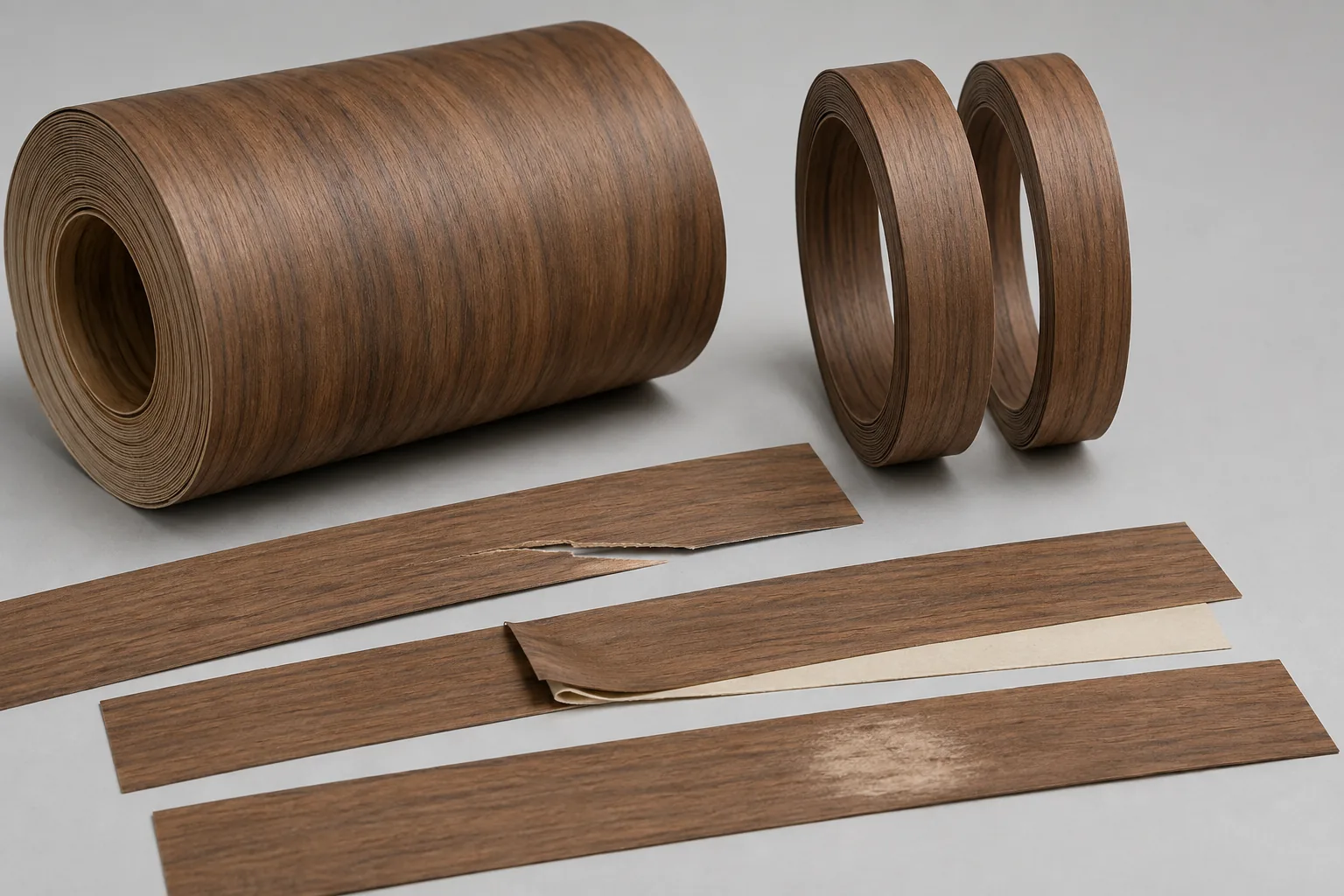
Decorative veneer supplied in rolls behaves more like a fragile web than a rigid wood sheet. Continuous slitting decisions therefore center on tension, lateral tracking, grain orientation and edge support, as well as the rotary knife overlap and side load permitted by the slitter.
Updated
Where This Cutting Application Appears
Converting master veneer rolls
Divide a wide roll into narrower bands for wrapping, edging or laminated component production.
Trimming coated decorative veneer
Remove uneven coated or backed edges before the web enters a laminating or winding operation.
Producing veneer tape and narrow strips
Maintain strip width while minimizing grain-related tears that can continue into the finished roll.
Continuous Veneer Slitting process boundary
continuous veneer slitting for decorative veneer rolls is planned around longitudinal width conversion of a moving roll, web, sheet or strip into controlled lanes or daughter rolls; it is not transverse length cutting, profile formation or removal of only a narrow damaged margin.
Continuous Veneer Slitting setup checkpoint
For decorative veneer rolls, confirm unwind and rewind tension, lane widths, knife positions, edge guidance, core alignment, trim removal and discharge behavior.
Continuous Veneer Slitting acceptance checkpoint
For decorative veneer rolls, evaluate lane width, edge condition, camber or wandering, debris, telescoping, interleaving and stable winding or downstream transfer.
Define the Required Cut Result
- Continuous slit edges without progressive grain tears
- Stable strip width from unwind to rewind
- Low marking on decorative faces and backing layers
- Predictable winding without loose fibers at the roll edge
Problems to Diagnose Before Changing the Knife
A small edge nick develops into a long tear
Review grain angle, incoming edge damage, web tension, knife engagement and whether the slit edge is supported immediately after cutting.
Strip width changes across the roll
Check web guiding, shaft runout, spacer stack, knife axial movement and changes in roll tension.
The decorative face is burnished or marked
Inspect side load, debris trapped at the knife, contact with guides and pressure differences across laminated layers.
Backing and veneer separate at the slit
Confirm adhesive cure, backing construction, knife overlap, edge sharpness and the direction in which each layer is loaded.
Knife Forms That May Be Considered
| Possible knife form | When it may be considered | What must be confirmed |
|---|---|---|
| circular slitter | A rotary slitter can provide continuous cutting with limited interruption when the web is well guided and supported. | Confirm outside and bore diameters, thickness, bevel, rotation, shaft fit, line speed and usable adjustment range. |
| paired rotary shear knife | An upper-and-lower shear pair may control thicker or backed veneer with less unsupported fracture. | Confirm overlap, horizontal clearance, side load, upper/lower knife geometry and the machine's setting method. |
Information to Send for Technical Review
You do not need to know the exact blade name. Send the available workpiece, machine, current-knife and cut-result information so the application can be reviewed against a drawing or sample.
- Veneer species, thickness and grain orientation
- Backing film, paper, fleece or adhesive layer construction
- Master-roll width, finished strip widths and slit count
- Unwind and rewind arrangement, tension range and web path
- Line speed range and whether speed changes during a roll
- Knife shaft dimensions, spacers, runout condition and rotation direction
- Current blade dimensions, material and regrinding history
- Edge samples showing where tearing or delamination begins
Questions About This Cutting Application
Why does veneer slit well at first and then begin to tear?
Debris, loss of sharpness, tension drift or a growing nick can start a grain-following tear. Record roll position and operating time when the change appears.
Is razor slitting suitable for decorative veneer?
Do not assume it is. Veneer thickness, backing and support may require shear cutting; compare the machine design and trial samples before choosing a format.
What determines rotary knife overlap?
The slitter design, knife geometry, material stack and side load determine overlap. Use the equipment setting range rather than a generic value.
Can one setup slit different wood species?
Species differ in grain, density and brittleness. A shared setup should be proven with representative rolls, not inferred from nominal thickness alone.
What should a replacement knife drawing show?
Include shaft fit, diameters, thickness, bevel and orientation, tolerances, datum faces and any matched lower-knife relationship.
Related product and service information
- Wood Edge-Banding Roll Slitting - wood veneer or melamine edge-banding rolls · roll slitting and edge trimming
- Fresh Noodle and Pasta Sheet Cutting - fresh noodles and pasta sheets · strand cutting and sheet trimming
- Medical Mask Nonwoven Web Cutting - medical mask nonwoven webs · web slitting and cutoff
Request a Custom Cutting-Knife Review
Send the workpiece details, machine or holder information, current knife photos or sample, required quantity and examples of the present cut problem. Final dimensions, material, edge geometry and tolerances are confirmed from the approved requirements.