
Blade Application Guides / Application Guide / seafood processing
Fish Fillet Trimming and Portioning
Fish fillets are soft, anisotropic and easily bruised; skin, pin bones and changing thickness add local resistance. A portioning edge must enter without dragging the flesh, while the conveyor or product support keeps the fillet from shifting or curling.
Updated
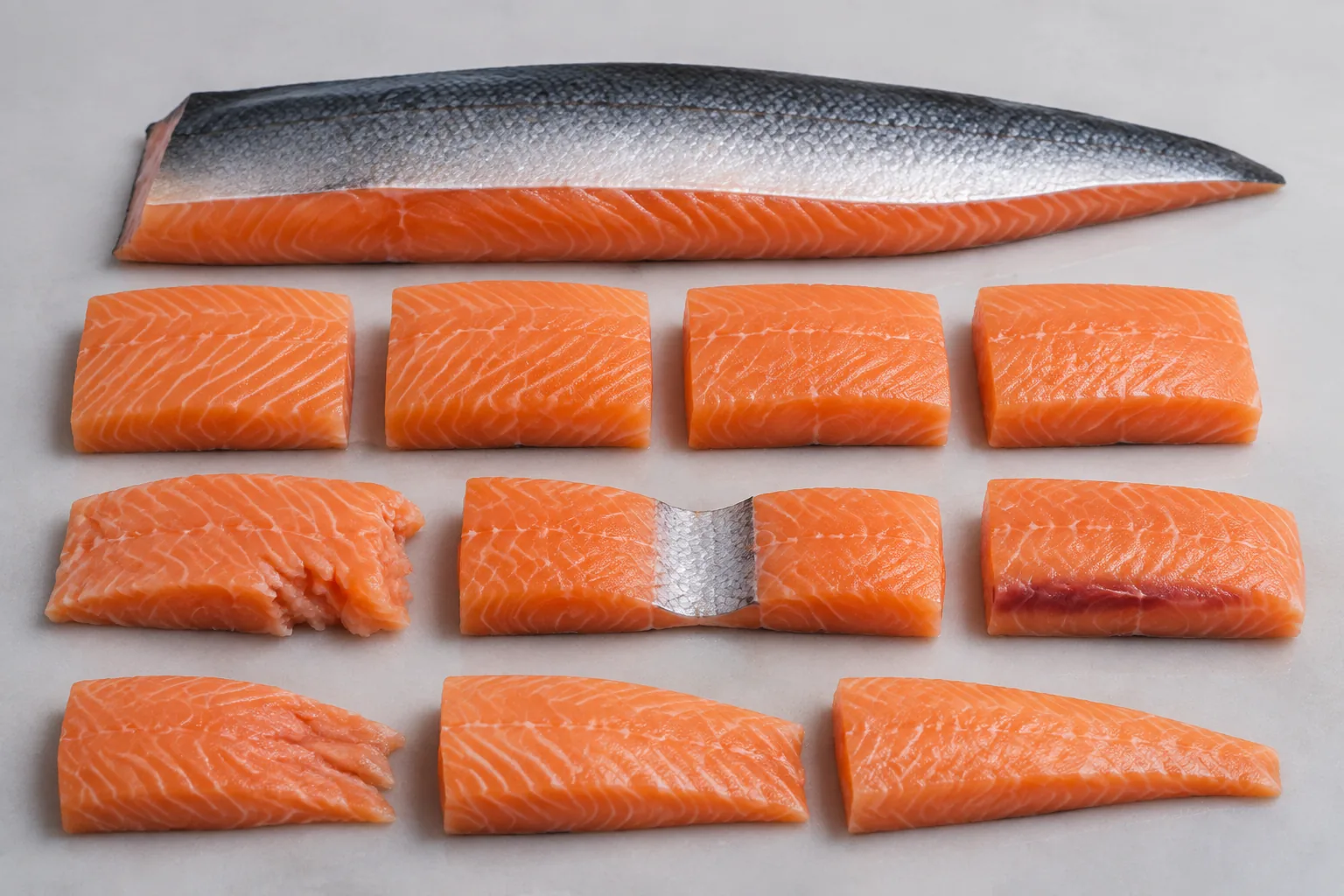
Where This Cutting Application Appears
Trimming fillet edges
Remove belly flaps, fins or irregular edges before grading and portioning.
Cutting retail-size portions
Divide fillets across the grain into repeatable pieces while preserving the visible cut face.
Portioning skin-on fillets
Cut flesh and skin in one pass without pulling the skin away from the portion.
Fillet Trimming And Portioning process boundary
fillet trimming and portioning for fish fillets and portions is a linked sequence: the output condition and datum from each operation become the controlled input for the next. It should not be evaluated as one generic cut or accepted only by the final dimension.
Fillet Trimming And Portioning setup checkpoint
For fish fillets and portions, define the operation order, intermediate dimensions, registration transfer, material support, web or part handling and waste route for every stage of fillet trimming and portioning.
Fillet Trimming And Portioning acceptance checkpoint
Verify both intermediate and final results from fillet trimming and portioning, including dimensions, registration, edge or feature quality, material damage, waste separation and stable transfer between stages.
Define the Required Cut Result
- Smooth flesh surfaces with limited tearing
- Complete separation of skin and connective tissue
- Consistent portion geometry despite tapered fillets
- Low compression and visible bruising at the cut
Problems to Diagnose Before Changing the Knife
Flesh drags and forms a ragged tail
Review edge sharpness, slicing angle, product support, conveyor speed and whether the knife lifts during exit.
Skin remains attached between portions
Check edge continuity, skin orientation, cutting depth, backing support and local scale or membrane buildup.
The fillet moves before separation
Inspect belt grip, product moisture, hold-down timing and whether cutting force is directed laterally.
Cut surfaces show compression bands
Review edge thickness, approach angle, stroke speed, product temperature and time since processing.
Knife Forms That May Be Considered
| Possible knife form | When it may be considered | What must be confirmed |
|---|---|---|
| straight slicing knife | A fine straight edge may suit supported cross-cuts where the motion provides a clean slicing component. | Confirm bevel, edge angle, stroke direction, holder and food-contact cleaning conditions from the machine and samples. |
| scalloped knife | A shallow scallop may reduce continuous contact on soft flesh in equipment designed for that edge. | Confirm scallop pitch and depth through product trials; verify that the holder and sanitation method accept the profile. |
Information to Send for Technical Review
You do not need to know the exact blade name. Send the available workpiece, machine, current-knife and cut-result information so the application can be reviewed against a drawing or sample.
- Fish species and fillet style, including skin-on or skinless
- Fresh, chilled, partially frozen or thawed condition
- Thickness taper and expected portion geometry
- Presence of skin, scales, pin bones or connective tissue
- Machine motion, belt material and product-support arrangement
- Current knife dimensions, bevel and cutting direction
- Required visual finish and acceptable deformation
- Photos of the top, cut face and any unseparated skin
Questions About This Cutting Application
Why does a sharp knife still tear fish flesh?
A sharp edge can still drag if the slicing angle, support or exit motion is wrong. Product temperature and fiber direction also matter.
Does skin-on fish require a serrated edge?
Not automatically. A suitable smooth or scalloped edge may separate skin when depth and support are correct; test the actual product and machine.
How should a fillet sample be photographed?
Show the whole portion, cut face, skin side and feed direction under neutral light, with a scale placed beside rather than over the defect.
Can one knife handle several fish species?
Possibly, but thickness, skin and flesh firmness vary. Define the operating range and verify it with representative fillets.
What information helps control portion consistency?
Provide the fillet size distribution, locating method, target geometry, conveyor behavior and the point where the product begins to move.
Related product and service information
- Meat Skin and Rind Removal - meat skin and rind · skin removal and trimming
- Poultry Joint Cutting and Portioning - poultry portions · joint cutting and portioning
- Frozen Meat Block Portioning - frozen meat blocks · block portioning
Request a Custom Cutting-Knife Review
Send the workpiece details, machine or holder information, current knife photos or sample, required quantity and examples of the present cut problem. Final dimensions, material, edge geometry and tolerances are confirmed from the approved requirements.