
Blade Application Guides / Application Guide / marine plastics recycling
Discarded Fishing Net Cutting
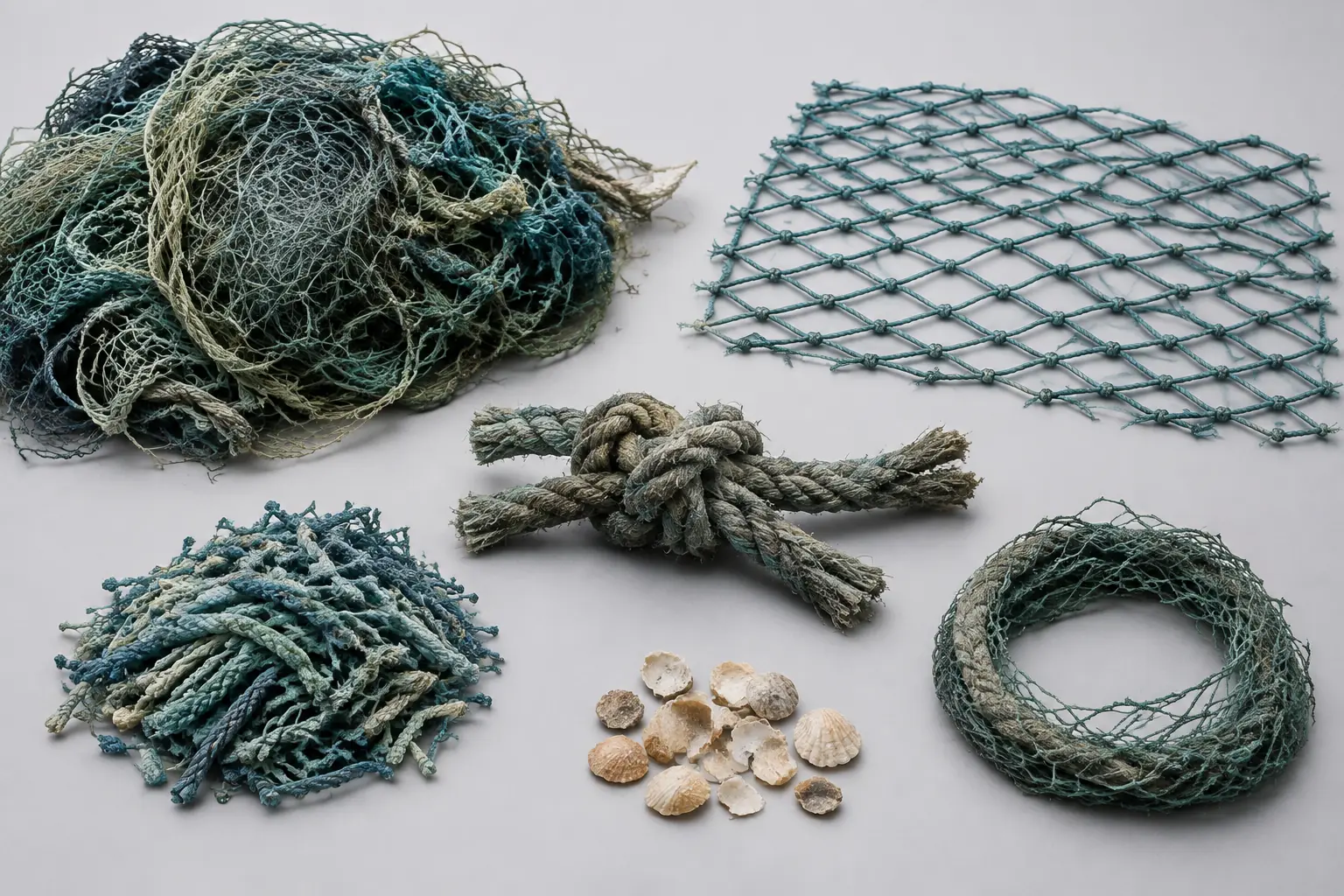
Discarded fishing nets are open structures made from long, tough monofilaments or multifilament yarns, often with knots, ropes and marine contamination. Instead of presenting a solid cutting plane, the net can stretch around an edge and wrap moving components, making feed preparation and strand capture decisive.
Updated
Where This Cutting Application Appears
Pre-cutting recovered net bundles
Open compacted or tangled fishing nets before washing, sorting or controlled shredder feeding.
Reducing sorted polymer nets
Shorten declared nylon, polyethylene or polypropylene net after ropes and hard gear are separated.
Cutting knot- and rope-rich sections
Process heavier junctions separately when the recycler's equipment is designed for their higher load.
Net Cutting And Shredding process boundary
net cutting and shredding for discarded fishing nets is a linked sequence: the output condition and datum from each operation become the controlled input for the next. It should not be evaluated as one generic cut or accepted only by the final dimension.
Net Cutting And Shredding setup checkpoint
For discarded fishing nets, define the operation order, intermediate dimensions, registration transfer, material support, web or part handling and waste route for every stage of net cutting and shredding.
Net Cutting And Shredding acceptance checkpoint
Verify both intermediate and final results from net cutting and shredding, including dimensions, registration, edge or feature quality, material damage, waste separation and stable transfer between stages.
Define the Required Cut Result
- Positive strand capture without stretching through the gap
- Limited wrapping around shafts and rotor ends
- Controlled output length for washing or polymer separation
- Impact protection through declared removal of hooks and hard gear
Problems to Diagnose Before Changing the Knife
Net stretches across the cutting chamber
Review feed tension, strand capture, hook profile, counter-edge clearance and bundle size.
Long strands wrap shaft ends
Inspect pre-cut length, lateral migration, guards, rotor direction and cleaning access.
Knots overload one edge location
Check feed distribution, knot and rope diameter, local support and whether heavy sections require a separate route.
Knife chips follow marine debris events
Identify hooks, swivels, wire, stones and shells; correlate impact damage with sorting records.
Knife Forms That May Be Considered
| Possible knife form | When it may be considered | What must be confirmed |
|---|---|---|
| hooked serrated knife | A contained hooked tooth may engage open net strands where the machine prevents escape and entanglement. | Confirm hook and tooth profile, rotation or stroke, guard, counter-tool and maximum strand bundle from trials. |
| rotor knife | A rotor knife may suit secondary reduction of prepared net pieces against a fixed edge. | Confirm rotor seat, cutting circle, rotation, stator relationship, screen and permitted hard contaminants. |
Information to Send for Technical Review
You do not need to know the exact blade name. Send the available workpiece, machine, current-knife and cut-result information so the application can be reviewed against a drawing or sample.
- Net polymer and mono- or multifilament construction
- Mesh size, twine diameter and knot type
- Rope, float line, lead line or reinforced sections
- Moisture, sand, shell and organic contamination
- Hook, swivel, wire and other hard-gear removal
- Bundle dimensions and pre-cut feed length
- Cutter, rotor, counter-tool and screen drawings
- Samples showing stretch-through, wrapping, overload and impact chips
Questions About This Cutting Application
Why are open nets difficult to cut despite low material mass?
The strands move and stretch away from an edge unless they are positively captured against a counter-tool.
Can rope sections be mixed with ordinary netting?
Only if the equipment is designed for their diameter and load. Declare them separately during review.
What causes net to wrap rather than shred?
Long strand length, loose feed, poor counter-edge engagement and shaft-end migration are common factors.
How should metal hooks be handled?
Hard fishing gear should be controlled by the recycler's sorting process; it must not be treated as normal knife load.
What feed sample is representative?
Include knots, repaired areas, rope junctions and actual contamination, not only a clean square of netting.
Related product and service information
- Tobacco Leaf and Sheet Cutting - tobacco leaf and reconstituted sheet · leaf and sheet cutting
- Corrugated Board Scrap Cutting - corrugated board scrap · sheet shredding
- Discarded Carpet Roll Cutting - discarded carpet rolls · roll splitting and shredding
Request a Custom Cutting-Knife Review
Send the workpiece details, machine or holder information, current knife photos or sample, required quantity and examples of the present cut problem. Final dimensions, material, edge geometry and tolerances are confirmed from the approved requirements.