
Blade Application Guides / Application Guide / tobacco processing
Tobacco Leaf and Sheet Cutting
Whole tobacco leaf is fibrous and moisture-sensitive, while reconstituted sheet is more uniform but can be brittle or layered. Cutting decisions should distinguish leaf lamina, stems and manufactured sheet, because each produces different strand quality, dust and edge loading.
Updated
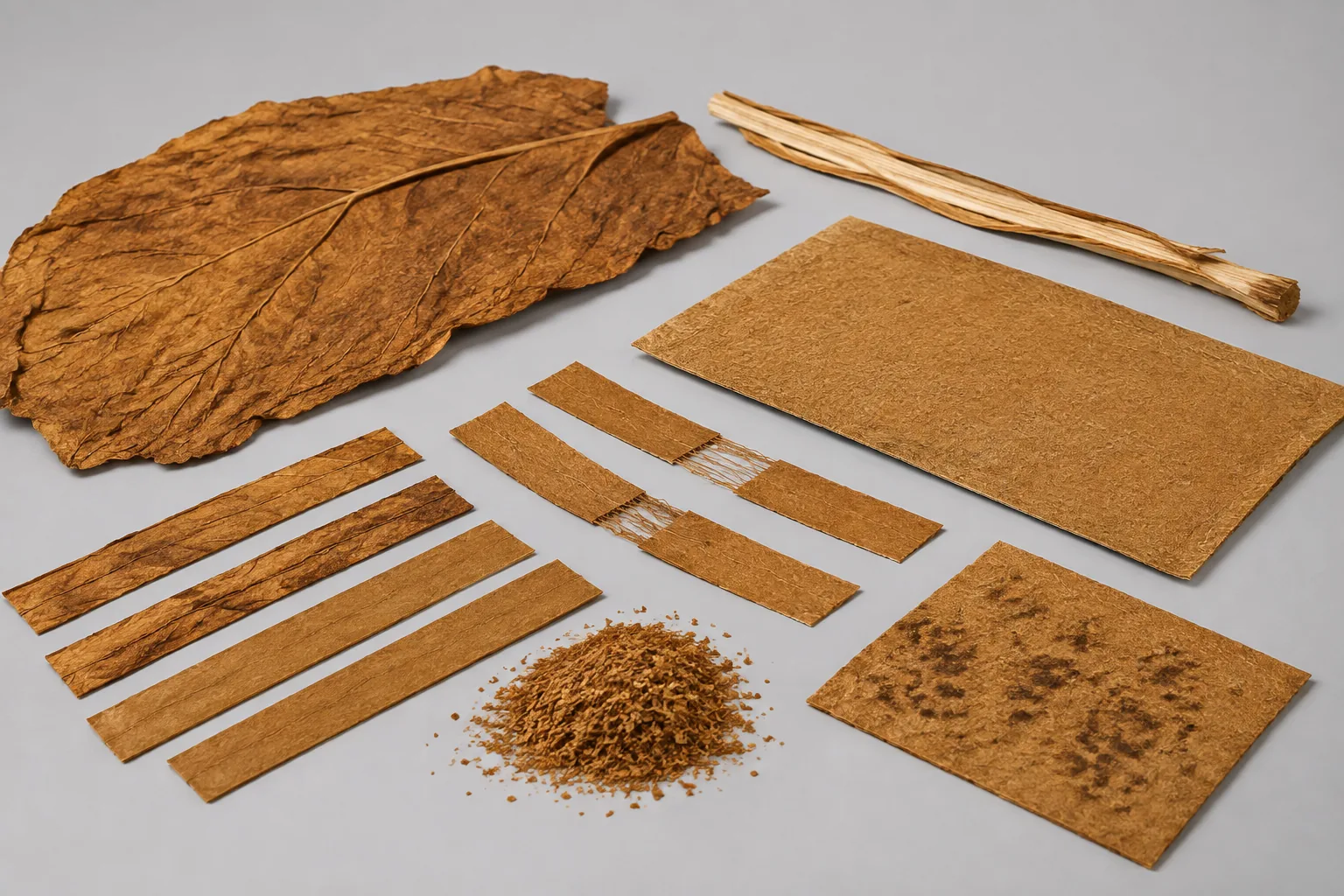
Where This Cutting Application Appears
Cross-cutting conditioned leaf lamina
Produce strips or pieces from moisture-conditioned leaf after the customer's stemming and preparation stages.
Reducing separated tobacco stems
Cut tougher stem material through equipment intended for its higher stiffness and localized load.
Slitting reconstituted tobacco sheet
Convert continuous manufactured sheet into defined widths before downstream processing.
Leaf And Sheet Cutting process boundary
leaf and sheet cutting for tobacco leaf and reconstituted sheet is a linked sequence: the output condition and datum from each operation become the controlled input for the next. It should not be evaluated as one generic cut or accepted only by the final dimension.
Leaf And Sheet Cutting setup checkpoint
For tobacco leaf and reconstituted sheet, define the operation order, intermediate dimensions, registration transfer, material support, web or part handling and waste route for every stage of leaf and sheet cutting.
Leaf And Sheet Cutting acceptance checkpoint
Verify both intermediate and final results from leaf and sheet cutting, including dimensions, registration, edge or feature quality, material damage, waste separation and stable transfer between stages.
Define the Required Cut Result
- Consistent cut size without long fibrous tails
- Limited fines and dust from conditioned material
- Stable feeding without leaf folding or sheet drift
- Even wear despite changes between lamina, stem and sheet
Problems to Diagnose Before Changing the Knife
Dry leaf shatters into fines
Check conditioning moisture, handling time, edge condition, compression and cutting speed.
Fibrous strands remain connected
Review leaf or stem orientation, penetration, counter-surface and whether folds shield material.
Reconstituted sheet drifts in width
Inspect web tension, guiding, shaft runout, knife side load and winding behavior.
Residue builds on knife faces
Identify moisture, binder or casing condition, temperature, surface finish and cleaning interval.
Knife Forms That May Be Considered
| Possible knife form | When it may be considered | What must be confirmed |
|---|---|---|
| rotary cutter knife | A rotary format may suit continuous leaf or sheet feed when timing and product presentation are controlled. | Confirm diameter, mounting, rotation, cutting width, counter-tool and declared material stream. |
| serrated straight knife | Progressive teeth may suit supported fibrous or stem-rich feed, but can increase fines if mismatched. | Confirm tooth pitch, depth and direction, stroke, backing and accepted output samples. |
Information to Send for Technical Review
You do not need to know the exact blade name. Send the available workpiece, machine, current-knife and cut-result information so the application can be reviewed against a drawing or sample.
- Whole leaf, lamina, stem or reconstituted-sheet duty
- Material variety or construction category
- Moisture and conditioning range at cutting
- Incoming dimensions, orientation and feed density
- Required strip, strand or sheet width
- Machine motion, holder and counter-surface
- Current knife, residue pattern and cleaning method
- Output samples showing fines, tails, drift or buildup
Questions About This Cutting Application
Why must leaf moisture be recorded?
Dry leaf can fracture into fines, while wetter material may drag or build residue. Use the actual process range.
Can lamina and stems use one setup?
Not automatically. Stems are stiffer and more concentrated, creating different load and strand behavior.
Does reconstituted sheet cut like natural leaf?
No assumption should be made. Its binder, density and web form change tension and fracture response.
What causes dust to rise later in a run?
Conditioning drift, edge wear, residue and material mix may change; record when the increase begins.
What should accepted samples show?
Provide the desired size distribution, permitted fines and edge or strand appearance under the normal conditioning state.
Related product and service information
- Cutting Extruded Rubber Profiles to Length - extruded rubber profiles · in-line cut-to-length
- Corrugated Board Scrap Cutting - corrugated board scrap · sheet shredding
- Discarded Carpet Roll Cutting - discarded carpet rolls · roll splitting and shredding
Request a Custom Cutting-Knife Review
Send the workpiece details, machine or holder information, current knife photos or sample, required quantity and examples of the present cut problem. Final dimensions, material, edge geometry and tolerances are confirmed from the approved requirements.