
Blade Application Guides / Application Guide / Corrugated packaging
Corrugated Carton Slotting Without Liner Tear
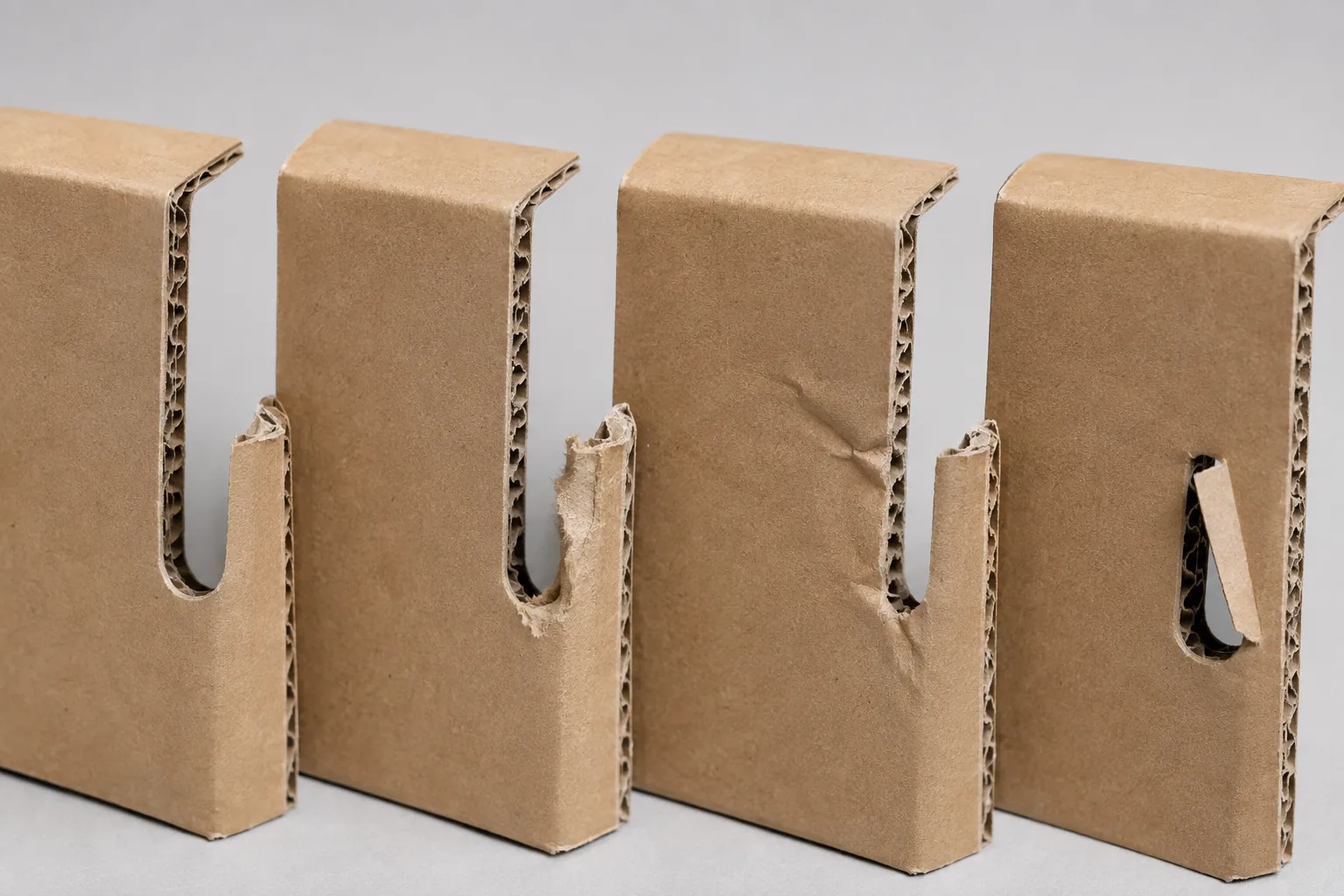
A corrugated slot crosses two liners and a fluted medium while defining how carton flaps fold and meet. Board grade, flute direction, score relationship, slot width, support, and waste removal all affect the finished corner.
Updated
Where This Cutting Application Appears
Regular slotted container production
Slots separate the major and minor flaps on common shipping cases, where depth and position determine flap meeting and box squareness.
Heavy-duty double-wall case converting
Thicker board is slotted for industrial cartons while liner fracture, flute crushing, and incomplete waste release require closer control.
Partition and internal fitment slotting
Narrow slots and interlocking features are cut into corrugated partitions so assembled cells fit without tearing or excessive play.
Slotting process boundary
slotting for corrugated carton blanks is planned around formation of a localized line or feature at a specified position and depth without treating the operation as general sizing; it is not unregistered full separation, broad slitting or complete contour cutting.
Slotting setup checkpoint
For corrugated carton blanks, confirm feature geometry, position, depth, registration, local support, sequence and the required residual connection or separation.
Slotting acceptance checkpoint
For corrugated carton blanks, evaluate feature position and dimensions, depth consistency, corner condition, residual strength, tearing and functional fit.
Define the Required Cut Result
- Cut both liners without pulling fibers into the slot
- Preserve flute height beside the flap corner
- Hold slot depth and position relative to score lines
- Release slot waste without leaving hanging tabs
Problems to Diagnose Before Changing the Knife
Torn outer liner at the slot end
Inspect liner grade, moisture, score-to-slot distance, corner radius, entry direction, backing support, and whether the tear follows the paper grain.
Flutes crushed beside the slot
Review board thickness, flute type, compression, anvil or support condition, slot width, and recovery after the blank leaves the station.
Slot depth or spacing variation
Check blank registration, feed skew, shaft or head position, score datum, board warp, and measurements across machine direction.
Hanging slot waste and incomplete separation
Compare liner penetration, flute bridge, waste geometry, ejection path, board moisture, and the exact point still attached.
Knife Forms That May Be Considered
| Possible knife form | When it may be considered | What must be confirmed |
|---|---|---|
| Paired slotting form | Consider where two cutting edges define a straight carton slot and remove the intervening waste. | Confirm slot width, depth, corner form, shaft interface, rotation, and the approved carton drawing. |
| Profiled slotting form | Consider for locking slots, relief shapes, or partition features that are not simple parallel cuts. | Confirm every radius, transition, waste-release feature, board range, and machine mounting from samples and drawings. |
Information to Send for Technical Review
You do not need to know the exact blade name. Send the available workpiece, machine, current-knife and cut-result information so the application can be reviewed against a drawing or sample.
- Board construction, liner grades, medium, and recycled content
- Flute type, single- or double-wall build, and caliper range
- Board moisture, warp condition, and feed direction
- Slot width, depth, spacing, corner radius, and score relationship
- Carton style and flap meeting or partition-fit requirement
- Line speed, blank registration, support, and waste-ejection method
- Photos of liner tear, flute crush, and hanging waste by slot position
- Current slotting-part sample, shaft or head interface, and drawing revision
Questions About This Cutting Application
Why does the liner tear mainly at the closed end of a carton slot?
Stress concentrates where the parallel cuts terminate, especially near a score or with dry liner. Corner geometry, support, grain direction, and moisture should be compared.
How does flute direction affect slotting?
A slot crossing or following flute lines presents different support and bridge conditions. Mark board orientation and the slot position on every trial sample.
What should be measured after slotting a regular carton?
Measure slot depth, width, spacing, relation to scores, flap meeting, corner tears, flute recovery, and whether waste is fully released.
Can a double-wall board run with a setup approved for single wall?
Do not assume it can. Caliper, liner strength, flute stack, compression, penetration, and waste behavior change; review representative production blanks.
What is needed when the slotter part number is unknown?
Provide the existing part, shaft or head dimensions, rotation, fastener pattern, carton drawing, and marked blanks. Confirm a controlled drawing before manufacture.
Related product and service information
- Masking Tape Log Cutting With Clean Roll Faces - masking tape logs · log cutting
- Carton Sealing Tape Cutoff for Reliable Cycle Separation - carton sealing tape · cutoff
- Woven Sack Mouth Cutting Without Yarn Unraveling - woven packaging sacks · mouth cutting
Request a Custom Cutting-Knife Review
Send the workpiece details, machine or holder information, current knife photos or sample, required quantity and examples of the present cut problem. Final dimensions, material, edge geometry and tolerances are confirmed from the approved requirements.