
Blade Application Guides / Application Guide / confectionery production
Confectionery Slab and Bar Cutting
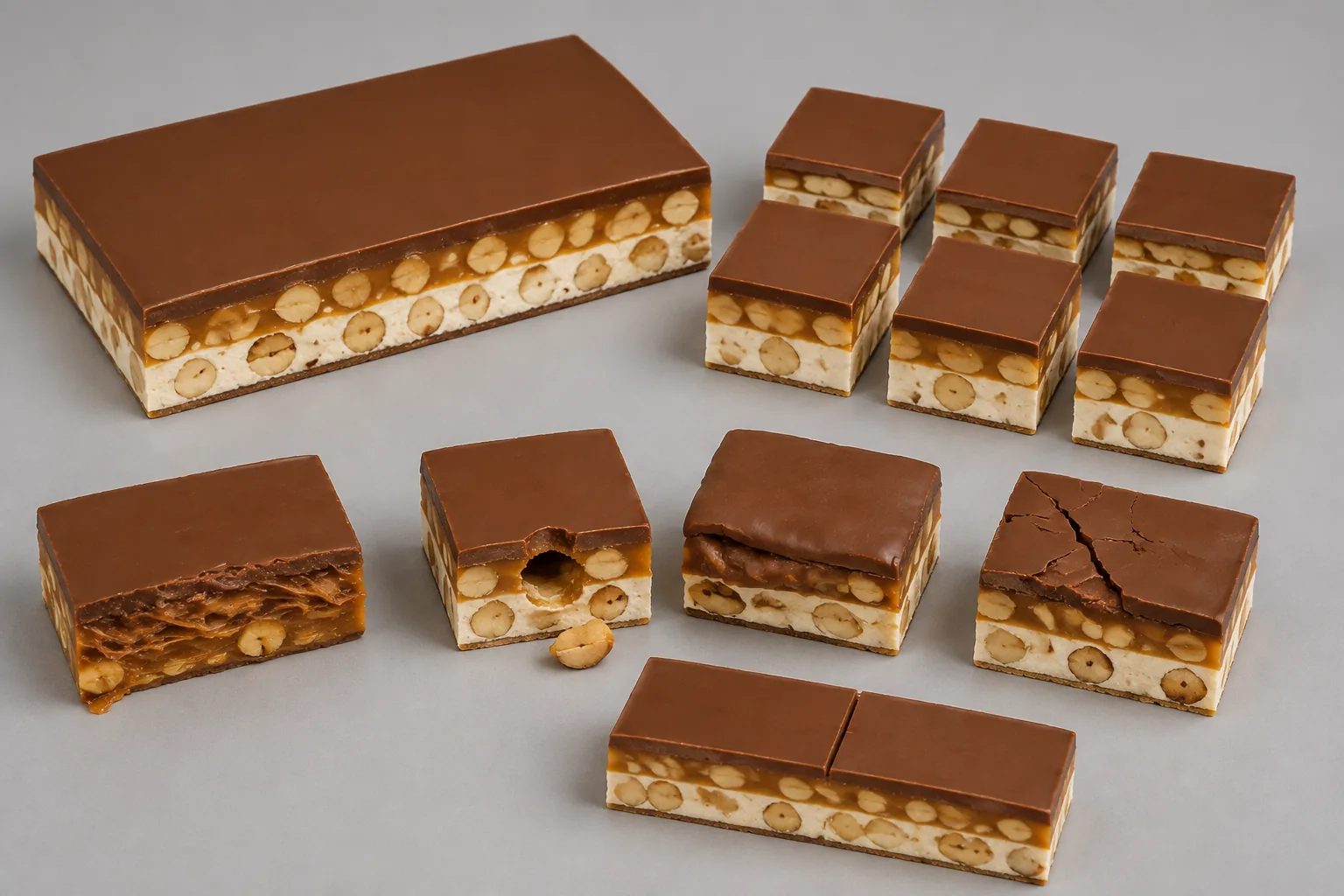
Confectionery slabs may be brittle, elastic, sticky or layered, and the same product can change markedly with temperature. A cutting review must distinguish full-depth portioning from shallow scoring, then account for inclusions, release from the knife face and support beneath the cut.
Updated
Where This Cutting Application Appears
Portioning caramel or nougat slabs
Divide deposited or rolled slabs into bars after cooling, while controlling sticking and shape distortion.
Cutting inclusion-filled confectionery
Separate products containing nuts, fruit pieces or crisp layers without pulling inclusions from the cut face.
Scoring chocolate or compound slabs
Create controlled break lines without requiring the knife to pass completely through the product.
Guillotine Cutting And Scoring process boundary
guillotine cutting and scoring for confectionery slabs and bars is a linked sequence: the output condition and datum from each operation become the controlled input for the next. It should not be evaluated as one generic cut or accepted only by the final dimension.
Guillotine Cutting And Scoring setup checkpoint
For confectionery slabs and bars, define the operation order, intermediate dimensions, registration transfer, material support, web or part handling and waste route for every stage of guillotine cutting and scoring.
Guillotine Cutting And Scoring acceptance checkpoint
Verify both intermediate and final results from guillotine cutting and scoring, including dimensions, registration, edge or feature quality, material damage, waste separation and stable transfer between stages.
Define the Required Cut Result
- Square portions with limited compression or elastic recovery
- Clean faces without dragged inclusions or smear ridges
- Reliable release from the knife after each stroke
- Consistent score depth without uncontrolled cracking
Problems to Diagnose Before Changing the Knife
Product adheres to the knife face
Review product temperature, sugar and fat surface condition, blade finish, contact area, dwell time and release motion.
Brittle layers crack beyond the cut
Check cooling state, internal layering, support span, scoring depth and whether the edge is wedging the slab.
Soft bars bulge before separation
Inspect hold-down, cutting speed, edge thickness and whether the slab is fully stationary during the stroke.
Nuts or inclusions tear out
Compare inclusion size and distribution with edge path, support and slicing action; retain cut-face samples for review.
Knife Forms That May Be Considered
| Possible knife form | When it may be considered | What must be confirmed |
|---|---|---|
| straight guillotine knife | A straight edge can suit indexed full-width cuts when the slab is supported and a controlled release stroke is available. | Confirm knife section, bevel, mounting, stroke, cutting bed and product-temperature range from the machine drawing and trials. |
| scoring wheel | A wheel may suit continuous shallow scoring where the product and conveyor can tolerate local compression. | Confirm wheel profile, penetration, spacing, backing surface and acceptable fracture line on representative product. |
Information to Send for Technical Review
You do not need to know the exact blade name. Send the available workpiece, machine, current-knife and cut-result information so the application can be reviewed against a drawing or sample.
- Product type, formulation category and layer construction
- Temperature and conditioning time at the cutting station
- Slab dimensions, portion geometry and permitted recovery
- Type, size and distribution of inclusions
- Full-depth cut or score-and-break requirement
- Machine stroke, product support and release arrangement
- Current knife dimensions, finish and cleaning method
- Accepted and rejected samples showing sticking, cracks or deformation
Questions About This Cutting Application
Why does a confectionery product cut cleanly only within a narrow temperature range?
Texture and adhesion change with temperature. Record product temperature at the blade, not only the room or cooling-set value.
Can one knife cut both caramel and brittle chocolate?
Do not assume so. Their deformation, fracture and release behavior differ; verify each product state and acceptable cut face.
What causes inclusions to pull out?
The edge may push rather than slice, or an inclusion may lack support. Show inclusion size, cut direction and the resulting cavity.
Is a non-stick coating always required?
No. Finish, contact area, temperature and release motion may matter as much as coating. Any coating must also suit the customer's process requirements.
What should be specified for scoring?
Provide target score depth and width, product thickness, backing condition and the intended break test, together with the machine interface.
Related product and service information
- Dried Fruit Strip Dicing Blades - dried fruit strip · dicing
- Sanitary Pad Absorbent Core Cutting - sanitary pad absorbent cores · core contour cutting
- Wound Dressing Laminate Die Cutting - wound dressing laminates · laminate die cutting
Request a Custom Cutting-Knife Review
Send the workpiece details, machine or holder information, current knife photos or sample, required quantity and examples of the present cut problem. Final dimensions, material, edge geometry and tolerances are confirmed from the approved requirements.