
Blade Application Guides / Application Guide / Energy storage manufacturing
Zinc-Air Battery Separator Paper Edge-Trimming Blades
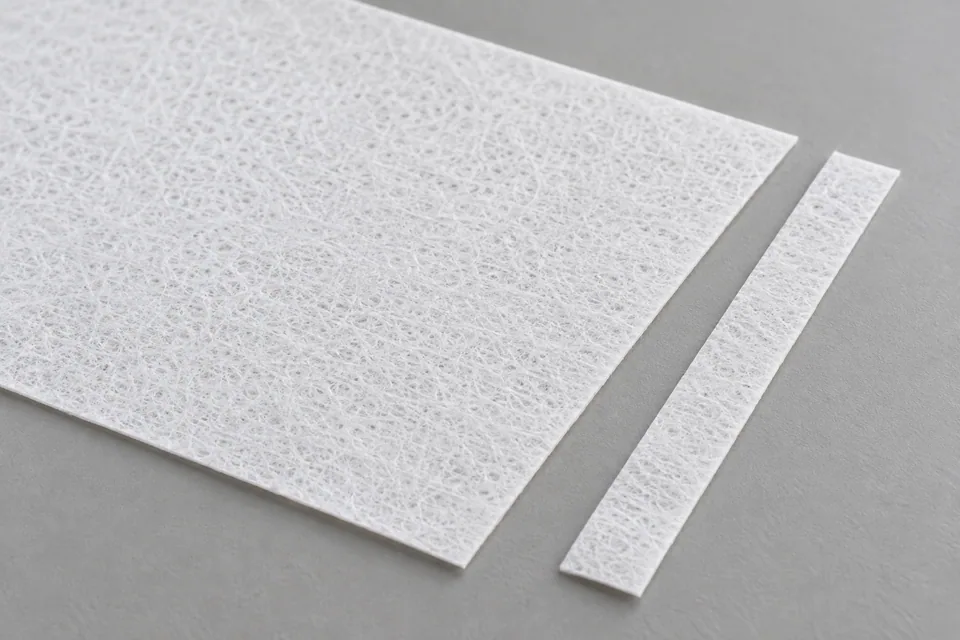
Edge trimming removes a narrow outside margin from zinc-air separator stock to establish a useful straight edge. The removed ribbon must leave without rubbing its loose fibers or particles onto the retained sheet. Energizer identifies the separator’s particle-barrier role, while Freudenberg shows that metal-air separators can use different nonwoven constructions; neither source sets a universal trim allowance. Define starting width, finished width, one-side or two-side trim, and the customer’s contamination test before choosing a circular pair or straight trim blade. Inspect the retained edge after waste takeoff, not only while the knife is cutting.
Updated
Where This Cutting Application Appears
Set the trim allowance
Record starting width, target finished width and the minimum usable edge allowance. Confirm whether one or both sides are trimmed and how the sheet is registered. An edge trim is not a substitute for multiple full-width slits.
Keep the narrow waste moving
Observe whether the trim ribbon stays continuous, breaks or wraps around the holder. Plan a takeoff path that does not pull the useful sheet sideways or contaminate its cut edge. For the zinc-air stock, collect the detached ribbon separately so its loose particles cannot settle on the retained separator face. Record where any break occurs along the run.
Inspect the retained edge
Measure finished width and straightness along the sheet. Inspect for loose particles on the retained edge and on the sheet face after waste removal.
Verify support and tension
Record support near the knife, guide contact and web tension or sheet feed method. The retained sheet can distort even when the detached ribbon looks clean.
Material-specific acceptance
Inspect the retained zinc-air separator edge after the waste ribbon has been taken away and after the useful sheet is packed. The buyer should define debris and puncture limits for that route; a clean-looking ribbon by itself does not prove the separator remains acceptable.
Define the Required Cut Result
- Reach the finished width with a straight retained edge.
- Meet the buyer's edge-particle limit on the useful sheet.
- Remove the waste ribbon without dragging or breaking into the product.
- Avoid skew, wrinkles and handling marks in the retained sheet.
- Preserve the buyer-approved separator handling and cleanliness condition.
Problems to Diagnose Before Changing the Knife
The retained sheet width drifts
- Measure starting width and guide position.
- Check blade position and lateral sheet movement.
- Compare width at the knife with width after collection.
The waste ribbon breaks or wraps
- Check trim allowance and ribbon path.
- Inspect cut quality, blade condition and takeoff tension.
- Observe whether the break coincides with a sheet defect.
Loose particles appear on the retained edge
- Inspect blade engagement and local support.
- Separate particles produced at cutting from those transferred during waste takeoff.
- Test against the buyer's agreed inspection method.
The useful sheet wrinkles after trimming
- Check guide contact, support and tension balance.
- Identify the first location where wrinkles appear.
- Compare against an untrimmed control from the same lot.
Knife Forms That May Be Considered
| Possible knife form | When it may be considered | What must be confirmed |
|---|---|---|
| Circular edge-trim knife pair | For continuous trimming on a compatible rotary sheet line. | Confirm pair dimensions, edge engagement, holder geometry and waste-takeoff path. |
| Supported straight trim blade | For a compatible intermittent sheet-trimming machine. | Confirm blade length, support and hold-down against the installed machine drawing. |
Information to Send for Technical Review
You do not need to know the exact blade name. Send the available workpiece, machine, current-knife and cut-result information so the application can be reviewed against a drawing or sample.
- Supplied separator construction and grade
- Starting and finished sheet widths
- One-side or two-side trim allowance
- Buyer-approved particle and edge tests
- Feed registration and guide drawing
- Circular-pair or straight-trim holder drawing
- Waste-ribbon path and collection
- Representative edge samples after handling
Questions About This Cutting Application
What is removed during edge trimming?
Only the specified outside allowance is removed to make a useful finished edge and width.
Why does waste takeoff affect quality?
A narrow ribbon can break, wrap or pull the useful sheet sideways. Trial the collection path with the cut.
Should the removed edge be inspected?
Yes. Its continuity and failure mode help explain whether the retained edge is at risk.
Can trimming fix all sheet-width variation?
No. Starting width, guide stability and sheet movement still determine the finished width.
What information is needed to quote tooling?
Provide starting and finished widths, trim allowance, material samples, machine drawing and edge-particle criteria.
Does zinc-air separator paper have a universal fiber specification?
No. The customer must identify the actual construction and approved porosity and particle tests; “paper” is not enough to choose an edge geometry.
Public references and scope
These public sources provide material, cutting-method or safety context for this guide. Supplier pages describe their own materials or equipment; they do not establish a MEIRENTE blade specification or performance claim. Confirm the actual grade, machine setup and required cut with a drawing or sample.
Related product and service information
- Zinc-Air Battery Separator Paper Sheet Slitting Blades - zinc-air battery separator paper · sheet slitting
- AGM Battery Separator Mat Edge-Trimming Blades - AGM battery separator mat · edge trimming
- Vanadium Redox-Flow Membrane Sheet Slitting Blades - vanadium redox-flow membrane · sheet slitting
Request a Custom Cutting-Knife Review
Send the workpiece details, machine or holder information, current knife photos or sample, required quantity and examples of the present cut problem. Final dimensions, material, edge geometry and tolerances are confirmed from the approved requirements.