
Blade Application Guides / Application Guide / Energy storage manufacturing
Zinc-Air Battery Separator Paper Sheet Slitting Blades
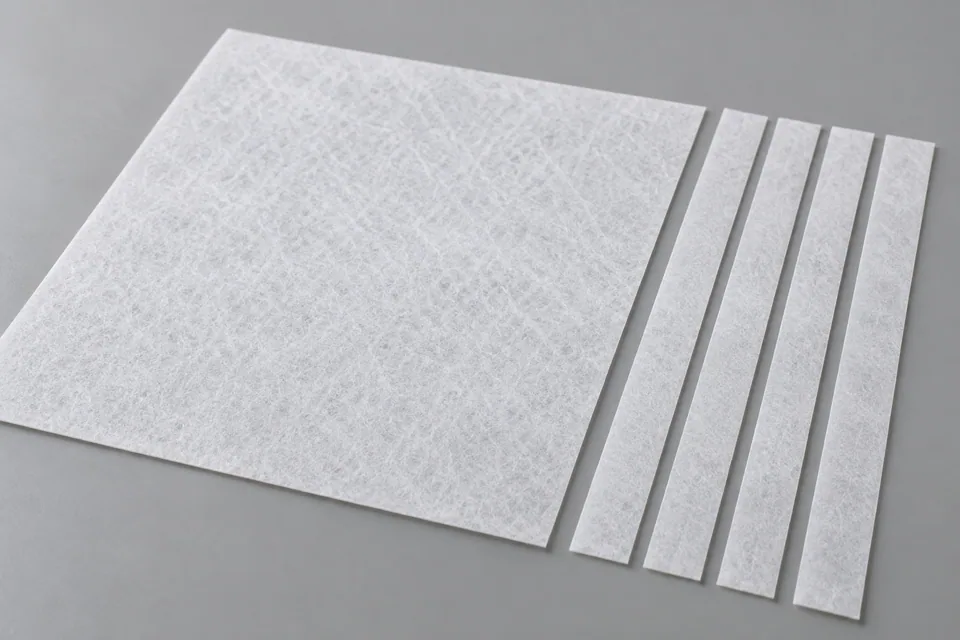
Zinc-air separator “paper” describes the buyer’s supplied stock, not a universal fiber recipe. Energizer describes the separator as preventing migration of solid particles between electrodes; Freudenberg lists multiple nonwoven constructions for metal-air batteries. A sheet-slitting trial therefore starts with the actual flat stock and a strip-layout drawing. Record the width and both newly cut edges of every lane, then inspect for transferred fibers or particles after normal handling. Select a rotary slitter pair or supported straight shear only after the installed line and the buyer’s cleanliness method are known.
Updated
Where This Cutting Application Appears
Lay out the strips
Define each finished strip width, slit position and allowable edge deviation on a sheet drawing. Plan how the outer strips and any narrow waste pieces will be retained. Check cut quality at the start, middle and end of a trial sheet or batch.
Support the cut zone
Record the support surface, blade holder, sheet registration and any web tension. Unsupported soft stock may deflect before separation, so compare an accepted edge with the actual setup rather than selecting a blade from nominal thickness alone.
Inspect width and contamination
Measure each strip and inspect both sides of every slit for loose material. Use the buyer's agreed particle method; a visually straight edge can still shed material during downstream handling. For this zinc-air application, ask the buyer whether a particle, puncture, or permeability check follows slitting; the cutting inspection should use that specified method rather than treating a visually clean edge as proof of separator performance.
Follow the strips downstream
Check whether strips curl, stretch or rub after separation. Pack and handle them in the same way as production so damage after cutting is not attributed to the knife.
Material-specific acceptance
Use the buyer’s functional test plan after the strips have followed their normal handling route. Sample each lane for edge debris, punctures and damage, then compare with an uncut control of the same separator grade. The battery name alone does not establish a pore size or acceptance limit.
Define the Required Cut Result
- Hold strip width and straightness to the buyer drawing.
- Meet the agreed loose-particle and edge-quality limits.
- Avoid stretching, crushing or wrinkling the sheet at the cut.
- Keep waste and finished strips separated and traceable.
- Preserve the buyer-approved separator handling and cleanliness condition.
Problems to Diagnose Before Changing the Knife
Strip width varies across the sheet
- Check registration, slit spacing and blade-holder position.
- Compare dimensions before and after handling.
- Look for sheet stretch or skew at the feed.
One slit edge sheds more than its mate
- Inspect both blade edges and the support immediately beneath them.
- Check blade pressure or engagement and sheet direction.
- Compare material from the same lot at different strip positions.
A strip curls or wrinkles after separation
- Identify when the distortion first appears.
- Check support, tension and winding or stacking method.
- Compare against an uncut control sheet.
Narrow waste strips mix with accepted product
- Review strip layout and waste takeoff.
- Check whether trimming breaks into short pieces.
- Define a collection and labeling method for the trial.
Knife Forms That May Be Considered
| Possible knife form | When it may be considered | What must be confirmed |
|---|---|---|
| Paired circular slitter knives | For a compatible rotary sheet-slitting line making continuous straight cuts. | Confirm arbor, pair geometry, overlap and clearance from machine drawings and a material trial. |
| Straight shear blade set | For a sheet line that uses a supported straight shear rather than rotary slitting. | Confirm holder length, support and blade engagement from the installed machine. |
Information to Send for Technical Review
You do not need to know the exact blade name. Send the available workpiece, machine, current-knife and cut-result information so the application can be reviewed against a drawing or sample.
- Actual separator construction and supplied sheet grade
- Sheet thickness and measurement condition
- Buyer-approved porosity or permeability test, if cutting acceptance uses one
- Particle, puncture and edge-contamination limits
- Strip widths and lane layout
- Support surface and feed method
- Slitter-holder or straight-shear drawing
- Waste-strip collection method
Questions About This Cutting Application
Does slitting produce enclosed parts?
No. Sheet slitting makes long straight strips. Enclosed shapes require a contour-cutting operation.
Where should shedding be checked?
Inspect both newly cut edges and material after the normal handling path using the buyer's particle criterion.
Can one blade setup be used for every separator grade?
No. Construction, thickness under load and surface condition can change the cut. Validate on the actual supplied grade.
What drawings are needed?
Provide the strip layout and the cutter-holder or slitter-pair drawing with current setup records.
How should a trial be sampled?
Measure all strip positions and sample multiple points through the run or batch, including after packing or winding.
Does zinc-air separator paper have a universal fiber specification?
No. The customer must identify the actual construction and approved porosity and particle tests; “paper” is not enough to choose an edge geometry.
Public references and scope
These public sources provide material, cutting-method or safety context for this guide. Supplier pages describe their own materials or equipment; they do not establish a MEIRENTE blade specification or performance claim. Confirm the actual grade, machine setup and required cut with a drawing or sample.
Related product and service information
- Trimming Aluminum Sheet Edges - aluminum sheet and strip · edge trimming
- AGM Battery Separator Mat Sheet Slitting Blades - AGM battery separator mat · sheet slitting
- Vanadium Redox-Flow Membrane Sheet Slitting Blades - vanadium redox-flow membrane · sheet slitting
Request a Custom Cutting-Knife Review
Send the workpiece details, machine or holder information, current knife photos or sample, required quantity and examples of the present cut problem. Final dimensions, material, edge geometry and tolerances are confirmed from the approved requirements.