
Blade Application Guides / Application Guide / Energy storage manufacturing
Vanadium Redox-Flow Membrane Sheet Slitting Blades
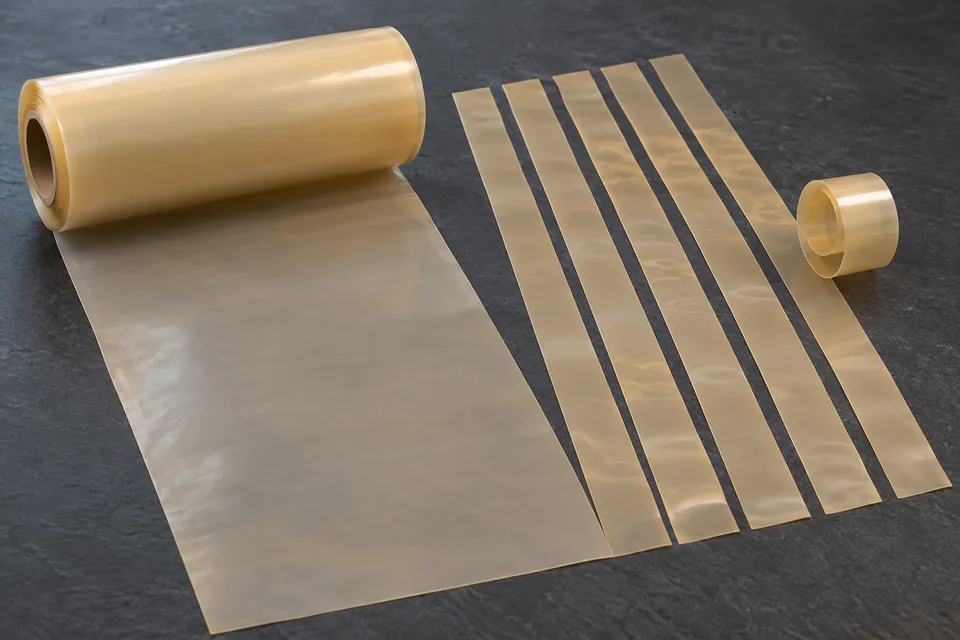
Vanadium redox-flow battery membranes can use different ion-exchange chemistries and may have reinforcement or a designated face. Sheet slitting divides a supplied membrane sheet into long straight strips. Confirm the grade and supplier-defined dry or conditioned handling state before choosing support, blade engagement or the measurement condition.
Updated
Where This Cutting Application Appears
Define strips from the membrane sheet
State parent-sheet size, strip widths, feed direction and edge allowance. Sheet slitting makes long straight strips, not individual cell-shaped membranes. If the stock has a designated face, preserve its orientation through cutting and labeling.
Support a soft membrane
Record the support surface, feed registration, blade engagement and any protective liner. A thin membrane may stretch, crease or adhere to tooling; compare the actual supplied grade against an accepted control.
Inspect exposed edges
Measure strip width and straightness. Examine both sides of every cut for tears, pinholes, pulled reinforcement or loose particles. Inspect after the buyer-approved conditioning state and normal handling.
Protect strips after cutting
Separate the finished strips from trim, label the grade and orientation, and package according to the membrane supplier’s requirements. Cutting inspection is distinct from later ionic-transport and crossover testing.
Compare the slit with the supplier handling state
Ion Power documents a composite VANADion membrane supplied dry, with a marked positive face and a specified wetting procedure before use. Keep the buyer’s grade and face orientation on each strip, then inspect edge tears and any reinforcement pullout under the buyer’s stated measurement condition. A knife trial records geometry and physical damage; ionic resistance and vanadium crossover require separate cell tests.
Define the Required Cut Result
- Produce straight membrane strips to the buyer layout.
- Prevent edge tears, pinholes or pulled reinforcement.
- Keep dry or conditioned handling and face orientation traceable.
- Measure strip dimensions under the stated supplier/buyer condition.
Problems to Diagnose Before Changing the Knife
A membrane strip stretches and narrows
- Review feed tension and unsupported span.
- Compare dimensions at the knife and after handling.
- Confirm the supplier-specified measurement condition.
A slit edge tears or develops a pinhole
- Inspect blade condition and local support.
- Check whether a liner was removed too early.
- Apply the buyer’s defect inspection method to both faces.
The strip curls or sticks to tooling
- Check stock conditioning and face orientation.
- Inspect takeoff and support-contact surfaces.
- Compare the behavior of an uncut sample.
Edge quality differs among lanes
- Check blade position, spacer stack and support across the width.
- Sample every strip position.
- Compare accepted and rejected material from the same lot.
Knife Forms That May Be Considered
| Possible knife form | When it may be considered | What must be confirmed |
|---|---|---|
| Paired circular slitter knives | For continuous straight slits on a compatible membrane line after a sample trial. | Confirm arbor, pair geometry, clearance and support from machine drawings. |
| Supported straight shear set | For intermittent straight slits on a compatible sheet cutter. | Confirm backing, hold-down and complete separation on the actual membrane. |
Information to Send for Technical Review
You do not need to know the exact blade name. Send the available workpiece, machine, current-knife and cut-result information so the application can be reviewed against a drawing or sample.
- Membrane grade, ion-exchange chemistry and any reinforcement
- Supplier dry or conditioned handling instructions
- Marked face and desired strip orientation
- Parent size, lane layout and trim allowance
- Buyer tear, pinhole and particle inspection method
- Slitter, support and knife-pair drawings
- Accepted strip samples and downstream stack test owner
Questions About This Cutting Application
Does sheet slitting make a final cell profile?
No. It makes straight strips. Contour cutting creates individual shapes and openings.
Can all flow-battery membranes use the same cutting setup?
No. Construction and conditioning vary by grade; test the actual supplied membrane.
Does cutting prove ionic performance?
No. The stack maker must test conductivity, crossover and cell performance separately.
Why state the measurement condition?
Some membrane dimensions may depend on handling or conditioning state, so compare like with like.
Which side of the VANADion example is identified?
Ion Power marks a positive face on that grade. Other membranes require their own supplier instructions; do not infer orientation from appearance.
Public references and scope
These public sources provide material, cutting-method or safety context for this guide. Supplier pages describe their own materials or equipment; they do not establish a MEIRENTE blade specification or performance claim. Confirm the actual grade, machine setup and required cut with a drawing or sample.
Related product and service information
- Zinc-Air Battery Separator Paper Edge-Trimming Blades - zinc-air battery separator paper · edge trimming
- AGM Battery Separator Mat Sheet Slitting Blades - AGM battery separator mat · sheet slitting
- Fuel-Cell Microporous-Layer Sheet Slitting Blades - fuel-cell microporous-layer sheet · sheet slitting
Request a Custom Cutting-Knife Review
Send the workpiece details, machine or holder information, current knife photos or sample, required quantity and examples of the present cut problem. Final dimensions, material, edge geometry and tolerances are confirmed from the approved requirements.