
Blade Application Guides / Application Guide / wood recycling and biomass
Reducing Wood Offcuts to Controlled Chips
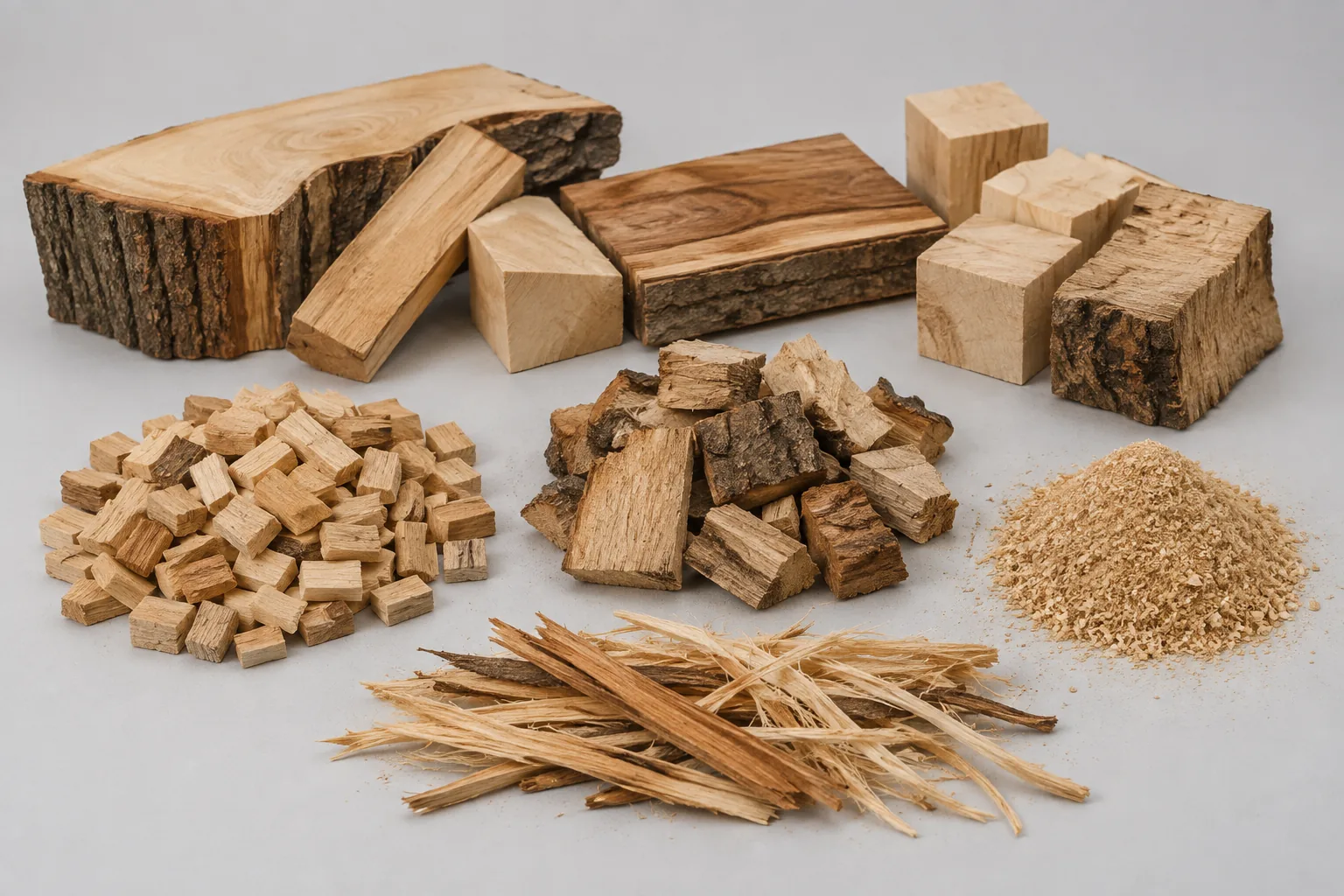
Wood residuals may include slabs, edgings, trim blocks and dry or green offcuts whose grain, moisture and cross-section load a chipper differently. Chip geometry comes from the interaction of feed orientation, knife projection, counter-knife condition, rotor speed and screening rather than from knife sharpness alone.
Updated
Where This Cutting Application Appears
Panel-plant residual recovery
Converts trimmed board edges and solid-wood offcuts into controlled furnish for an approved downstream process.
Biomass fuel preparation
Reduces sorted wood residuals to a feed size defined by the plant's handling and combustion equipment.
Pulp or fiber-feed prechipping
Produces chips for subsequent refining or pulping after species, bark and dimensional targets are specified.
Chipping And Size Reduction process boundary
chipping and size reduction for wood slabs, offcuts and chips is a linked sequence: the output condition and datum from each operation become the controlled input for the next. It should not be evaluated as one generic cut or accepted only by the final dimension.
Chipping And Size Reduction setup checkpoint
For wood slabs, offcuts and chips, define the operation order, intermediate dimensions, registration transfer, material support, web or part handling and waste route for every stage of chipping and size reduction.
Chipping And Size Reduction acceptance checkpoint
Verify both intermediate and final results from chipping and size reduction, including dimensions, registration, edge or feature quality, material damage, waste separation and stable transfer between stages.
Define the Required Cut Result
- Chip dimensions within the agreed screening method
- Low fines and splinter content
- No long stringers that bridge handling equipment
- Predictable knife and counter-edge maintenance
Problems to Diagnose Before Changing the Knife
Too many oversize chips
- Measure knife projection and counter-knife gap
- Check feed orientation and hold-down
- Inspect screen or rechipper condition
Excess fines
- Separate brittle dry feed from green wood
- Review repeated impacts and residence time
- Inspect edge wear and cutting speed
Long stringers or slabs
- Identify grain and bark content
- Check whether pieces bypass the cutting circle
- Inspect counter-knife support and gap
Chipped or broken knives
- Audit nails, stones and other contaminants
- Check fastener torque and knife seating
- Map damage to rotor or disc position
Knife Forms That May Be Considered
| Possible knife form | When it may be considered | What must be confirmed |
|---|---|---|
| straight drum-chipper knives | Long straight knives suit drums designed to slice across a controlled feed bed with specified projection and counter-edge geometry. | Confirm final geometry and mounting from the drum chipper rotor and knife pocket, an unworn sample or an approved drawing before manufacture. |
| disc-chipper knives | Radially mounted knives may suit disc chippers where spout angle, projection and feed orientation establish chip length. | Confirm final geometry and mounting from the disc chipper and knife slots, an unworn sample or an approved drawing before manufacture. |
| segmented rotor knives | Replaceable sections may suit equipment built for staggered or localized cutting loads, but segment interfaces and balance are machine-specific. | Confirm final geometry and mounting from the segmented wood-size-reduction rotor, an unworn sample or an approved drawing before manufacture. |
| stationary counter knives | The fixed counter-edge supports shearing and gap control, and should be reviewed together with the moving knife rather than as a separate wear part. | Confirm final geometry and mounting from the chipper counter-knife seat, an unworn sample or an approved drawing before manufacture. |
Information to Send for Technical Review
You do not need to know the exact blade name. Send the available workpiece, machine, current-knife and cut-result information so the application can be reviewed against a drawing or sample.
- Chipper manufacturer, model and rotor or disc type
- Wood species, moisture range and bark content
- Offcut dimensions and feed orientation
- Required chip-size distribution and test sieve
- Throughput, feed system and rotor speed
- Knife projection, counter-knife gap and screen details
- Oversize, fines, stringer and damage samples
- Knife set drawing, quantity and delivery schedule
Questions About This Cutting Application
Why are chips longer than the nominal knife projection?
Feed angle, wood splitting along grain, counter-edge gap and piece movement can extend chip length beyond a simple projection estimate.
Can one setting process both dry and green offcuts?
Moisture changes fracture, friction and fines generation, so validate the expected mix under controlled trials.
What produces thin stringers instead of compact chips?
Grain-following splits, bark, excessive gap or poor feed restraint can let long fibers escape complete severing.
Should a damaged knife be replaced as a full set?
Follow the chipper manufacturer's balance and dimensional rules; rotor position, mass and remaining section must be evaluated before mixing knives.
How should chip quality be reported?
Use an agreed sampling point and sieve method, and record moisture, feed mix, throughput and knife hours with the result.
Related product and service information
- Hydrocolloid Wound Dressing Cut To Size Blades - hydrocolloid wound dressing · cut to size
- Clipping Natural Wood Veneer Sheets - natural wood veneer sheets · clipping and edge joint preparation
- Trimming Plywood Panel Edges - plywood panels · panel edge trimming
Request a Custom Cutting-Knife Review
Send the workpiece details, machine or holder information, current knife photos or sample, required quantity and examples of the present cut problem. Final dimensions, material, edge geometry and tolerances are confirmed from the approved requirements.