
Blade Application Guides / Application Guide / wood panel manufacturing
Trimming Plywood Panel Edges
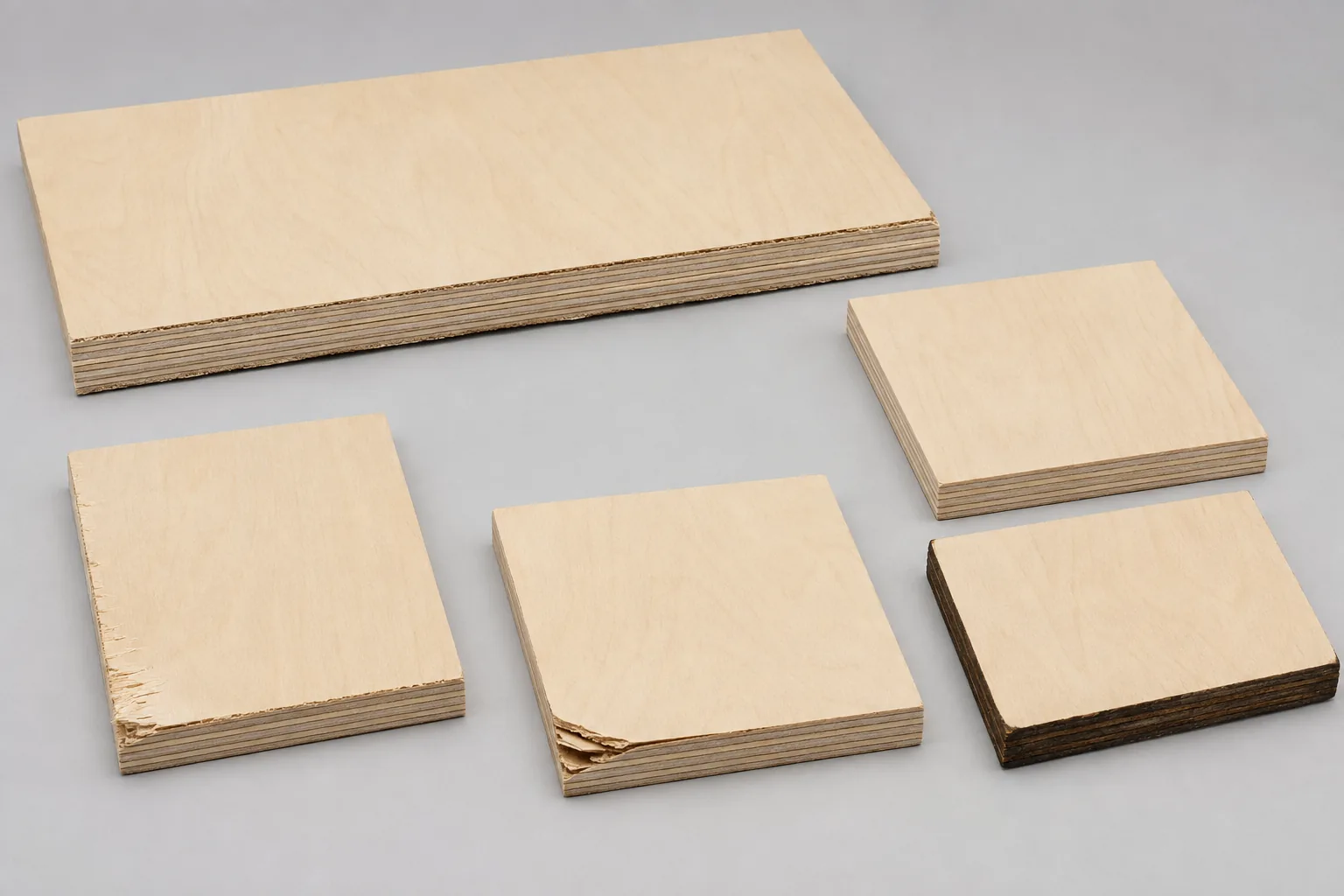
Plywood alternates veneer grain direction across resin-bonded plies, so a perimeter cut repeatedly changes from along-grain to cross-grain cutting. Face support, scoring strategy and tool condition determine whether the visible veneer stays attached while the thicker core remains square.
Updated
Where This Cutting Application Appears
Post-press panel squaring
Removes uneven press margins and brings plywood panels to controlled rectangular dimensions.
Furniture and cabinet blank sizing
Cuts finished panels before drilling, edge banding or machining, with visible-face breakout limits defined.
Packaging and structural panel conversion
Produces repeated blanks from thicker plywood where ply voids and core overlap must be considered.
Panel Edge Trimming process boundary
panel edge trimming for plywood panels is planned around removal of a defined excess allowance to establish a finished edge, end or perimeter without changing the intended main part geometry; it is not multi-width slitting, primary blank formation or general material size reduction.
Panel Edge Trimming setup checkpoint
For plywood panels, confirm trim allowance, finished datum, local support, positional control, part orientation and reliable removal of narrow or irregular waste.
Panel Edge Trimming acceptance checkpoint
For plywood panels, evaluate final dimension and edge position, straightness or contour continuity, burr or fray, surface damage and uninterrupted waste removal.
Define the Required Cut Result
- Square panel with parallel opposite edges
- Low breakout on both face veneers
- Bonded plies retained at the perimeter
- Stable size without edge burn
Problems to Diagnose Before Changing the Knife
Exit-face splintering
- Identify face-grain direction
- Check scoring or backing support
- Inspect tooth or edge condition
Ply separation at the corner
- Inspect glue-line quality and voids
- Review cut sequence around the panel
- Support corners through tool exit
Burned or glazed edge
- Check feed rate and tool sharpness
- Remove resin buildup
- Verify tool runout and panel restraint
Out-of-square panel
- Calibrate guides and stops
- Measure spindle or beam alignment
- Check whether the panel shifts between opposing cuts
Knife Forms That May Be Considered
| Possible knife form | When it may be considered | What must be confirmed |
|---|---|---|
| toothed circular panel cutter | A guided circular cutter suits continuous or indexed sizing when tooth geometry addresses alternating grain and bonded plies. | Confirm final geometry and mounting from the plywood panel-sizing spindle, an unworn sample or an approved drawing before manufacture. |
| scoring and main cutter pair | A shallow scoring pass may protect the exit face ahead of the main cut on lines designed for two-tool operation. | Confirm final geometry and mounting from the panel saw scoring unit, an unworn sample or an approved drawing before manufacture. |
| straight panel shear knife | May suit selected thin plywood grades with full support if shear deformation and veneer marking are acceptable. | Confirm final geometry and mounting from the thin-panel shear, an unworn sample or an approved drawing before manufacture. |
Information to Send for Technical Review
You do not need to know the exact blade name. Send the available workpiece, machine, current-knife and cut-result information so the application can be reviewed against a drawing or sample.
- Panel saw or trim-line model
- Wood species and plywood construction
- Panel thickness and ply count
- Face veneer grade, grain direction and coating
- Incoming margin and finished dimensions
- Feed speed, scoring unit and dust extraction
- Marked breakout, delamination and burn samples
- Tool dimensions, quantity and production schedule
Questions About This Cutting Application
Why does only the bottom plywood face splinter?
It is commonly the unsupported exit face; verify tool rotation, scoring depth, backing and face orientation.
Do more plies always make a cleaner edge?
Not necessarily. Veneer quality, voids, glue lines, grain angle and tooling condition all affect the cut.
What causes corners to delaminate after trimming?
Cut sequence, weak bonding, unsupported exit or handling impact can open the outer plies at a corner.
Can coated plywood use the same cutter as raw panels?
The surface layer may change abrasion, heat and visible-chip limits, so provide the exact coated panel for review.
How should squareness be reported?
State the reference edges, panel support condition and diagonal or angular measurement method.
Related product and service information
- Reducing Wood Offcuts to Controlled Chips - wood slabs, offcuts and chips · chipping and size reduction
- Clipping Natural Wood Veneer Sheets - natural wood veneer sheets · clipping and edge joint preparation
- Sizing MDF and HDF Panels - MDF and HDF panels · panel sizing
Request a Custom Cutting-Knife Review
Send the workpiece details, machine or holder information, current knife photos or sample, required quantity and examples of the present cut problem. Final dimensions, material, edge geometry and tolerances are confirmed from the approved requirements.