
Blade Application Guides / Application Guide / veneer processing
Clipping Natural Wood Veneer Sheets
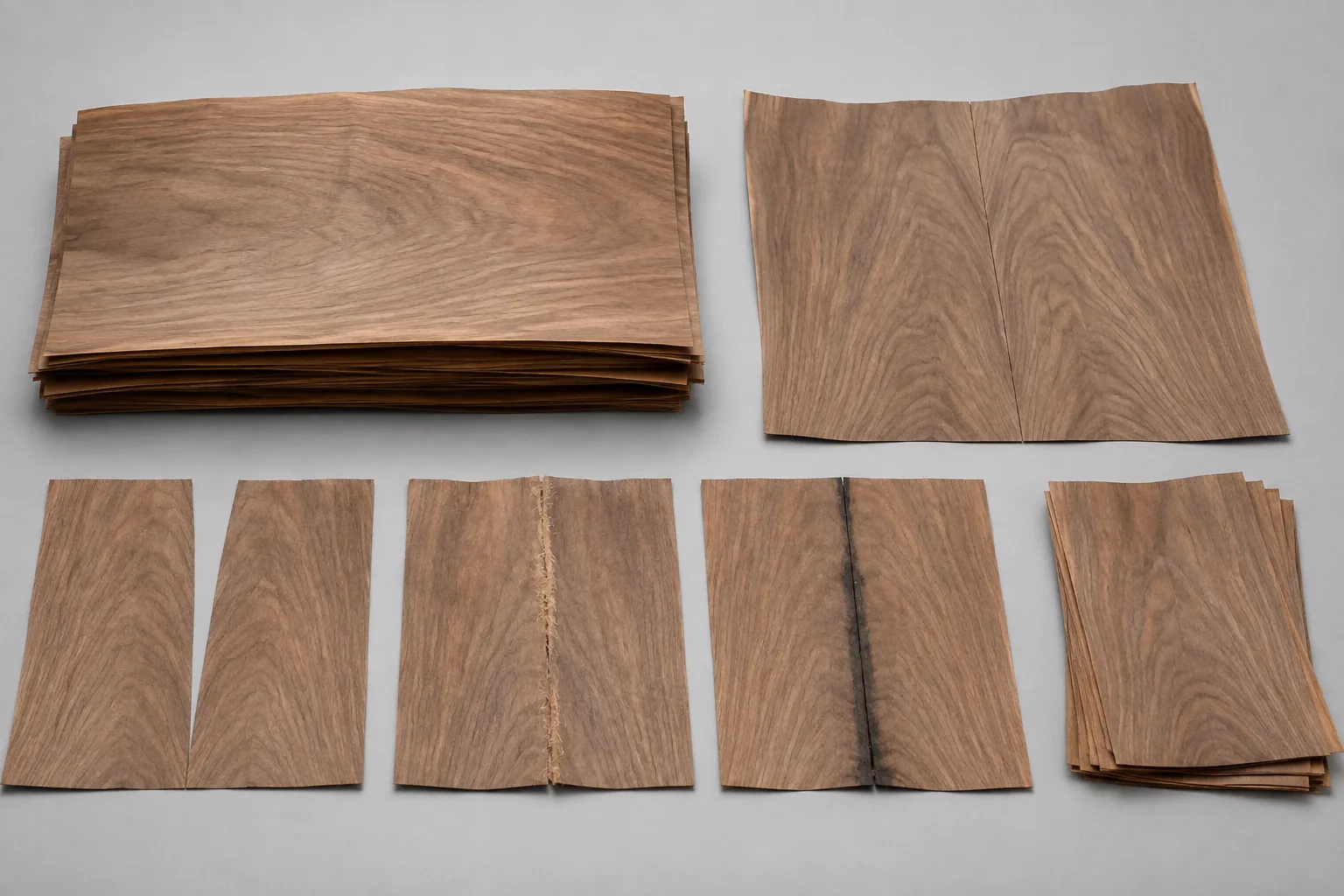
Natural veneer leaves vary in species, moisture, grain slope and local defects even within one flitch. Clipping for jointing must create a straight, closed edge through the entire bundle without crushing soft earlywood or pulling sloped grain away from the intended line.
Updated
Where This Cutting Application Appears
Book-matched face preparation
Clips paired leaves so adjacent edges close consistently before taping or stitching.
Veneer bundle width correction
Straightens flitch edges through a controlled stack while preserving leaf order and match.
Decorative layup component cutting
Produces narrow bands or field pieces for doors, furniture panels and architectural faces.
Clipping And Edge Joint Preparation process boundary
clipping and edge joint preparation for natural wood veneer sheets is a linked sequence: the output condition and datum from each operation become the controlled input for the next. It should not be evaluated as one generic cut or accepted only by the final dimension.
Clipping And Edge Joint Preparation setup checkpoint
For natural wood veneer sheets, define the operation order, intermediate dimensions, registration transfer, material support, web or part handling and waste route for every stage of clipping and edge joint preparation.
Clipping And Edge Joint Preparation acceptance checkpoint
Verify both intermediate and final results from clipping and edge joint preparation, including dimensions, registration, edge or feature quality, material damage, waste separation and stable transfer between stages.
Define the Required Cut Result
- Closed joint line without daylight
- Straight edge through every leaf
- Low grain tear and fiber crush
- No bundle shift or leaf-order loss
Problems to Diagnose Before Changing the Knife
Open joint after matching
- Check knife straightness and bed alignment
- Inspect edge squareness through bundle height
- Condition leaves to the specified moisture
Grain tears ahead of the knife
- Identify grain runout and burl areas
- Review cutting direction for the flitch
- Inspect edge angle and sharpness
Dark or crushed clipping line
- Reduce excessive hold-down pressure
- Check for a blunt or burnished knife edge
- Compare earlywood and latewood response
Leaves shift within the bundle
- Check stack height and leaf curl
- Inspect clamp coverage and pressure
- Align the bundle against a reliable datum
Knife Forms That May Be Considered
| Possible knife form | When it may be considered | What must be confirmed |
|---|---|---|
| single straight veneer clipper knife | A rigid full-length edge suits one-sided clipping where the bed, beam and hold-down establish joint straightness. | Confirm final geometry and mounting from the veneer clipper beam, an unworn sample or an approved drawing before manufacture. |
| paired veneer clipper knives | Opposed knives may trim both bundle edges in machines built for double-knife joint preparation. | Confirm final geometry and mounting from the double-knife veneer clipper, an unworn sample or an approved drawing before manufacture. |
| segmented straight knife | Segments may be considered only when the clipper is designed to maintain a continuous joint line across supported sections. | Confirm final geometry and mounting from the segmented veneer clipping beam, an unworn sample or an approved drawing before manufacture. |
Information to Send for Technical Review
You do not need to know the exact blade name. Send the available workpiece, machine, current-knife and cut-result information so the application can be reviewed against a drawing or sample.
- Clipper manufacturer, model and cutting length
- Wood species and flitch identification
- Veneer thickness and bundle height
- Moisture range and conditioning method
- Grain direction, figure and known defects
- Jointing method and closed-joint acceptance
- Marked torn, crushed and open-joint samples
- Knife dimensions, hole pattern, quantity and delivery date
Questions About This Cutting Application
Why do veneer joints close at one end but open at the other?
Knife-to-bed alignment, bundle slip, leaf curl or inconsistent conditioning can create an edge that is not straight through the stack.
Should burl veneer be clipped in the same direction as straight grain?
Burl and reversing grain may tear in multiple directions; trial the actual flitch and document the better orientation.
Can higher clamp pressure stop every bundle from shifting?
Too much pressure can crush veneer or lock in curl, so clamp coverage, stack height and moisture must be balanced.
How is clipping quality checked before gluing?
Pair the intended leaves under light, verify closure along the full joint and inspect both faces for crushed or pulled fibers.
Can a chipped clipper knife be locally repaired?
A local defect can print through every leaf; evaluate remaining section, straightness and the approved regrinding limit before reuse.
Related product and service information
- Trimming Oriented Strand Board Edges - oriented strand board · edge trimming and sizing
- Trimming Plywood Panel Edges - plywood panels · panel edge trimming
- Sizing MDF and HDF Panels - MDF and HDF panels · panel sizing
Request a Custom Cutting-Knife Review
Send the workpiece details, machine or holder information, current knife photos or sample, required quantity and examples of the present cut problem. Final dimensions, material, edge geometry and tolerances are confirmed from the approved requirements.