
Blade Application Guides / Application Guide / Wind-turbine blade manufacturing
Wind-Blade Lightning-Protection Foil Edge-Trimming Blades
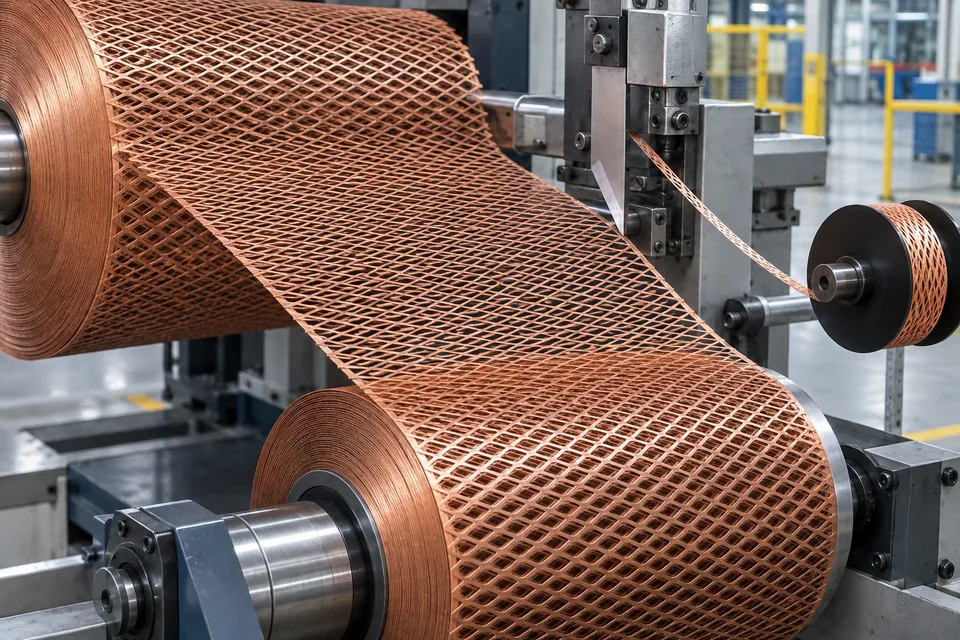
PPG and CThru identify expanded copper or aluminum foil mesh used in wind-blade lightning-protection systems. CThru describes coil formats, slitting and cut-to-length services. Edge trimming of such a coil is a specific longitudinal repair or sizing step: one narrow outside strip is removed while the principal mesh web remains. It is not the initial slit-and-stretch manufacturing operation that creates expanded metal and not the final shape of a blade lightning layer. The blade drawing must authorize the final width and connection or overlap area before an edge is discarded.
Updated
Where This Cutting Application Appears
Document why an edge is removed
Inspect the incoming coil for a bent strand, incomplete outer cell, handling damage or a width outside the approved allowance. Record affected side and required retained width. Verify that trimming will not remove a designed connection land or reduce mesh overlap in the blade layup. If the defect extends inside the permitted strip, ask for a disposition rather than silently widening the cut.
Guide and capture the narrow waste
Support the open mesh close to the longitudinal trim line. A slender scrap ribbon can curl, snag a diamond or pull a metal strand from the retained web. Choose a blade arrangement only after a coupon trial on the actual copper or aluminum pattern. Collect loose metallic fragments so they do not migrate onto laminate reinforcements.
Inspect pattern integrity
Check the new edge for hooks, sharp burrs, missing junctions and cell stretch. Measure retained width along the rewound coil and compare with the untouched edge. Confirm that the tool did not flatten or deform the nearby mesh diamonds. Inspect the removed strip to understand whether the defect has been completely separated.
Preserve the blade-zone identity
Label metal, expanded pattern, lot, trimmed side and usable width. Package the roll without crushing the new edge. Do not claim that a visually cleaner edge improves electrical performance; the connection layout and blade lightning design remain controlling.
Verify at layup
Unwind a test length and place it on the intended blade laminate fixture. Check that the trimmed side conforms, overlaps adjacent material as drawn and can reach specified conductor interfaces. A cut that passes the bench inspection but catches on composite fabric in layup is not ready for production. If supplier edge markings identify the metal grade, mesh pattern or intended blade zone, transfer that information to the retained roll before the marked margin is cut away. A trimmed width with lost identification should be treated as a traceability problem even if every diamond opening looks sound.
Define the Required Cut Result
- Remove only an authorized outer mesh strip.
- Keep required overlap and connection width.
- Limit hooks, burrs and loose metal fragments.
- Record affected side and source lot.
Problems to Diagnose Before Changing the Knife
Waste ribbon snags the retained mesh
- Control waste path before increasing speed.
- Inspect diamond pattern near the knife.
- Stop if strands pull inward.
Trimmed roll is narrower than the layup needs
- Measure after rewinding.
- Compare with connection and overlap drawing.
- Record actual width and disposition.
Knife Forms That May Be Considered
| Possible knife form | When it may be considered | What must be confirmed |
|---|---|---|
| Guided longitudinal edge blade | For a narrow authorized cut with adequate mesh support. | Check hooks, fragments and retained width. |
| Paired shear edge station | If actual mesh pattern passes a shear trial. | Inspect both faces and layup handling. |
Information to Send for Technical Review
You do not need to know the exact blade name. Send the available workpiece, machine, current-knife and cut-result information so the application can be reviewed against a drawing or sample.
- Approved copper/aluminum mesh pattern
- Incoming and minimum usable width
- Affected side and authorized trim margin
- Connection and overlap drawing
- Hook, burr and fragment criteria
Questions About This Cutting Application
Is edge trimming the same as making multiple rolls?
No. It removes a narrow outside strip while retaining the main web.
Is this how expanded mesh is manufactured?
No. Expansion uses slit and stretch before this conversion step.
Can every edge defect be trimmed away?
Only when enough qualified width remains.
Does a clean edge certify lightning performance?
No. Final system design and electrical testing remain separate.
Public references and scope
These public sources provide material, cutting-method or safety context for this guide. Supplier pages describe their own materials or equipment; they do not establish a MEIRENTE blade specification or performance claim. Confirm the actual grade, machine setup and required cut with a drawing or sample.
Related product and service information
- Wind-Blade Lightning-Protection Foil Roll Slitting Blades - wind-blade lightning-protection foil · roll slitting
- Blade-Root Reinforcement Fabric Edge-Trimming Blades - blade-root reinforcement fabric · edge trimming
- Wind-Blade Structural Adhesive Film Edge-Trimming Blades - wind-blade structural adhesive film · edge trimming
Request a Custom Cutting-Knife Review
Send the workpiece details, machine or holder information, current knife photos or sample, required quantity and examples of the present cut problem. Final dimensions, material, edge geometry and tolerances are confirmed from the approved requirements.