
Blade Application Guides / Application Guide / rubber extrusion
Cutting Extruded Rubber Profiles to Length
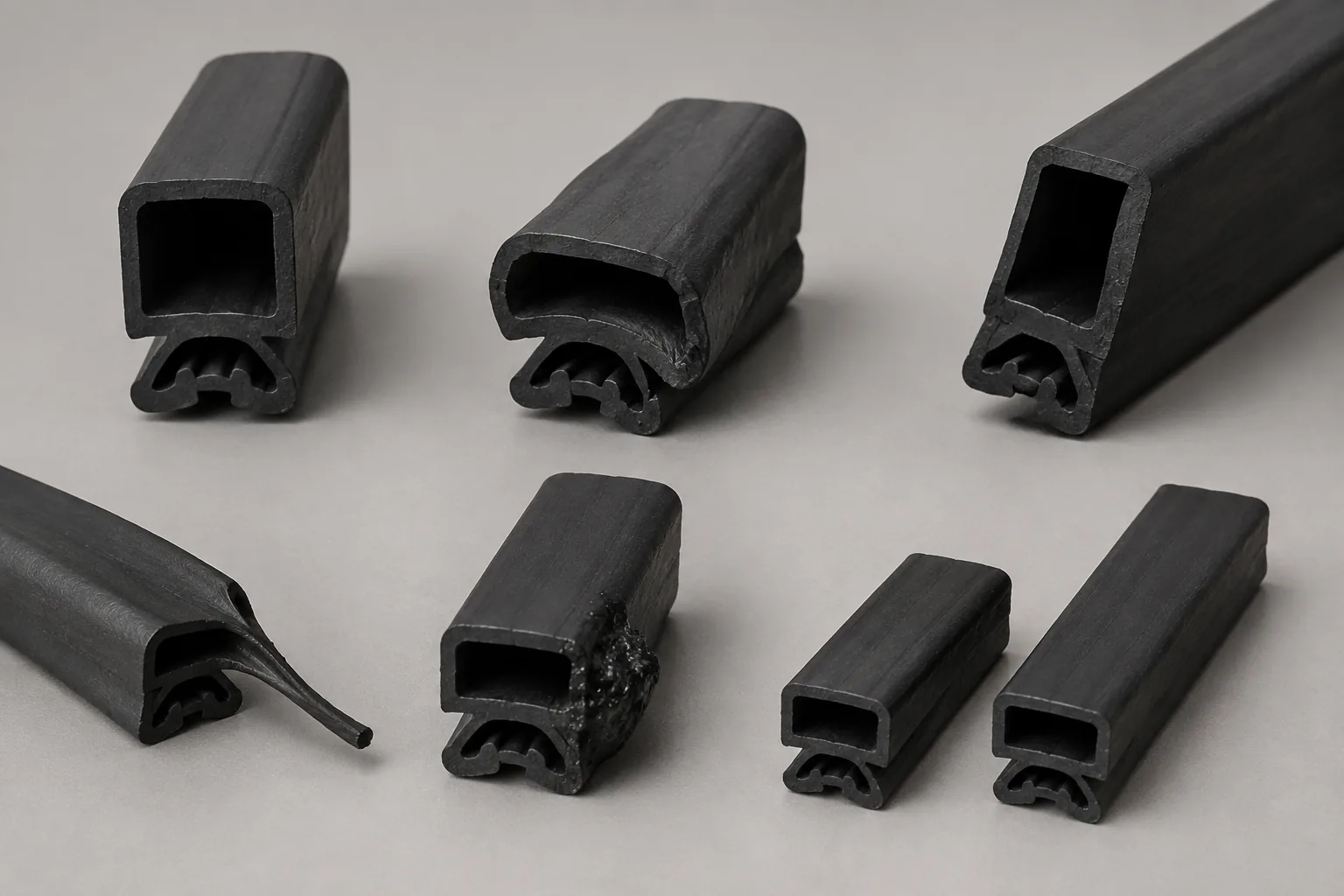
A warm extruded profile can be soft, tacky and dimensionally unstable as it leaves the die. Accurate cutoff depends on synchronizing the stroke with the line, supporting the full cross-section and defining when length and end-face quality are measured.
Updated
Where This Cutting Application Appears
Flying cutoff after extrusion
Separates a continuously moving profile without interrupting line speed when the cutoff carriage tracks the extrudate.
Indexed seal and weatherstrip cutting
Cuts stopped lengths for seals, channels or weatherstrips after a puller or measuring unit positions the profile.
Hollow-profile changeover
Reassesses support and entry when a new cross-section has thin walls, internal cavities or soft lips that can collapse.
In-Line Cut-To-Length process boundary
in-line cut-to-length for extruded rubber profiles is planned around separation across the material flow or part axis to establish a controlled repeat length or finished end; it is not longitudinal width conversion, shaped contour production or particle-size reduction.
In-Line Cut-To-Length setup checkpoint
For extruded rubber profiles, confirm target length, datum or registration reference, feed indexing, support on both sides, cut timing and post-cut transfer.
In-Line Cut-To-Length acceptance checkpoint
For extruded rubber profiles, evaluate length distribution, squareness or cutoff angle, both cut faces, deformation, registration drift and stacking or discharge consistency.
Define the Required Cut Result
- Square end faces across the entire profile
- Specified length after cooling and relaxation
- No crushing of hollow chambers or sealing lips
- Clean release with manageable rubber deposits
Problems to Diagnose Before Changing the Knife
Crushed profile section
- Check support inserts or nests against the actual cross-section
- Reduce unnecessary hold-down and penetration load
- Measure profile temperature and wall stiffness at cutoff
Angled end face
- Verify carriage synchronization or full feed stop
- Inspect guide play and knife parallelism
- Compare the angle through thick and thin parts of the profile
Profile stretch
- Check puller tension immediately before the knife
- Define measurement after cooling and relaxation
- Look for a slicing action that drags unsupported lips
Rubber buildup
- Record compound tack and surface treatment
- Inspect finish and temperature of the cutting edge
- Establish a safe, process-approved cleaning interval
Knife Forms That May Be Considered
| Possible knife form | When it may be considered | What must be confirmed |
|---|---|---|
| straight cutoff knife | Fits many clamped or supported profiles when the machine provides a rigid stroke and a shaped backing nest. | Confirm the mounting dimensions, cutting motion and edge details from the rubber extrusion cutoff equipment, an unworn sample or an approved drawing before manufacture. |
| serrated knife | May provide a lower-force slicing entry for soft sections, provided tooth marks and residue retention remain acceptable. | Confirm the mounting dimensions, cutting motion and edge details from the rubber extrusion cutoff equipment, an unworn sample or an approved drawing before manufacture. |
| supported shear pair | May control displacement when the extrudate can be located between matched edges without crushing its cross-section. | Confirm the mounting dimensions, cutting motion and edge details from the rubber extrusion cutoff equipment, an unworn sample or an approved drawing before manufacture. |
Information to Send for Technical Review
You do not need to know the exact blade name. Send the available workpiece, machine, current-knife and cut-result information so the application can be reviewed against a drawing or sample.
- Extrusion line and cutoff unit make and model
- Profile drawing with cavities, lips and datum dimensions
- Compound, hardness and temperature at the knife
- Line speed, cutoff cycle and flying-carriage details
- Support nest, clamp and puller arrangement
- Length tolerance and defined cooling or relaxation time
- Required end-face quality and allowed tooth marks
- Existing knife sample, quantity and delivery destination
Questions About This Cutting Application
Why is a rubber profile square when cut but angled after cooling?
Uneven tension, temperature or elastic recovery across the cross-section can change the face after release. Compare hot and conditioned measurements.
How should a hollow profile be supported?
The support should follow load-bearing regions without collapsing thin walls. Provide the cross-section and current nest details so support and knife entry can be reviewed together.
Is a serrated knife always better for soft rubber?
No. It may lower entry force but can leave tooth marks and hold residue. The required end finish and cleaning practice determine whether it is appropriate.
What causes length variation on a flying cutoff?
Check carriage synchronization, encoder resolution, puller slip and the defined measurement temperature before attributing variation to the knife.
Can one knife cover several profile sizes?
Only when the holder, stroke, support and cut-quality requirements overlap. Confirm each cross-section and working range before approving a common knife.
Related product and service information
- Cutting Uncured Tire Tread Rubber Strips - uncured tire tread rubber strips · cross-cutting tread strips
- V-Belt and Timing Belt Cut-to-Length Processing - V-belts and timing belts · cut-to-length separation and end preparation
- Cutting Carpet Tiles to Size - carpet tile stock · square cutting and sizing
Request a Custom Cutting-Knife Review
Send the workpiece details, machine or holder information, current knife photos or sample, required quantity and examples of the present cut problem. Final dimensions, material, edge geometry and tolerances are confirmed from the approved requirements.