
Blade Application Guides / Application Guide / Hydrogen equipment manufacturing
Titanium Porous Transport Layer Edge Trimming Blades
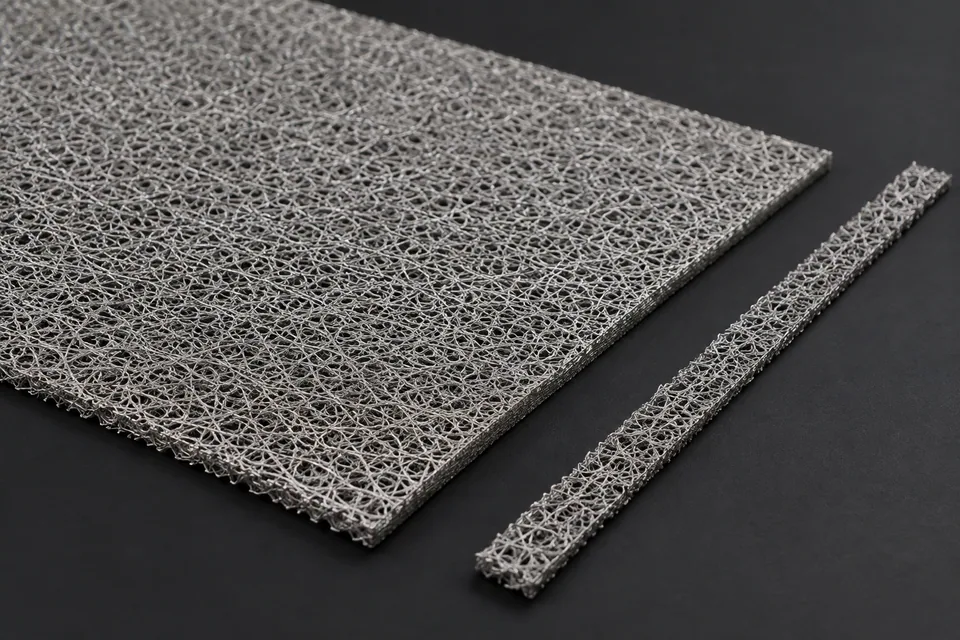
Edge trimming removes a defined outer margin from a titanium porous transport layer sheet. It establishes a straighter or cleaner boundary while leaving the main sheet in place, unlike contour cutting that releases a complete component profile. The stock may be porous, coated or surface-treated, so a trial must look beyond trim width. Compare the retained edge with an uncut control for compressed pores, torn ligaments and particle release, and confirm that the trimmed boundary stays outside any functional or sealing area specified by the stack owner.
Updated
Where This Cutting Application Appears
Define the sacrificial margin
Show the intended trim line, retained width and minimum distance to coated or active areas on the buyer’s drawing. An unmarked margin cannot be assumed safe to remove.
Support while removing a narrow strip
Inspect guidance and backing close to the cut so the porous sheet does not bend or drag. Record the trim takeoff path; a narrow, stiff strip can snag and damage the retained sheet.
Examine the retained boundary
Measure straightness or edge location and inspect local porosity and particles. Sample several positions along the cut, including start and stop, because the entry point may be different from steady running.
Check downstream handling
Transport a trial piece through the intended cleaning or assembly handling. Reinspect for loose fragments or coating damage, rather than approving only the immediate knife exit.
Define the Required Cut Result
- Remove only the specified outer margin.
- Keep the retained boundary within drawing and seal-zone limits.
- Minimize local pore deformation and loose particles.
- Extract the trim without scratching the functional sheet.
Problems to Diagnose Before Changing the Knife
Retained edge has crushed pores
- Check blade condition and support pressure.
- Inspect actual tool clearance or backing position.
- Compare edge cross-section with untouched stock.
Narrow trim catches at discharge
- Review strip width, curl and takeoff direction.
- Inspect scrap guides for snag points.
- Observe start and stop behavior separately.
Particles appear only after movement
- Inspect the cut boundary under the buyer’s handling test.
- Review any cleaning or vibration step.
- Distinguish stock debris from newly generated edge fragments.
Knife Forms That May Be Considered
| Possible knife form | When it may be considered | What must be confirmed |
|---|---|---|
| Straight shear edge pair | For a linear trim on a compatible sheet-cutting line. | Confirm backing, actual clearance, edge sample and trim discharge with the PTL stock. |
| Guided rotary edge-trim pair | Only if the installed feed line supports a paired rotary shear on this porous titanium grade. | Confirm feed support, tool geometry, trim width and retained-edge condition. |
Information to Send for Technical Review
You do not need to know the exact blade name. Send the available workpiece, machine, current-knife and cut-result information so the application can be reviewed against a drawing or sample.
- Actual PTL construction, thickness and titanium grade
- Surface treatment or coating side and protected zones
- Incoming sheet width and desired retained width
- Trim-line drawing and accepted edge/particle samples
- Feed support and knife station drawings
- Current clearance, guidance and trim takeoff
- Cleaning, handling and assembly sequence
- Trial inspection positions along the edge
Questions About This Cutting Application
Does edge trimming create the finished stack profile?
Usually it only removes an outside margin. If the component needs a shaped perimeter or openings, define those separately as contour cuts.
Why inspect porosity near the trimmed edge?
A dimensional pass may conceal local compression or torn ligaments in porous stock.
Is coating damage relevant if the cut is outside the active area?
It depends on the buyer’s drawing and handling rules. Identify the protected zone and inspect any adjacent coating.
What does a trim trial need to record?
Record retained width, edge location, particle condition, trim movement and the support/knife settings that produced the sample.
Public references and scope
These public sources provide material, cutting-method or safety context for this guide. Supplier pages describe their own materials or equipment; they do not establish a MEIRENTE blade specification or performance claim. Confirm the actual grade, machine setup and required cut with a drawing or sample.
Related product and service information
- Aluminum Battery-Tab Stock Cut-to-Length Blades - aluminum battery-tab stock · cut to length
- Electrolyzer Catalyst Decal Film Edge Trimming Blades - electrolyzer catalyst decal film · edge trimming
- PEM Electrolyzer Membrane Edge-trimming Blades - PEM electrolyzer membrane · edge trimming
Request a Custom Cutting-Knife Review
Send the workpiece details, machine or holder information, current knife photos or sample, required quantity and examples of the present cut problem. Final dimensions, material, edge geometry and tolerances are confirmed from the approved requirements.