
Blade Application Guides / Application Guide / Hydrogen equipment manufacturing
Electrolyzer Catalyst Decal Film Edge Trimming Blades
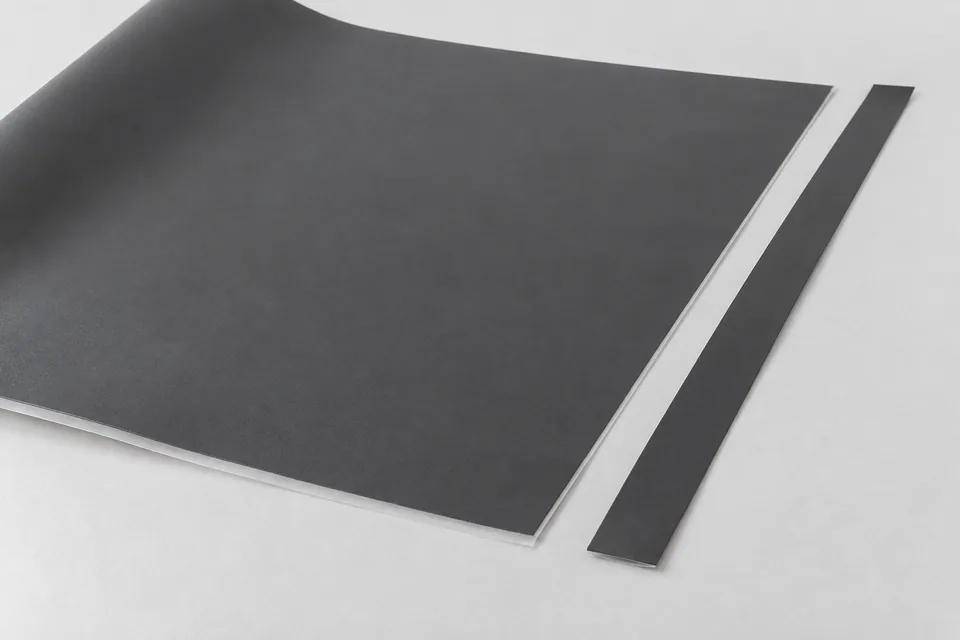
Edge trimming removes a narrow, specified border from an electrolyzer catalyst decal film while retaining the main sheet or lane. The cut should be defined relative to the coated patch and later transfer datum. It is neither a set of multiple longitudinal lanes nor a closed profile around an individual decal. Coating may be close to the border, and the substrate can have different mechanical behavior from its dried catalyst layer. Trial the actual construction, then inspect retained-edge position, layer integrity, trim movement and surface contact.
Updated
Where This Cutting Application Appears
Set the retained border
Map coated area, trim line and allowed setback on each side. State whether the objective is to remove uncoated margin, a defective edge or a registration strip; these lead to different acceptance checks.
Support the retained film
Guide the sheet without contacting its active face. Monitor curl or edge lift where the catalyst layer ends, and distinguish a pre-existing coating defect from one created by the trim.
Control scrap strip movement
Observe narrow trim at entry, steady cutting and exit. Catching or wrapping can pull on the retained decal and create cracks away from the blade.
Verify transfer-ready dimensions
Measure retained width and catalyst setback at multiple places along the sheet. Protect orientation and sample both faces; the edge may be correct while the patch-to-edge relationship drifts.
Define the Required Cut Result
- Remove only the specified outer margin.
- Preserve the agreed catalyst-to-edge setback.
- Avoid coating flakes and face marks on the retained sheet.
- Discharge trim without tugging or contaminating the decal.
Problems to Diagnose Before Changing the Knife
Coating flakes next to the trimmed edge
- Check actual setback and whether the cut enters the coating.
- Inspect support and blade condition.
- Compare with pre-cut coating-edge samples.
Trim strip winds around a guide
- Review trim width, static and takeoff path.
- Inspect guide geometry and start/stop behavior.
- Check whether pulling distorts the retained edge.
Retained width passes but patch offset fails
- Check original patch placement and sheet alignment.
- Measure both edges from the transfer datum.
- Review knife position after feed or roll change.
Knife Forms That May Be Considered
| Possible knife form | When it may be considered | What must be confirmed |
|---|---|---|
| Guided straight edge-trim blade | For a single outside-margin cut on a supported sheet. | Confirm coating clearance, backing and retained-edge sample. |
| Paired shear edge-trim knives | Where an existing feed line trims both sides continuously. | Confirm holder geometry, trim takeoff and patch-to-edge registration on trial stock. |
Information to Send for Technical Review
You do not need to know the exact blade name. Send the available workpiece, machine, current-knife and cut-result information so the application can be reviewed against a drawing or sample.
- Substrate and catalyst coating construction
- Patch map and permitted trim setback
- Retained width and edge-position drawing
- Accepted coating-edge and cosmetic samples
- Feed guide and knife-holder drawings
- Actual backing and trim takeoff route
- Coated-side handling and waste-accounting rules
- Inspection points across and along the sheet
Questions About This Cutting Application
Is edge trimming the same as sheet slitting?
No. Trimming removes a border; sheet slitting divides the sheet into several usable longitudinal lanes.
Can the tool be specified before the coating map is known?
No. The map determines whether the edge is cut in substrate only or near catalyst, and which setback must be inspected.
What is a useful acceptance measure?
Measure both retained width and the catalyst patch’s position relative to that edge, with coating integrity checked after handling.
Does a clean trimmed edge guarantee membrane transfer?
No. Transfer depends on the decal materials and process; the cut trial addresses dimensions and cut-induced defects.
Public references and scope
These public sources provide material, cutting-method or safety context for this guide. Supplier pages describe their own materials or equipment; they do not establish a MEIRENTE blade specification or performance claim. Confirm the actual grade, machine setup and required cut with a drawing or sample.
Related product and service information
- Electrolyzer Catalyst Decal Film Sheet Slitting Blades - electrolyzer catalyst decal film · sheet slitting
- Titanium Porous Transport Layer Edge Trimming Blades - titanium porous transport layer · edge trimming
- PEM Electrolyzer Membrane Edge-trimming Blades - PEM electrolyzer membrane · edge trimming
Request a Custom Cutting-Knife Review
Send the workpiece details, machine or holder information, current knife photos or sample, required quantity and examples of the present cut problem. Final dimensions, material, edge geometry and tolerances are confirmed from the approved requirements.