
Blade Application Guides / Application Guide / Hydrogen equipment manufacturing
PEM Electrolyzer Membrane Edge-trimming Blades
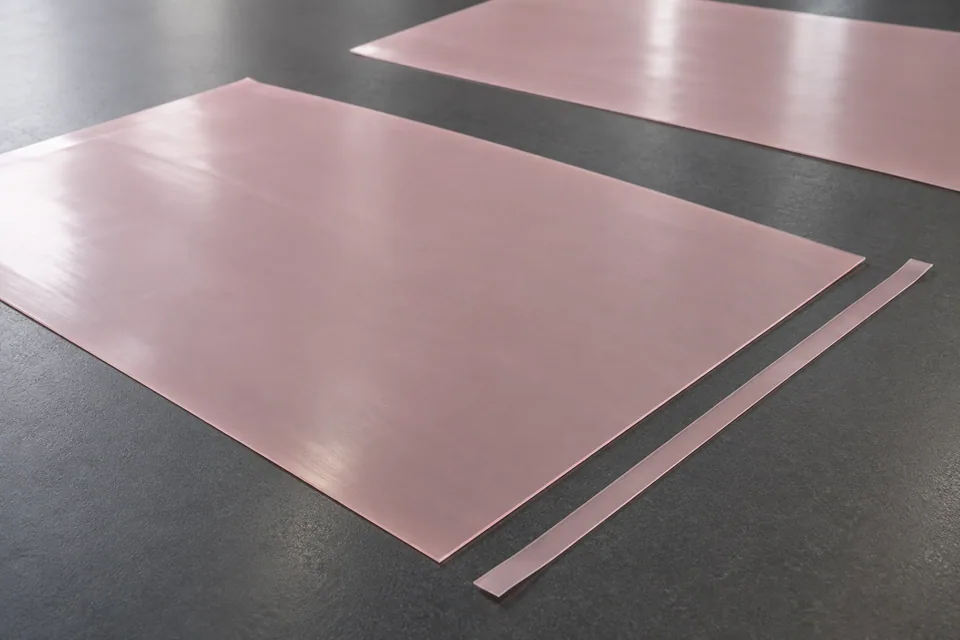
Edge trimming removes a narrow outside margin from a PEM water-electrolyzer membrane web or sheet while retaining the main usable membrane area. It is a straight boundary correction, not multi-lane slitting or a cell-profile cut. Chemours shows that some PFSA grades arrive between a backing film and coversheet, and Gore supplies electrolyzer PEM in rolls. That construction creates a practical decision before trimming: which layers are cut, which remain, and which face is allowed to contact a guide. Set the trim boundary from the later cell blank and gasket drawing. The trial should leave a continuous retained edge and should not let the waste strip scratch or pull the membrane.
Updated
Where This Cutting Application Appears
Locate the retained margin
Measure the original and intended widths, then confirm the remaining membrane will support the downstream cell outline. If only a carrier protrudes, distinguish carrier-only trimming from cutting the active membrane itself.
Keep films aligned
When backing and coversheet travel with the membrane, inspect their relative positions at the trimmed edge. A layer can remain attached but be offset enough to expose the membrane during later winding or storage.
Remove scrap cleanly
Plan the narrow waste-strip path so it does not brush the retained active surface or pull it sideways. Check for wrap, breaks and particles along the full trial length.
Check after conditioning
Inspect for nicks, curl, wrinkles and surface marks immediately after trimming and after the specified conditioning or transfer. Identify the membrane face and retain samples from both start and end of the run.
Define the Required Cut Result
- Hold the retained width and usable cell-blank margin.
- Keep membrane and protective layers in their specified alignment.
- Avoid nicks, scratches and particulate transfer at the retained edge.
- Collect outside scrap without disturbing the usable web.
Problems to Diagnose Before Changing the Knife
Protective cover recedes from the membrane edge
- Review layer tension and guide contacts.
- Check whether all layers are cut together.
- Compare incoming alignment with finished samples.
Waste strip breaks and contacts good stock
- Inspect trim width and blade condition.
- Review scrap takeoff angle and tension.
- Check the retained surface after each break.
Retained width varies
- Verify datum and lateral tracking.
- Measure several points along the trial.
- Record conditioning state during measurement.
Knife Forms That May Be Considered
| Possible knife form | When it may be considered | What must be confirmed |
|---|---|---|
| Straight edge-trim knife | For removal of a defined outside margin on a supported membrane web. | Confirm whether the tool cuts membrane, carriers or all layers and inspect the retained edge. |
| Opposed shear trim pair | Where a compatible line provides paired edges for continuous trimming. | Confirm machine geometry and trial the actual PEM grade without assuming settings from packaging film. |
Information to Send for Technical Review
You do not need to know the exact blade name. Send the available workpiece, machine, current-knife and cut-result information so the application can be reviewed against a drawing or sample.
- PEM grade and full supplied layer stack
- Incoming and required retained widths
- Downstream cell blank and gasket drawings
- Layer-cut and carrier-removal instructions
- Accepted membrane edge and cleanliness samples
- Guide contact, trim takeoff and winding layout
- Conditioning and inspection timing
Questions About This Cutting Application
What is the difference from sheet slitting?
Edge trimming discards an outside strip and keeps the main web; slitting can make several useful lanes.
Can the backing film be trimmed separately?
Only if the process drawing and material handling plan call for it. Confirm the resulting membrane exposure and registration.
How is an edge nick evaluated?
Use the buyer’s location and acceptance rules, especially relative to seal and active areas. Do not rely only on visual neatness.
Is the trimmed membrane ready for an electrolyzer stack?
It is still intermediate stock; later blanking, assembly and functional qualification remain the cell owner’s work.
Public references and scope
These public sources provide material, cutting-method or safety context for this guide. Supplier pages describe their own materials or equipment; they do not establish a MEIRENTE blade specification or performance claim. Confirm the actual grade, machine setup and required cut with a drawing or sample.
Related product and service information
- Titanium Porous Transport Layer Contour Cutting Blades - titanium porous transport layer · contour cutting
- Electrolyzer Catalyst Decal Film Edge Trimming Blades - electrolyzer catalyst decal film · edge trimming
- AEM Electrolyzer Membrane Edge-Trimming Blades - AEM electrolyzer membrane · edge trimming
Request a Custom Cutting-Knife Review
Send the workpiece details, machine or holder information, current knife photos or sample, required quantity and examples of the present cut problem. Final dimensions, material, edge geometry and tolerances are confirmed from the approved requirements.