
Blade Application Guides / Application Guide / Electronic metal converting
Aluminum Battery-Tab Stock Cut-to-Length Blades
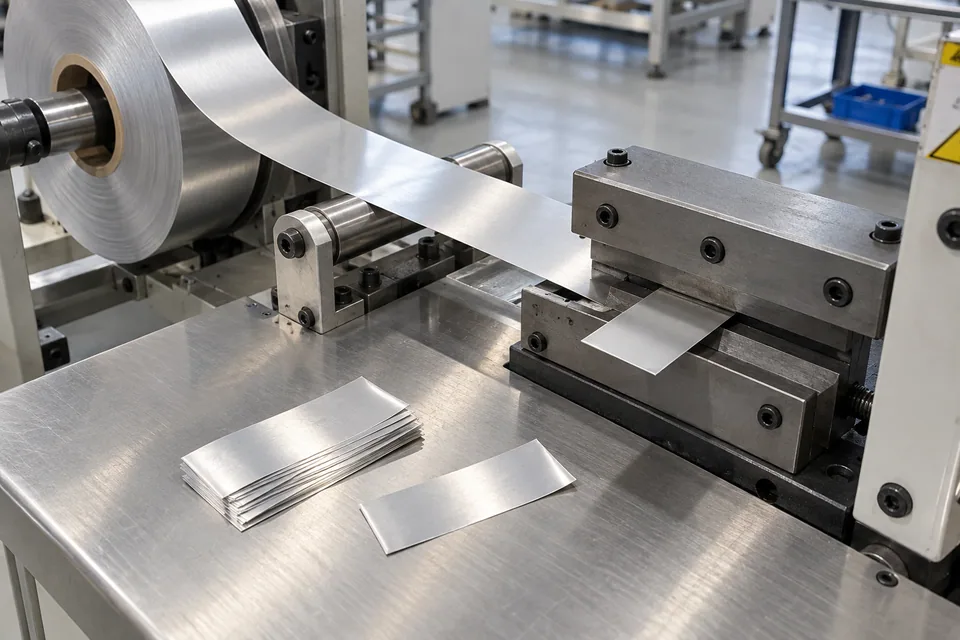
Iwatani describes aluminum foil as a cylindrical-battery cathode lead material. A battery connection strip machine supplier lists aluminum tab among materials for roll-fed cutting to length, while a foil-cutting equipment manufacturer separately lists aluminum foil and thin aluminum strip for transverse cutting. This guide concerns a buyer-approved flat rectangular length cut from uncoated aluminum lead stock. It does not describe notching the coated electrode web or sealing a finished cell lead. The accepted blank length, burr orientation and surface condition depend on the cell maker’s tab-joint design. A supported shear can be trialed on the actual foil, but the final weld, bend or sealing step must be qualified separately.
Updated
Where This Cutting Application Appears
Start from the tab route and length drawing
Record whether the length will be welded to a collector, folded, or used as a fixture coupon. Specify free length, gripping allowance and machine direction. A stock roll that is already at the required tab width needs a transverse cut only; a width change is a separate slitting task.
Stabilize the thin strip at each stroke
Feed the uncoated foil over a smooth support and trial a straight shear with hold-down appropriate to the sample. Check the outgoing blank and remaining web end for tail kick, folded lips and fine aluminum fragments. Compare cuts at the beginning and after repeated strokes for tool buildup.
Measure blanks after handling
Use the buyer’s flat fixture to check length, end squareness and curl after the strip has relaxed. Inspect both broad faces for scratches or contamination that could interfere with the later joining area. Keep a sequence of samples so feed slip or blade wear is visible.
Deliver a traceable joining input
Stack the lengths in a controlled orientation and protect the planned weld land. Record coil lot and which end came from which stroke. The cell maker evaluates resistance, weld integrity and any package-seal interaction after its complete assembly process.
Define the Required Cut Result
- Provide flat aluminum lead lengths to the released drawing.
- Control two-end burr, curl and loose particles.
- Protect designated joining surfaces.
- Keep coil and cutting-direction identity through packing.
Problems to Diagnose Before Changing the Knife
Cut end folds over
- Check hold-down and blade clearance on actual foil.
- Compare incoming coil set.
Lengths drift during a long run
- Inspect feeder registration and roll slip.
- Measure consecutive pieces, not only setup coupons.
A weld land is scratched during stacking
- Review tray and interleaf contact.
- Trace scratches to cut, transfer or packing.
Knife Forms That May Be Considered
| Possible knife form | When it may be considered | What must be confirmed |
|---|---|---|
| Supported transverse shear blades | For plain rectangular aluminum lead lengths from verified uncoated stock. | Check length, squareness, curl and both-end burr. |
Information to Send for Technical Review
You do not need to know the exact blade name. Send the available workpiece, machine, current-knife and cut-result information so the application can be reviewed against a drawing or sample.
- Aluminum lead alloy and temper
- Foil thickness, width and parent reel ID
- Rectangular blank length and machine direction
- Allowed burr, curl and particle levels
- Joining-face or weld-land map
- Feed, support and shear trial
- Stacking and identification method
- Assembly and electrical test owner
Questions About This Cutting Application
Does this guide cut a finished electrode?
No. It cuts separate uncoated aluminum lead material.
Why inspect the next web end?
Each stroke also creates the leading end of the following tab length.
Can a rectangle be treated as a sealed pouch tab?
No. Any sealant film and finished-cell qualification are separate.
What confirms a usable weld land?
The buyer must test its actual joining route on the cut material.
What is needed for a trial?
Send a roll sample, tab-length drawing, surface map and cut-end limits.
Public references and scope
These public sources provide material, cutting-method or safety context for this guide. Supplier pages describe their own materials or equipment; they do not establish a MEIRENTE blade specification or performance claim. Confirm the actual grade, machine setup and required cut with a drawing or sample.
Related product and service information
- Aluminum Battery-Tab Stock Precision Blanking Blades - aluminum battery-tab stock · precision blanking
- Rolled-Annealed Copper Foil Cut-to-Length Blades - rolled-annealed copper foil · cut to length
- Ultra-Thin Stainless-Steel Foil Cut-to-Length Blades - ultra-thin stainless-steel foil · cut to length
Request a Custom Cutting-Knife Review
Send the workpiece details, machine or holder information, current knife photos or sample, required quantity and examples of the present cut problem. Final dimensions, material, edge geometry and tolerances are confirmed from the approved requirements.