
Blade Application Guides / Application Guide / Bookbinding
Book Block Three-Side Trimming for Square Clean Edges
Three-side trimming cuts the head, foot and fore edge of a bound block after folding and binding have created an uneven stack. Spine construction, paper mix, clamp sequence and trim order influence whether pages stay registered and corners remain intact.
Updated
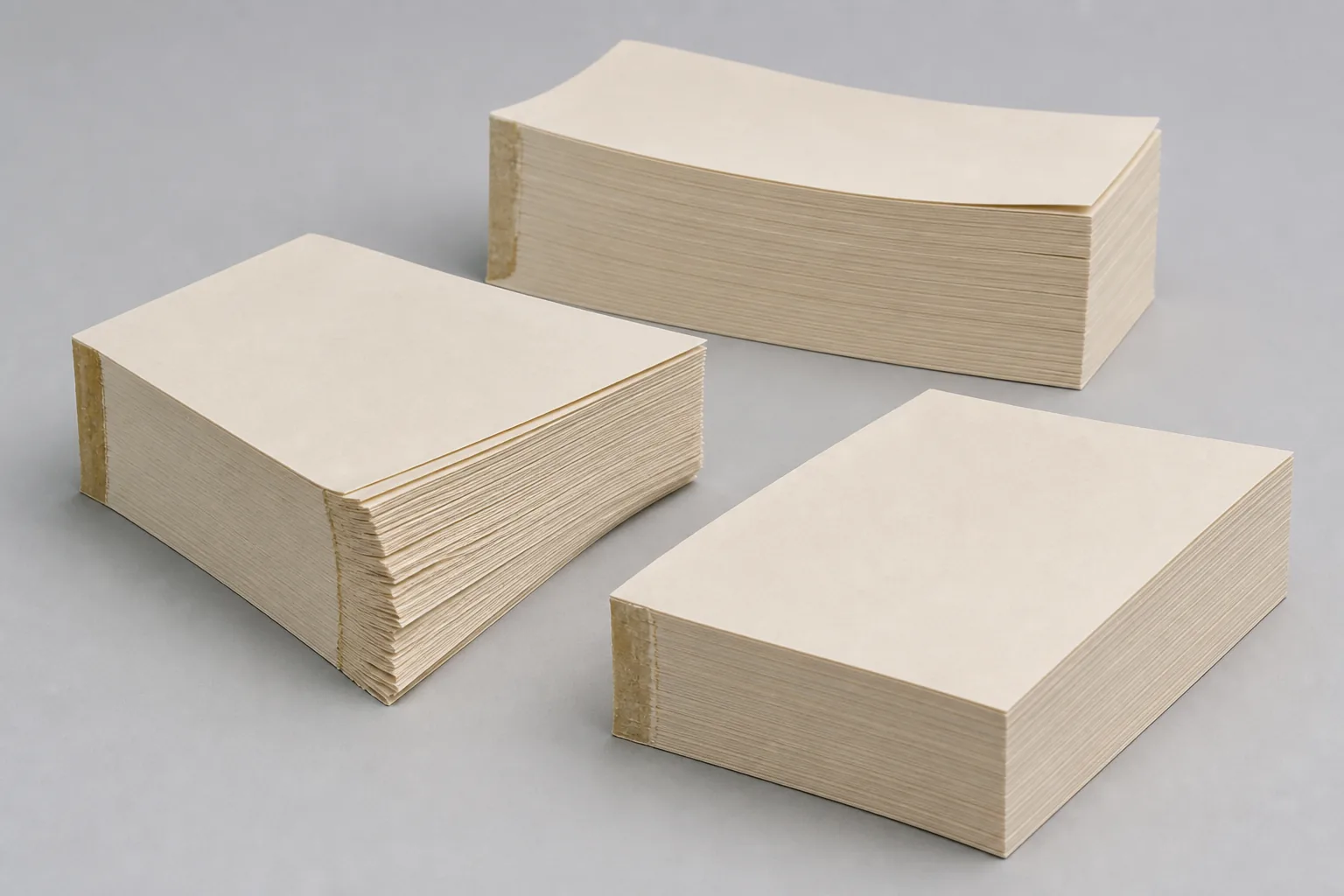
Where This Cutting Application Appears
Perfect-bound catalogue finishing
Adhesive-bound blocks are trimmed after curing, with attention to spine movement, cover scuffing and clean fore edges.
Sewn hardcover text-block preparation
Sewn signatures are squared before casing-in, where fold bulk and thread can affect stack support and final geometry.
Short-run manual and booklet trimming
Digitally printed mixed stocks are finished in smaller batches that may combine coated covers, uncoated text and variable block thickness.
Three-Side Trimming process boundary
three-side trimming for bound book blocks is planned around removal of a defined excess allowance to establish a finished edge, end or perimeter without changing the intended main part geometry; it is not multi-width slitting, primary blank formation or general material size reduction.
Three-Side Trimming setup checkpoint
For bound book blocks, confirm trim allowance, finished datum, local support, positional control, part orientation and reliable removal of narrow or irregular waste.
Three-Side Trimming acceptance checkpoint
For bound book blocks, evaluate final dimension and edge position, straightness or contour continuity, burr or fray, surface damage and uninterrupted waste removal.
Define the Required Cut Result
- Control spine movement during the trim cycle
- Maintain the required geometry for perfect-bound catalogue finishing
- Protect material integrity during three-side trimming
- Deliver a cut condition accepted by the next production step
Problems to Diagnose Before Changing the Knife
Spine movement during the trim cycle
Check adhesive cure, spine shape, clamp position, block thickness, trim sequence and whether movement begins at the first cut.
Torn corners or pulled pages
Review paper grain, fold position, cover overhang, entry and exit support, page alignment and damage location within the block.
Concave, stepped or out-of-square edges
Measure at the top, middle and bottom of the stack; then examine clamp pressure, back-gauge contact, fold bulk and cut order.
Coated cover scuff or edge chipping
Compare cover finish, protective handling, clamp surfaces, trapped debris and whether chipping is limited to the cover stock.
Knife Forms That May Be Considered
| Possible knife form | When it may be considered | What must be confirmed |
|---|---|---|
| Straight three-knife trimmer form | Consider where head, foot and fore-edge cuts follow the equipment's fixed sequence. | Confirm this form only from the bound book blocks sample, equipment interface, operating motion and approved drawing. |
| Single straight trim form | Consider for short-run equipment that indexes the book block between separate cuts. | Confirm this form only from the bound book blocks sample, equipment interface, operating motion and approved drawing. |
Information to Send for Technical Review
You do not need to know the exact blade name. Send the available workpiece, machine, current-knife and cut-result information so the application can be reviewed against a drawing or sample.
- Binding method: perfect bound, sewn, stapled or another construction
- Block height, width, thickness range and trim allowance on each side
- Text and cover paper grades, grain directions and coating finishes
- Adhesive type and curing time before trimming
- Clamp sequence, back-gauge datum and three-cut order
- Required squareness, edge appearance and allowable page movement
- Defect location by head, foot, fore edge and stack depth
- Existing cutting-part drawings or samples, equipment details and job volume
Questions About This Cutting Application
Why can the book spine shift on the first cut but not later cuts?
The first clamp and cut may seat an uneven spine or uncured adhesive differently. Record trim order, clamp position and movement after each individual cut.
How should mixed cover and text stocks be trialed?
Use a representative bound block with the actual cover coating, text paper, page count and adhesive cure. Loose paper stacks will not reproduce spine or fold behavior.
What causes torn corners on only part of the stack?
Local page misalignment, fold bulk, weak corners, cover overhang or uneven clamping may concentrate the load. Map the defect by stack depth and corner.
Which measurements show a square three-side trim?
Measure finished width and height at several positions, compare diagonals where appropriate, and inspect head and foot relative to the spine datum.
Can a cutting sample be copied for a different book format?
It can support an initial comparison, but block size, binding, trim order, mounting and acceptance criteria must be reviewed. Approve the drawing for the intended format before production.
Related product and service information
- Coated Paper Sheet Trimming Without Surface Damage - coated paper sheets · sheet trimming
- Tissue Log Cross Cutting and Compression Control - tissue logs · cross cutting
- Abrasive Paper Cutting With Controlled Grit Shedding - abrasive paper sheets · sheet cutting
Request a Custom Cutting-Knife Review
Send the workpiece details, machine or holder information, current knife photos or sample, required quantity and examples of the present cut problem. Final dimensions, material, edge geometry and tolerances are confirmed from the approved requirements.