
Blade Application Guides / Application Guide / Paperboard converting
Liquid Packaging Board Profile-Cutting Blades
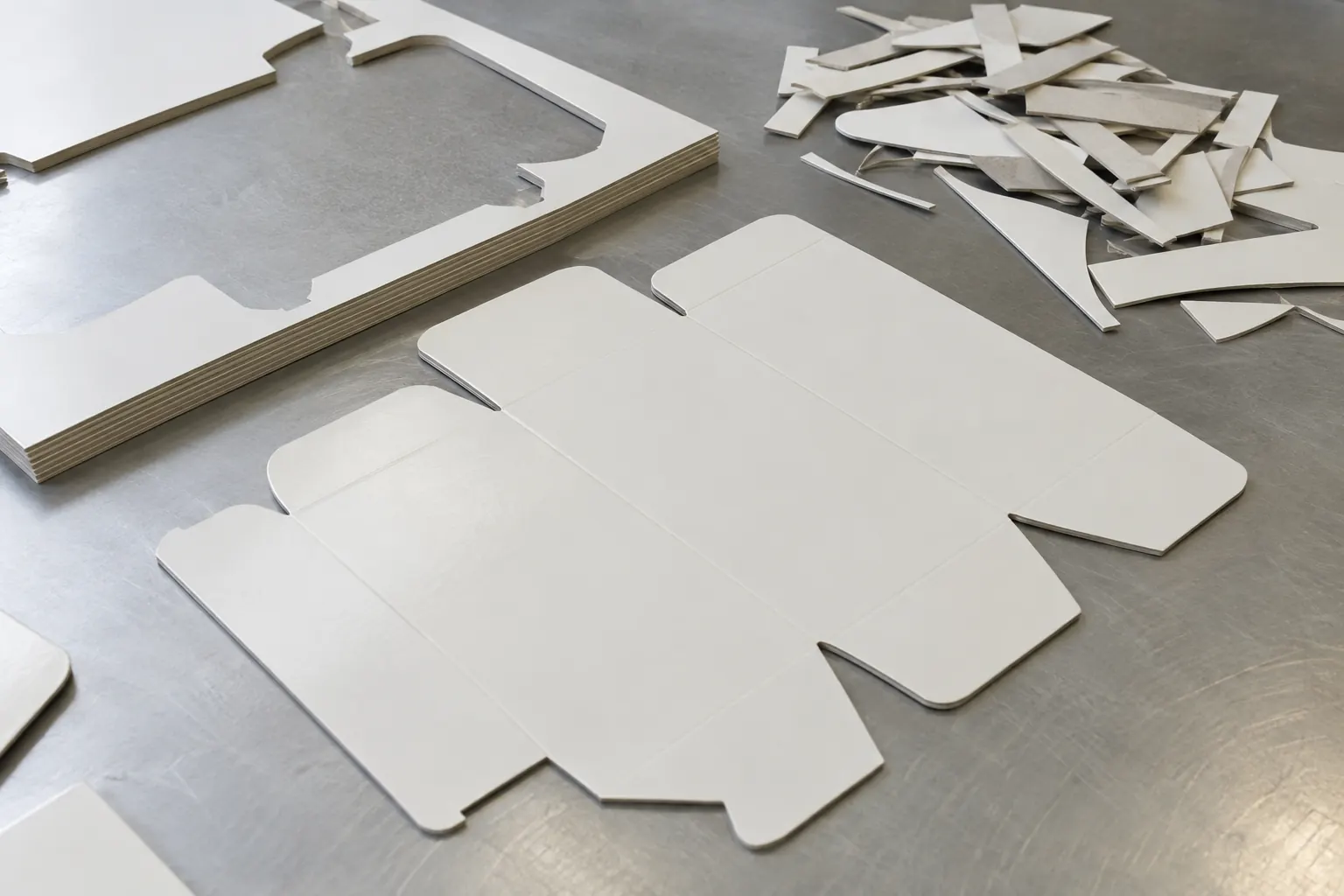
Profile cutting creates carton outlines, openings or test shapes in liquid packaging board. The board's fiber direction, barrier layers and crease relationship influence corner quality and dimensional stability, so the approved blank drawing and functional sealing zones are more informative than a material name alone.
Updated
Where This Cutting Application Appears
Carton-outline sampling
Cuts representative profiles for forming and filling trials before production tooling is finalized.
Functional opening preparation
Creates declared holes or slots while preserving nearby barrier and sealing areas.
Special-format package blanks
Produces nonrectangular board shapes whose corners and datums must align with print and crease features.
Profile Cutting process boundary
Profile cutting follows the specified finished outline, including shaped or non-rectangular boundaries; it is distinct from straight sizing and narrow edge cleanup.
Profile Cutting setup checkpoint
Review the finished outline, inside and outside radii, start and stop points, material support near corners and the method used to remove shaped waste.
Profile Cutting acceptance checkpoint
Compare the complete profile to the drawing or template, including corners, holes, narrow features, edge condition and fit in the downstream assembly.
Define the Required Cut Result
- Profile registered to print and crease datums
- Smooth radii without corner tearing or fiber breakout
- Barrier layers continuous at critical sealing zones
- Complete scrap separation without damaging the finished blank
Problems to Diagnose Before Changing the Knife
Corners tear beyond the intended outline
- Compare radius size and fiber direction
- Inspect support at transitions
- Map whether tearing begins in the fiber or barrier layer
Profile shifts relative to printed features
- Confirm registration datum and sensor reference
- Measure board stretch and feed skew
- Compare tool position with artwork revision
Small cutouts remain attached
- Locate fiber bridges and coating tails
- Review support and scrap release path
- Compare moisture and layer construction
Barrier layer cracks around tight radii
- Identify layer material and orientation
- Inspect radius and adjacent crease stress
- Evaluate conditioned samples rather than visual appearance alone
Knife Forms That May Be Considered
| Possible knife form | When it may be considered | What must be confirmed |
|---|---|---|
| profile die-cutting arrangement | May suit repeated carton outlines supported on a compatible cutting base. | Confirm the approved profile, board build, cutting base, press interface, ejection and scrap path before defining the form. |
| matched punch-and-die arrangement | May be considered for registered openings or profiles where the equipment provides controlled guidance. | Confirm clearances, datum, stroke, support and mounting only from equipment records, trials and an approved drawing. |
Information to Send for Technical Review
You do not need to know the exact blade name. Send the available workpiece, machine, current-knife and cut-result information so the application can be reviewed against a drawing or sample.
- Board construction and barrier-layer sequence
- Finished profile drawing and revision
- Print, crease and sealing-zone datums
- Fiber direction and conditioned moisture range
- Minimum radii, openings and dimensional tolerances
- Cutting base, support, motion and mounting details
- Scrap stripping and finished-blank handling method
- Accepted samples and mapped corner or coating defects
Questions About This Cutting Application
Why does profile direction matter?
Paper fibers and laminated layers may resist or extend differently across and along the machine direction, especially at corners.
Can a CAD outline alone define the tooling?
No. Board construction, datum, support, cutting motion, ejection and acceptable edge condition are also needed.
How should tight radii be approved?
Inspect dimensional accuracy, fiber breakout and barrier integrity on conditioned parts, then verify package forming and sealing.
Why do small cutouts stay connected?
Fiber bridges, stretched coating, uneven support or incomplete engagement can prevent clean scrap separation.
Should printed sheets be supplied?
Yes when registration matters; they reveal the actual relationship among artwork, creases and the profile datum.
Related product and service information
- Recycled Grey Chipboard Profile-Cutting Blades - recycled grey chipboard · profile cutting
- Solid Bleached Sulfate Board Profile-Cutting Blades - solid bleached sulfate board · profile cutting
- Honeycomb Paper Panel Profile-Cutting Blades - honeycomb paper panel · profile cutting
Request a Custom Cutting-Knife Review
Send the workpiece details, machine or holder information, current knife photos or sample, required quantity and examples of the present cut problem. Final dimensions, material, edge geometry and tolerances are confirmed from the approved requirements.