
Blade Application Guides / Application Guide / electronics and battery materials
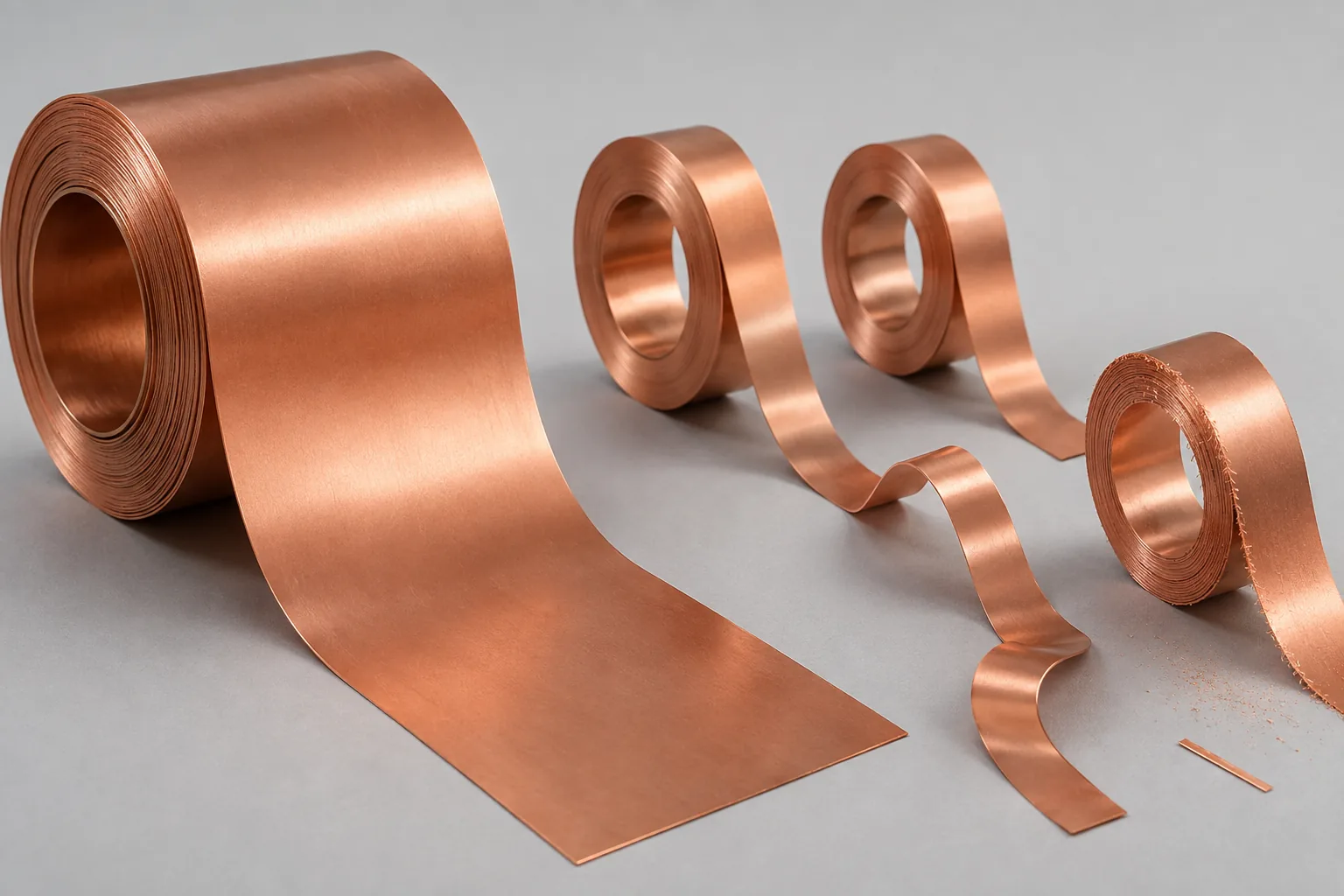
Thin Copper Foil Precision Slitting
Thin copper foil is ductile and readily develops a raised burr or stretched edge when shear clearance and knife alignment drift. Because the web also carries rolling texture and residual stress, slit quality should be evaluated together with tension, winding and the direction of the foil surface.
Updated
Where This Cutting Application Appears
Slitting rolled copper foil master coils
Produce narrow coils for electronics or battery-material conversion with controlled width and edge condition.
Trimming plated or treated copper foil
Remove process margins while avoiding scratches or particles on a functional surface.
Preparing copper foil strips for lamination
Create aligned strip edges before bonding to films, substrates or other layers.
Precision Roll Slitting process boundary
precision roll slitting for thin copper foil is planned around longitudinal width conversion of a moving roll, web, sheet or strip into controlled lanes or daughter rolls; it is not transverse length cutting, profile formation or removal of only a narrow damaged margin.
Precision Roll Slitting setup checkpoint
For thin copper foil, confirm unwind and rewind tension, lane widths, knife positions, edge guidance, core alignment, trim removal and discharge behavior.
Precision Roll Slitting acceptance checkpoint
For thin copper foil, evaluate lane width, edge condition, camber or wandering, debris, telescoping, interleaving and stable winding or downstream transfer.
Define the Required Cut Result
- Low, consistent burr on both slit edges
- Stable strip width without edge wave
- Limited metallic particles and loose slivers
- Rewind edges aligned without telescoping or curl
Problems to Diagnose Before Changing the Knife
A continuous burr forms on one edge
Check horizontal clearance, upper/lower overlap, bevel orientation, side load and whether the burr direction follows the shear setup.
The slit edge becomes wavy
Review web tension, residual stress, knife drag, side pressure and support between slitting and rewind.
Fine copper particles increase during the run
Inspect edge condition, overlap, adhesive or oxide contamination, knife contact and the position where particles appear.
Widths differ across lanes
Measure spacer stack, shaft runout, thermal change, axial movement and web steering relative to the knife set.
Knife Forms That May Be Considered
| Possible knife form | When it may be considered | What must be confirmed |
|---|---|---|
| razor slitter | A razor mode may suit very thin supported foil on equipment designed for it, with limited lateral load. | Confirm web support, blade holder, penetration, surface orientation, tension and particle acceptance through line trials. |
| paired rotary shear knife | A matched shear pair is often considered where clearance, overlap and side load can be set accurately. | Confirm upper and lower diameters, bores, thicknesses, bevels, overlap, clearance, shaft fits and rotation. |
Information to Send for Technical Review
You do not need to know the exact blade name. Send the available workpiece, machine, current-knife and cut-result information so the application can be reviewed against a drawing or sample.
- Copper foil type, nominal thickness and tolerance
- Temper or mechanical condition and rolling direction
- Surface treatment, plating or coating on each face
- Master width, slit plan and finished-width tolerance
- Line speed, tension and rewind arrangement
- Upper/lower knife and spacer drawings with setup values
- Runout, overlap and clearance measurement method
- Edge micrographs or samples showing burr, wave, slivers or scratches
Questions About This Cutting Application
Why is the burr larger on only one side of the strip?
Rotary shear creates direction-dependent edges. Map burr orientation to upper and lower knives, then check clearance and overlap.
Can more overlap reduce copper foil burrs?
Not automatically. Excess overlap can raise force, wear and edge distortion. Use the machine's controlled setting range and inspect both edges.
What causes a copper foil edge to wave after slitting?
Residual stress, tension imbalance or knife side load can stretch one margin. Compare the strip before and after rewinding.
How should burr height be specified?
Use the customer's defined measurement method, sampling positions and acceptance limit; do not rely on visual description alone.
Can a worn knife sample define a replacement set?
It helps identify interfaces, but wear cannot reveal intended clearance. Provide shaft, spacer and setup data with an approved drawing.
Related product and service information
- Gas-Diffusion Electrode Roll Precision-Trimming Blades - gas-diffusion electrode roll · precision trimming
- Battery Aluminum Foil Slitting - battery-grade aluminum foil · precision roll slitting
- Coated Battery Electrode Sheet Slitting - coated battery electrode sheets · electrode slitting
Request a Custom Cutting-Knife Review
Send the workpiece details, machine or holder information, current knife photos or sample, required quantity and examples of the present cut problem. Final dimensions, material, edge geometry and tolerances are confirmed from the approved requirements.