
Blade Application Guides / Application Guide / battery materials
Battery Aluminum Foil Slitting
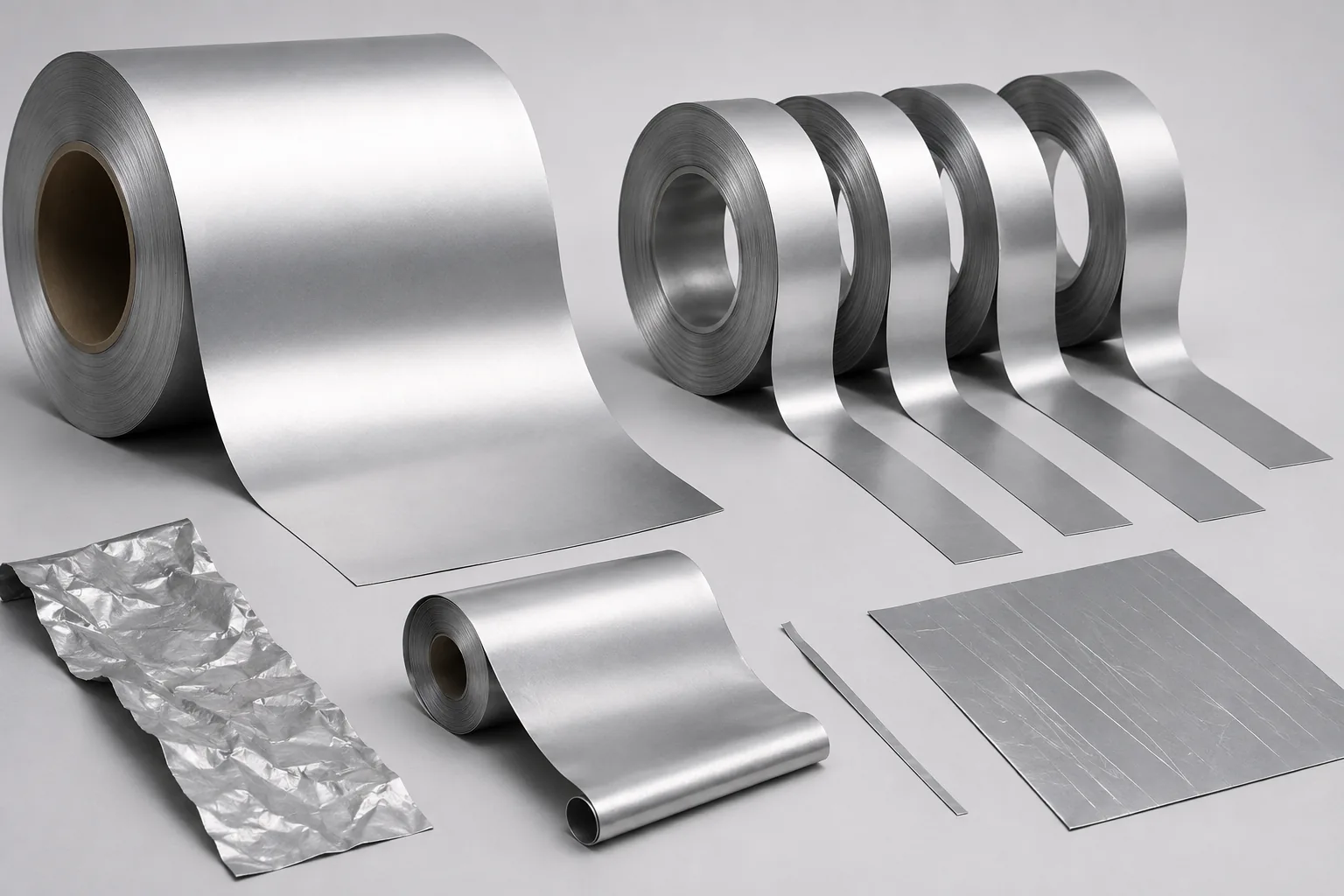
Battery-grade aluminum foil is thin, easily creased and more prone to edge deformation than its flat appearance suggests. Precision slitting must control shear geometry without adding scratches, wrinkles or loose metallic fragments that can be created by misalignment or unstable handling.
Updated
Where This Cutting Application Appears
Converting aluminum current-collector coils
Slit master material into widths required for later coating or electrode processing.
Edge trimming coated-line feedstock
Remove damaged or nonuniform margins before the foil enters a downstream coating or laminating process.
Producing narrow foil strips
Maintain strip tracking and rewind quality where thin aluminum is vulnerable to curl and telescoping.
Precision Roll Slitting process boundary
precision roll slitting for battery-grade aluminum foil is planned around longitudinal width conversion of a moving roll, web, sheet or strip into controlled lanes or daughter rolls; it is not transverse length cutting, profile formation or removal of only a narrow damaged margin.
Precision Roll Slitting setup checkpoint
For battery-grade aluminum foil, confirm unwind and rewind tension, lane widths, knife positions, edge guidance, core alignment, trim removal and discharge behavior.
Precision Roll Slitting acceptance checkpoint
For battery-grade aluminum foil, evaluate lane width, edge condition, camber or wandering, debris, telescoping, interleaving and stable winding or downstream transfer.
Define the Required Cut Result
- Low burr and no loose edge slivers
- Flat strips without creases or stretched margins
- Finished width held through winding and relaxation
- Functional surfaces protected from scratches and transfer marks
Problems to Diagnose Before Changing the Knife
Foil wrinkles as it approaches the knives
Check incoming roll quality, tension profile, web alignment, unsupported span and local contact with guides.
A feathered or rolled edge appears
Review shear clearance, overlap, edge sharpness, side load and foil temper at the cutting point.
Narrow lanes curl after separation
Compare residual stress, differential tension, knife drag and rewind position across the web.
Surface scratches repeat at one lane
Trace guides, spacers, debris, knife faces and contact rolls at the matching cross-machine position.
Knife Forms That May Be Considered
| Possible knife form | When it may be considered | What must be confirmed |
|---|---|---|
| razor slitter | A supported razor cut may be evaluated for suitably thin foil where the line controls penetration and surface contact. | Confirm holder geometry, support method, foil face, tension, speed and particle requirements with representative trials. |
| circular shear knife | A precision shear pair may provide controlled separation when overlap, clearance, side load and shaft runout are repeatable. | Confirm matched knife dimensions, bevels, shaft fits, rotation, setup method and the equipment's adjustment resolution. |
Information to Send for Technical Review
You do not need to know the exact blade name. Send the available workpiece, machine, current-knife and cut-result information so the application can be reviewed against a drawing or sample.
- Foil alloy family, temper, thickness and tolerance
- Surface finish and protected or functional face
- Incoming flatness, rolling direction and edge condition
- Master width, lane plan and finished-width tolerance
- Line speed, tension zones, web support and rewind mode
- Knife-pair, spacer and shaft drawings
- Recorded overlap, clearance, runout and side-load method
- Samples showing burr, rolled edge, wrinkle, curl, sliver or scratch
Questions About This Cutting Application
Why can aluminum foil wrinkle before it reaches the cut?
Very thin foil reflects upstream tension and alignment errors. Inspect the incoming span before attributing every wrinkle to the knife.
Does a harder knife eliminate aluminum pickup?
Material choice alone does not control transfer. Surface condition, pressure, contamination and shear setup also matter.
What creates loose foil slivers?
Edge damage, excessive clearance, unstable overlap or contact at a nick can peel a narrow fragment. Preserve the sliver and both parent edges.
Should width be measured on the rewound coil or free strip?
Use the customer's inspection method and state tension and sampling position, because thin foil can shift or recover.
Can copper-foil settings be reused for aluminum?
Do not assume so. Temper, ductility, thickness and surface response differ; qualify the aluminum application separately.
Related product and service information
- Coated Battery Electrode Sheet Slitting - coated battery electrode sheets · electrode slitting
- Thin Copper Foil Precision Slitting - thin copper foil · precision roll slitting
- Battery Separator Film Slitting - battery separator film · film slitting
Request a Custom Cutting-Knife Review
Send the workpiece details, machine or holder information, current knife photos or sample, required quantity and examples of the present cut problem. Final dimensions, material, edge geometry and tolerances are confirmed from the approved requirements.