
Blade Application Guides / Application Guide / Thermal paper converting
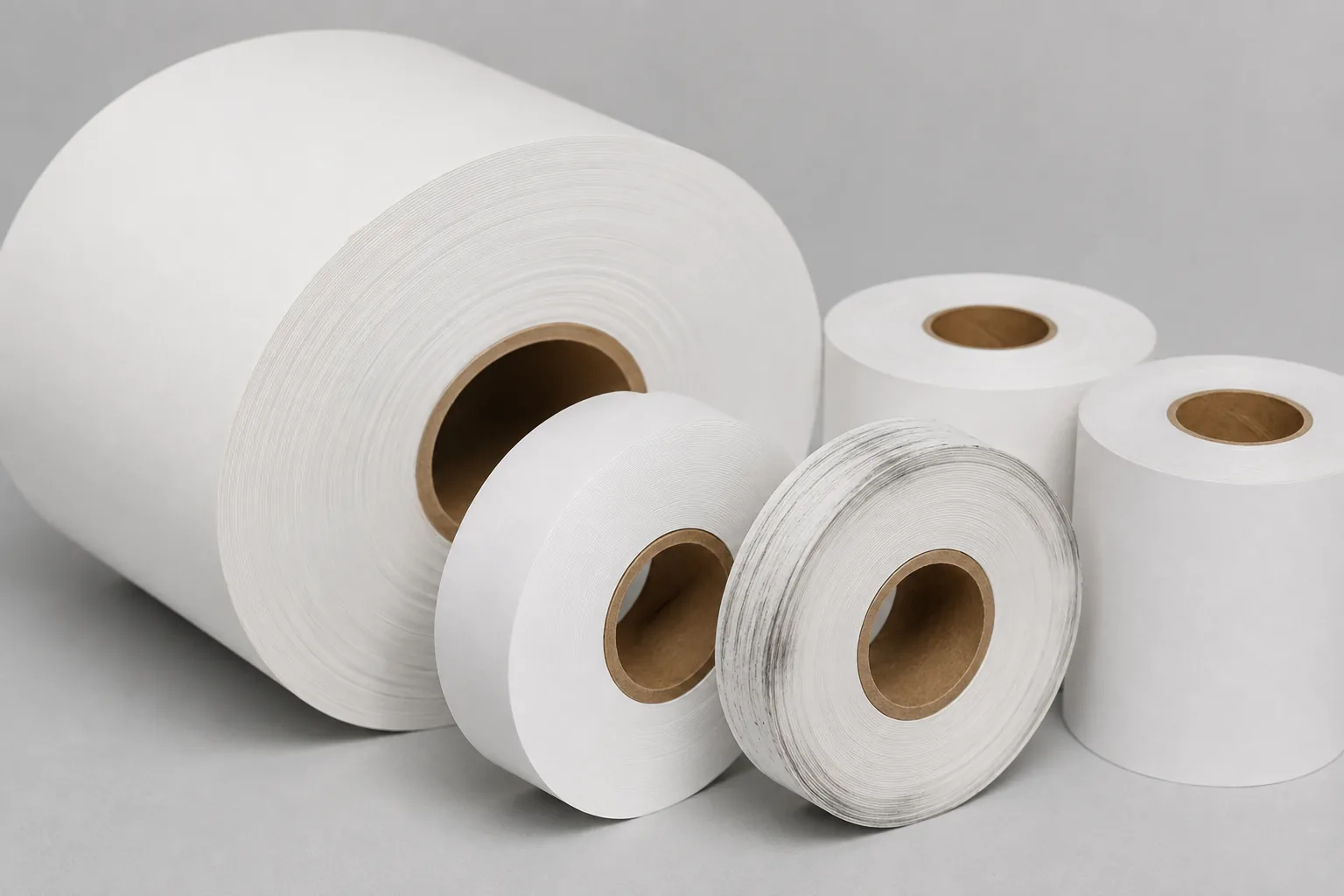
Thermal Paper Roll Slitting Without Coating Damage
Thermal paper has a functional coating that can mark under heat, pressure or friction. Slitting decisions should account for coated-side orientation, sensitivity, dust, curl and the winding quality required by receipt or ticket converting lines.
Updated
Where This Cutting Application Appears
Point-of-sale receipt roll conversion
Thermal master rolls are slit into narrow reels before final rewinding and cutoff, where edge dust can affect printers and sensors.
Ticket and kiosk media preparation
Controlled-width reels are prepared for transport, parking or queue systems that require stable feeding and readable coated surfaces.
Medical and chart recorder roll production
Special thermal grades are converted for recording equipment, with emphasis on clean edges, coating integrity and consistent winding.
Roll Slitting process boundary
Roll slitting divides a master roll longitudinally into narrower rolls; it does not separate the web transversely into sheets or fixed lengths.
Roll Slitting setup checkpoint
Confirm unwind and rewind tension, slit widths, knife positions, core alignment, trim removal and the winding behavior of every daughter roll.
Roll Slitting acceptance checkpoint
Inspect roll width, edge condition, telescoping, interleaving, debris and whether each rewound roll remains stable at the required diameter.
Define the Required Cut Result
- Prevent dark or pressure-marked thermal coating
- Maintain the required geometry for point-of-sale receipt roll conversion
- Protect material integrity during roll slitting
- Deliver a cut condition accepted by the next production step
Problems to Diagnose Before Changing the Knife
Dark or pressure-marked thermal coating
Review coated-side contact, local heat, nip or clamp pressure, sliding friction and whether marks appear before or after rewinding.
Powdery coating or paper dust at the edge
Compare coating bond, base-paper furnish, extraction, edge support, speed and particle accumulation across the run.
Edge curl on narrow thermal reels
Check paper moisture, coating asymmetry, slit width, tension profile, winding direction and storage conditioning.
Telescoped reels or variable finished width
Inspect core alignment, web guiding, lateral cutting position, shaft runout, rewind tension and reel-width measurements.
Knife Forms That May Be Considered
| Possible knife form | When it may be considered | What must be confirmed |
|---|---|---|
| Circular shear slitting | Consider for thermal master rolls where side load and coated-side contact can be controlled. | Confirm this form only from the thermal paper rolls sample, equipment interface, operating motion and approved drawing. |
| Score slitting | Consider only when the coating response and existing anvil system have been evaluated. | Confirm this form only from the thermal paper rolls sample, equipment interface, operating motion and approved drawing. |
Information to Send for Technical Review
You do not need to know the exact blade name. Send the available workpiece, machine, current-knife and cut-result information so the application can be reviewed against a drawing or sample.
- Thermal grade, coating supplier and coated-side orientation
- Basis weight, caliper, moisture and sensitivity information
- Master-roll width, diameter, core and roll-hardness range
- Required reel widths, tolerances and final roll format
- Line speed, unwind and rewind tension, and winding direction
- Contact points near the coating and cleaning practice
- Photos of dark marks, dust, curl or telescoping with roll position
- Existing slitting-part interface, order volume and downstream printer needs
Questions About This Cutting Application
How can we tell whether a dark mark came from slitting or rewinding?
Map marks to the coated side and roll position, then inspect contact points and temperature before and after the cut. A timed sample sequence helps locate the responsible station.
Why do narrow thermal reels curl more than wider reels?
Coating asymmetry, moisture balance, residual web tension and storage conditions can become more visible at narrow widths. Compare reels across the master roll.
Should thermal sensitivity data be included in the RFQ?
Yes, when the supplier provides it. Also send actual material because coating response can vary by grade and condition at the converting line.
What should be checked before approving receipt-roll edge quality?
Inspect dust, coating chips, width, reel build, telescoping and printer-feed performance using a representative finished roll.
Can a general paper-slitting setup be assumed suitable for thermal stock?
No. The functional coating, contact orientation, dust limits and narrow-reel winding must be reviewed with equipment details and samples before confirming a specification.
Related product and service information
- Folding Boxboard Edge Trimming: Clean Coated Margins and True Width - folding boxboard · edge trimming
- Kraft Paper Roll Slitting: Edge Quality and Dust - kraft paper rolls · roll slitting
- Laminated Paperboard Slitting Across Multiple Layers - laminated paperboard rolls · roll slitting
Request a Custom Cutting-Knife Review
Send the workpiece details, machine or holder information, current knife photos or sample, required quantity and examples of the present cut problem. Final dimensions, material, edge geometry and tolerances are confirmed from the approved requirements.