
Blade Application Guides / Application Guide / Biopharmaceutical manufacturing
Sterile Vent-Filter Membrane Edge-Trimming Blades
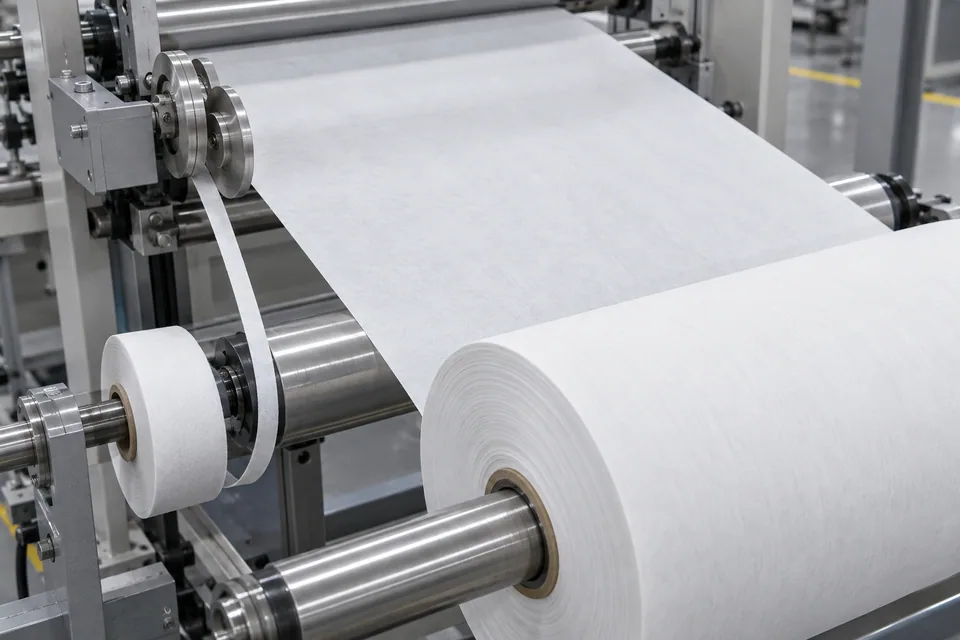
Gore states that supported ePTFE microfiltration media can be supplied in customized slit rolls or die-cut forms. Merck lists a hydrophobic PVDF membrane roll for air and gas sterilization applications. An edge trim on such raw media removes a selected outside strip of a parent web, often before the remaining material is slit into production lanes. It is a geometry and cleanliness operation on unassembled membrane. No operator should infer sterility, bacterial retention or final vent integrity from a clean-looking margin. The buyer and membrane maker must define which outer material can be discarded and what handling state the stock requires.
Updated
Where This Cutting Application Appears
Map the discard strip
Mark the parent-roll edge, supplier-documented usable width and any damaged travel margin. An outer strip may include winding damage or coating variation, but only the buyer can authorize its width. Preserve enough useful area for downstream lane widths and disc nest.
Keep the trim ribbon away from the porous face
Arrange collection so the separated narrow ribbon does not wrap a blade or brush the membrane surface. Watch for support-layer threads at the transition between useful web and waste. Inspect the same location before and after trimming to avoid blaming pre-existing edge scuffs on the tool.
Measure from a repeatable datum
Use a guide or printed fiducial only if the actual construction provides one. Record trim width along the roll and note edge wander or telescoping inherited from winding. Inspect the retained boundary in the buyer-defined conditioning state.
Check compatibility with the next station
Feed a trial length to subsequent slitting, punching or sealing. The retained edge must provide a reliable datum without crossing the filter’s functional or seal area. Let the buyer qualify finished assemblies with its normal airflow and integrity procedure.
Define the Required Cut Result
- Remove only approved outside material.
- Collect narrow waste without surface recontact.
- Keep a straight reference edge for later conversion.
- Distinguish pre-existing edge defects from trim-induced damage.
Problems to Diagnose Before Changing the Knife
Waste ribbon wraps around a blade
- Inspect waste-path angle and extraction.
- Reduce long unsupported ribbon travel.
- Check winding direction and static behavior.
Retained edge shows projecting support fibers
- Compare incoming and outgoing edge samples.
- Inspect knife engagement and support-layer orientation.
- Review blade wear and local web flutter.
Useful web becomes too narrow
- Recalculate trim allowance from actual parent-roll width.
- Check lateral guide reference.
- Confirm downstream lane nest with the buyer.
Knife Forms That May Be Considered
| Possible knife form | When it may be considered | What must be confirmed |
|---|---|---|
| Guided rotary outer trim | For stable membrane rolls with a narrow approved discard margin. | Confirm waste capture and retained-edge cleanliness. |
| Supported sheet-edge cut | If the supplied format is short sheets rather than a parent roll. | Use the same useful-area and edge-inspection criteria. |
Information to Send for Technical Review
You do not need to know the exact blade name. Send the available workpiece, machine, current-knife and cut-result information so the application can be reviewed against a drawing or sample.
- Supplier usable-width statement
- Membrane polymer and backing construction
- Parent-roll width and edge map
- Approved trim width and downstream lane plan
- Face and winding orientation
- Waste collection arrangement
- Edge imagery and particle criteria
- Buyer completed-vent validation requirements
Questions About This Cutting Application
Is edge trimming the same as cutting vent discs?
No. It removes an outer web margin; a later operation may form discrete inserts.
Can a visibly damaged roll edge always be trimmed away?
Only if the buyer allows enough margin without reducing the functional nest or needed seal land.
Why inspect the scrap ribbon?
Its fibers and behavior reveal incomplete separation or a collection path that could contaminate useful media.
Does a straight edge prove the vent is sterile?
No. Sterility and integrity are properties of the qualified completed filter and process.
What belongs on the drawing?
Show discard width, retained useful width, winding orientation and the next conversion datum.
Public references and scope
These public sources provide material, cutting-method or safety context for this guide. Supplier pages describe their own materials or equipment; they do not establish a MEIRENTE blade specification or performance claim. Confirm the actual grade, machine setup and required cut with a drawing or sample.
Related product and service information
- Sterile Vent-Filter Membrane Roll Slitting Blades - sterile vent-filter membrane · roll slitting
- Single-Use Bioreactor Bag Film Edge Trimming Blades - single-use bioreactor bag film · edge trimming
- Virus-Filtration Membrane Edge Trimming Blades - virus-filtration membrane · edge trimming
Request a Custom Cutting-Knife Review
Send the workpiece details, machine or holder information, current knife photos or sample, required quantity and examples of the present cut problem. Final dimensions, material, edge geometry and tolerances are confirmed from the approved requirements.