
Blade Application Guides / Application Guide / Biopharmaceutical manufacturing
Sterile Vent-Filter Membrane Roll Slitting Blades
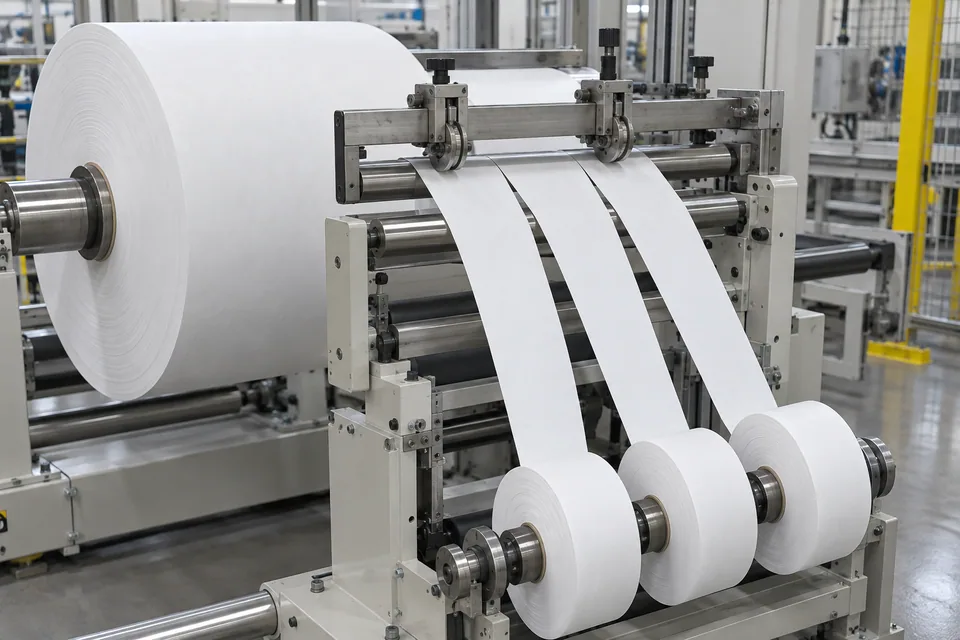
Gas-vent filters used in biopharmaceutical processing commonly use hydrophobic PTFE or PVDF media, but a membrane web is not a sterile vent filter assembly. Merck lists hydrophobic PVDF roll stock for air or gas sterilization applications, and Gore describes supported ePTFE microfiltration media available as custom slit rolls. This guide addresses raw, unassembled stock only. Roll slitting divides a parent web into lanes for a subsequent disc-cutting or assembly operation. Before choosing any blade, identify whether the supplied material is unsupported film, a backed membrane or a multilayer media; the buyer and membrane maker set surface handling and test requirements.
Updated
Where This Cutting Application Appears
Define downstream lane widths
Work back from the disc nest, pleat width or housing insert drawing. Include only the buyer-approved allowance for registration or further edge removal. Note which membrane face and support side must remain outward through winding; the lane width alone does not describe a usable vent component.
Trial web handling before knife selection
Observe the supplied roll under the intended unwinding tension and support span. Hydrophobic membranes can carry a nonwoven backing or other support; inspect whether the media follows the support at the slit or creates a stepped edge. Do not transfer parameters from an unrelated film grade.
Control debris and wind quality
Locate any loose fibrils, slivers or support fibers at the split edge. Record trim and lane takeoff so scrap cannot re-enter the useful surface. Wind sample lanes with the specified face outward and check for blocking, telescoping or pressure marks after a storage interval.
Preserve the buyer’s validation boundary
Inspect dimensions and appearance at slit, rewind and later die-cut stages. The membrane and completed vent must still pass the buyer’s gas-flow, liquid intrusion, integrity and sterilization-validation plan where applicable.
Define the Required Cut Result
- Cut the supplied parent roll into the required lane widths.
- Avoid support-layer peel and membrane surface contact.
- Keep slit debris away from downstream vent components.
- Retain winding orientation and lot traceability.
Problems to Diagnose Before Changing the Knife
Membrane and backing separate at the slit
- Inspect construction cross-section and knife support.
- Compare tension on both sides of the knife.
- Trial different engagement on supplier-approved samples.
Dust appears after rewind
- Inspect slitting edge and trim extraction.
- Check interleaf and winding pressure.
- Locate the first handling stage that sheds.
Lane width varies across the roll
- Check parent-roll edge and guide tracking.
- Record tension and web stretch.
- Measure after buyer-specified conditioning.
Knife Forms That May Be Considered
| Possible knife form | When it may be considered | What must be confirmed |
|---|---|---|
| Continuous rotary slitting pair | For a raw roll whose membrane and backing stay registered under feed. | Confirm lane width and no interlayer peel on the exact supplied media. |
| Supported low-contact slitting setup | For a fragile, unsupported or easily marked grade. | Validate surface contact, debris and wind quality before production choice. |
Information to Send for Technical Review
You do not need to know the exact blade name. Send the available workpiece, machine, current-knife and cut-result information so the application can be reviewed against a drawing or sample.
- Vent membrane maker, polymer and exact grade
- Unsupported or backed construction
- Roll width, core, winding and face orientation
- Target lane widths and downstream part nest
- Allowed edge fibers and particles
- Web tension and contact restrictions
- Packaging and traceability requirements
- Buyer finished-filter integrity and sterility validation
Questions About This Cutting Application
Does slitting create a sterile filter?
No. It sizes unassembled membrane stock; sterility and device integrity belong to the buyer’s validated final process.
Are PTFE and PVDF interchangeable?
No. The supplier’s grade and construction govern handling and the final vent design.
Why inspect the backing edge?
A support that peels or projects beyond the membrane can interfere with later sealing or die cutting.
What can a slit-edge check establish?
It can show width, damage and visible debris; it cannot establish microbial retention or gas-flow specification.
What samples should be sent for a blade trial?
Use the actual roll construction with its supplier handling instructions and downstream part drawing.
Public references and scope
These public sources provide material, cutting-method or safety context for this guide. Supplier pages describe their own materials or equipment; they do not establish a MEIRENTE blade specification or performance claim. Confirm the actual grade, machine setup and required cut with a drawing or sample.
Related product and service information
- Sterile Vent-Filter Membrane Rotary Die-Cutting Blades - sterile vent-filter membrane · rotary die cutting
- Single-Use Bioreactor Bag Film Roll Slitting Blades - single-use bioreactor bag film · roll slitting
- Virus-Filtration Membrane Roll Slitting Blades - virus-filtration membrane · roll slitting
Request a Custom Cutting-Knife Review
Send the workpiece details, machine or holder information, current knife photos or sample, required quantity and examples of the present cut problem. Final dimensions, material, edge geometry and tolerances are confirmed from the approved requirements.