
Blade Application Guides / Application Guide / Shrink packaging
Shrink Film Perforation and Cutoff Consistency
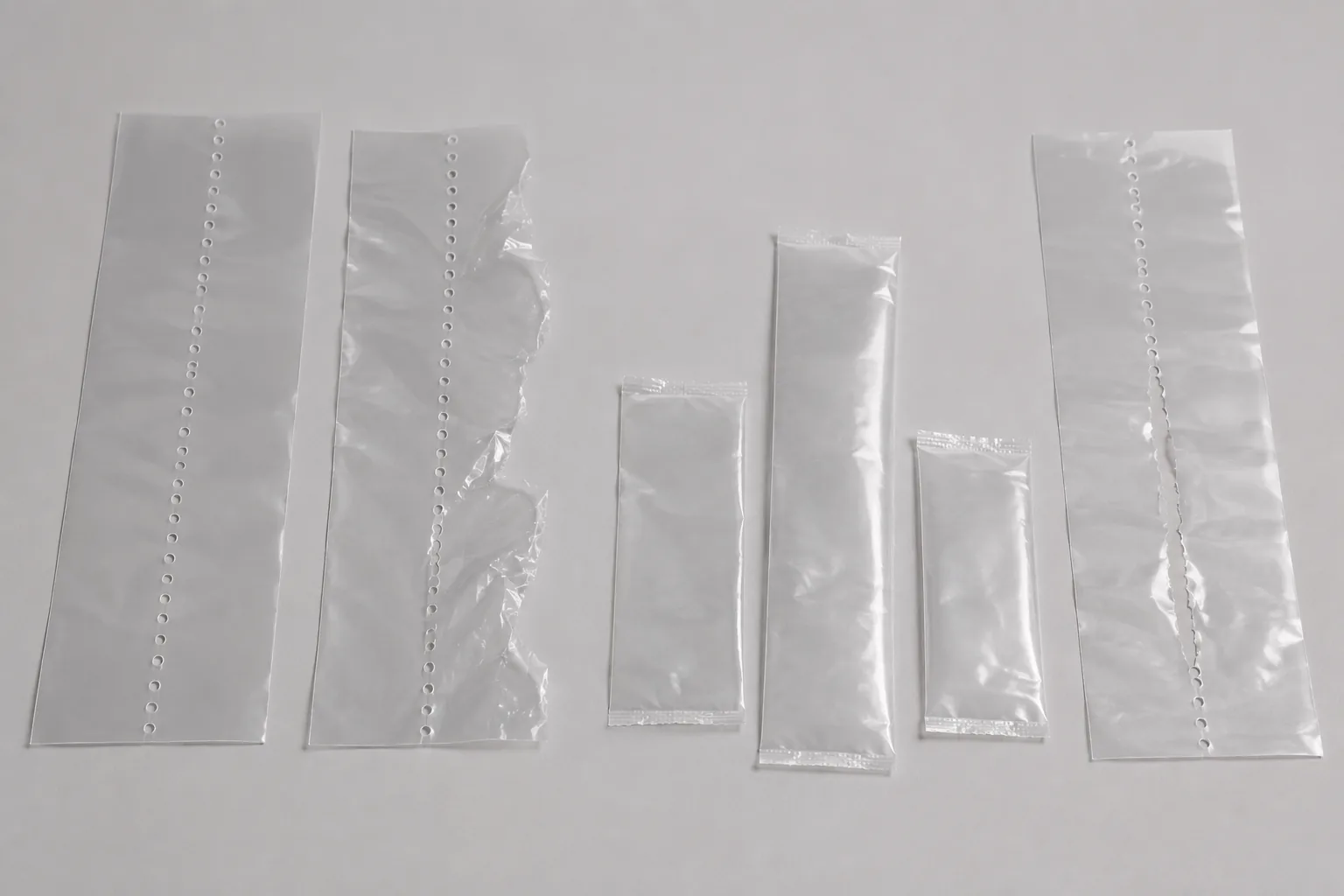
Shrink film can stretch at a cutoff and distort around a perforation before heat is ever applied. Film orientation, gauge, temperature, tension, perforation pattern, registration, and support determine whether the web separates and later shrinks as intended.
Updated
Where This Cutting Application Appears
Shrink-bag length separation
Tubular or folded film is perforated or cut into bag lengths while the mouth remains open and the dimensions suit the packaged item.
Bundle-film cutoff
PE or polyolefin shrink web is separated after wrapping a product group, with a complete cutoff and controlled trailing edge.
Registered shrink-sleeve perforation
Printed shrink webs receive tear lines or separation features positioned against artwork and later opening requirements.
Perforating And Cutoff process boundary
perforating and cutoff for shrink film is a linked sequence: the output condition and datum from each operation become the controlled input for the next. It should not be evaluated as one generic cut or accepted only by the final dimension.
Perforating And Cutoff setup checkpoint
For shrink film, define the operation order, intermediate dimensions, registration transfer, material support, web or part handling and waste route for every stage of perforating and cutoff.
Perforating And Cutoff acceptance checkpoint
Verify both intermediate and final results from perforating and cutoff, including dimensions, registration, edge or feature quality, material damage, waste separation and stable transfer between stages.
Define the Required Cut Result
- Create a perforation that tears along the intended line without premature breaks
- Complete cutoff without drawing stretched film tails
- Hold bag or sleeve length relative to print and seal datums
- Avoid holes, wrinkles, or fused areas outside the designed pattern
Problems to Diagnose Before Changing the Knife
Perforation will not tear along the intended line
Review cut-to-tie pattern, film type, orientation, gauge, tear direction, tension, hole shape, and the user's opening motion.
Film stretches into a long tail at cutoff
Compare polymer, temperature, web tension, support, cutoff speed, entry direction, and where final separation occurs.
Bag or sleeve length drifts during production
Check registration sensing, encoder or feed slip, tension changes, print repeat, seal timing, and measurements before and after relaxation.
Perforation causes premature web breaks
Inspect tie width, pattern alignment, edge distance, film defects, splice passage, tension spikes, and break origin.
Knife Forms That May Be Considered
| Possible knife form | When it may be considered | What must be confirmed |
|---|---|---|
| Perforating form | Consider where a controlled tear line is required in a continuous shrink web. | Confirm cut-to-tie pattern, direction, print register, film samples, motion, and approved perforation drawing. |
| Straight or serrated cutoff form | Consider where the web must separate fully at a defined cycle point. | Confirm film construction, support, stroke, tension, registration, mounting, and accepted cutoff samples. |
Information to Send for Technical Review
You do not need to know the exact blade name. Send the available workpiece, machine, current-knife and cut-result information so the application can be reviewed against a drawing or sample.
- Shrink-film polymer and construction: PE, polyolefin, PVC, or laminate
- Gauge range, orientation, fold, tube, gusset, and surface treatment
- Printed repeat, eye mark, seal position, and perforation datum
- Perforation cut-to-tie pattern, tear direction, and opening requirement
- Finished bag, sleeve, or bundle length with tolerance and relaxation time
- Line speed, web tension, feed or encoder control, and cutoff cycle
- Photos or video of failed tears, stretched tails, drift, and web breaks
- Current perforating or cutoff sample, mounting, motion, volume, and downstream shrink process
Questions About This Cutting Application
Why does a perforation tear sideways into the shrink film?
Film orientation, tie layout, hole shape, tension, and the direction of the opening force can redirect the tear. Test the actual user-opening direction.
How should cutoff length be measured on extensible shrink film?
Define tension state, time after cutting, temperature, and datum. Record both in-line length and conditioned flat length when relaxation is significant.
Can perforation strength be set from film gauge alone?
No. Polymer, orientation, pattern, tie width, temperature, and tear direction also matter. Approve physical samples using an agreed test.
What causes premature breaks near a printed eye mark?
A perforation or edge defect may align with a tension spike, splice, register correction, or local print treatment. Map break origin to the repeat pattern.
Should PE and polyolefin shrink films use one cutoff review?
They can differ in stretch, tear, friction, temperature response, and recovery. Review each production construction with the equipment interface and drawing.
Related product and service information
- Slicing Flexible Polyurethane Foam Blocks - flexible polyurethane foam blocks · horizontal and vertical slicing
- Carton Sealing Tape Cutoff for Reliable Cycle Separation - carton sealing tape · cutoff
- Corrugated Carton Slotting Without Liner Tear - corrugated carton blanks · slotting
Request a Custom Cutting-Knife Review
Send the workpiece details, machine or holder information, current knife photos or sample, required quantity and examples of the present cut problem. Final dimensions, material, edge geometry and tolerances are confirmed from the approved requirements.