
Blade Application Guides / Application Guide / foam fabrication
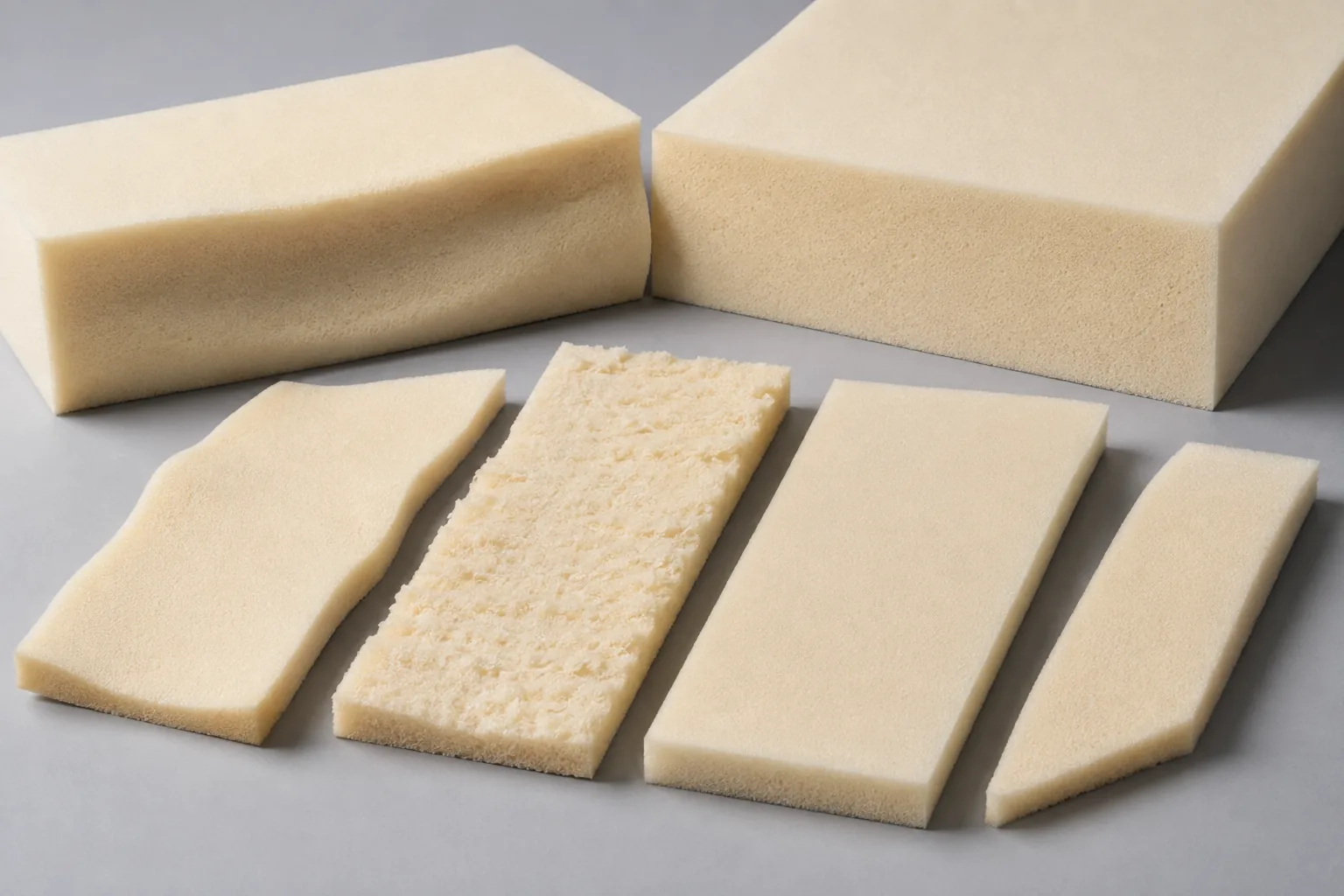
Slicing Flexible Polyurethane Foam Blocks
Flexible PU foam is cut as a large cellular block whose density and firmness may vary within the bun. Band-knife tension, guide alignment, block support and feed rate control whether a slice stays flat across its full area.
Updated
Where This Cutting Application Appears
Horizontal sheet peeling
Slices a block into sheets for upholstery, packaging or lamination.
Vertical block sizing
Squares bun sides before detailed conversion.
Contour-grade preparation
Creates consistent blanks for later profiled cutting.
Horizontal And Vertical Slicing process boundary
horizontal and vertical slicing for flexible polyurethane foam blocks is a linked sequence: the output condition and datum from each operation become the controlled input for the next. It should not be evaluated as one generic cut or accepted only by the final dimension.
Horizontal And Vertical Slicing setup checkpoint
For flexible polyurethane foam blocks, define the operation order, intermediate dimensions, registration transfer, material support, web or part handling and waste route for every stage of horizontal and vertical slicing.
Horizontal And Vertical Slicing acceptance checkpoint
Verify both intermediate and final results from horizontal and vertical slicing, including dimensions, registration, edge or feature quality, material damage, waste separation and stable transfer between stages.
Define the Required Cut Result
- Uniform thickness across the sheet
- Low surface tear and drag marks
- Straight knife tracking
- Minimal block compression
Problems to Diagnose Before Changing the Knife
Wavy thickness
- Check density variation
- Measure knife tension
- Inspect feed flatness
Surface tearing
- Inspect edge finish
- Compare cell size
- Adjust feed rate
Block compression
- Review hold-down
- Support the bun evenly
- Measure firmness
Tracking drift
- Check guides and wheels
- Inspect weld or joint
- Measure lateral feed load
Knife Forms That May Be Considered
| Possible knife form | When it may be considered | What must be confirmed |
|---|---|---|
| long band knife | Provides continuous full-width slicing on machines designed to tension and guide a long flexible edge. | Confirm the final geometry and mounting from the foam band-knife slicer equipment, an unworn sample or an approved drawing before manufacture. |
| serrated band knife | May improve entry in selected foam densities, subject to surface-mark limits. | Confirm the final geometry and mounting from the serrated foam slicer equipment, an unworn sample or an approved drawing before manufacture. |
| oscillating straight knife | May suit smaller blocks or programmed cuts where stroke and support are controlled. | Confirm the final geometry and mounting from the foam oscillating cutter equipment, an unworn sample or an approved drawing before manufacture. |
Information to Send for Technical Review
You do not need to know the exact blade name. Send the available workpiece, machine, current-knife and cut-result information so the application can be reviewed against a drawing or sample.
- Slicer make and model
- Foam chemistry, density and firmness
- Block dimensions and rise direction
- Target sheet thickness and tolerance
- Horizontal or vertical cut
- Feed speed, guide and tension data
- Surface-defect samples
- Knife length, quantity and destination
Questions About This Cutting Application
Why is a foam sheet thicker at one side?
Guide alignment, block support, density gradient or knife tension may bias the cut.
Does a serrated edge give a smoother face?
Not necessarily; evaluate tooth pitch against cell size and finish target.
Why does a band knife wander?
Unequal guide loading, low tension, edge asymmetry or feed pressure can deflect it.
How should thickness be measured?
Use an agreed low-pressure method after recovery.
Can a used band knife define replacement length?
Confirm machine path and tension allowance as well as the sample.
Related product and service information
- Ceramic Fiber Blanket Cutting - ceramic fiber insulation blankets · blanket slitting and sizing
- Cutting Uncured Tire Tread Rubber Strips - uncured tire tread rubber strips · cross-cutting tread strips
- Cutting Extruded Rubber Profiles to Length - extruded rubber profiles · in-line cut-to-length
Request a Custom Cutting-Knife Review
Send the workpiece details, machine or holder information, current knife photos or sample, required quantity and examples of the present cut problem. Final dimensions, material, edge geometry and tolerances are confirmed from the approved requirements.