
Blade Application Guides / Application Guide / Hose manufacturing
Rubber Hose Cutoff for Square Uncollapsed Ends
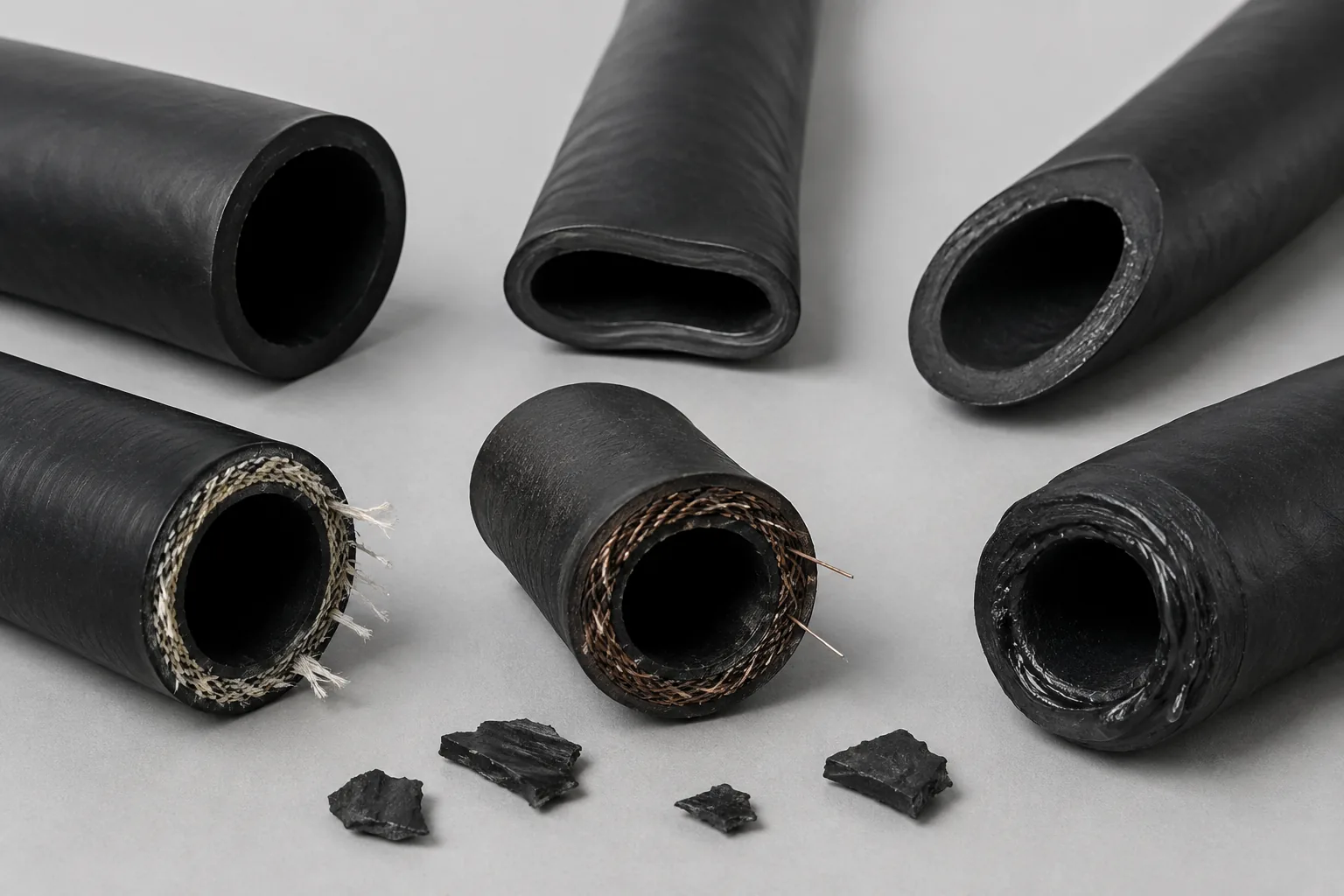
A hose cutoff must pass through a curved elastomer wall and may also encounter textile braid, spiral wire, or other reinforcement without flattening the bore. The hose construction, cured state, unsupported length, cut speed, restraint, reinforcement pitch, and end-use preparation determine what constitutes an acceptable end.
Where This Cutting Application Appears
Cut lengths for hose assemblies
Bulk cured hose is separated into specified lengths before fitting insertion, crimping, clamping, or another documented assembly step.
Reinforced hose section preparation
Textile-braided or wire-reinforced hose is cut where reinforcement ends must remain contained and accessible for the approved termination process.
Short sleeves, connectors, and protective segments
Hose or tubular rubber stock is converted into short pieces whose parallel ends, bore shape, and recovered length affect feeding or manual assembly.
Common Ways to Describe This Cutting Problem
- rubber hose length cutoff
- hose end collapse during cutting
- rubber hose square cut problem
- braided hose reinforcement fraying
- wire reinforced hose cutoff
- rubber buildup on hose cutting blade
- hose cut length tolerance after recovery
- how to prevent oval hose cut ends
Define the Required Cut Result
- Leave the end face perpendicular to the hose axis around the full circumference
- Preserve the bore opening instead of pinching the wall into a lasting oval shape
- Sever braid or wire reinforcement without long projections or pulled strands
- Control rubber chips and smear so the inner passage and outer cover remain clean
Problems to Diagnose Before Changing the Knife
The hose flattens and retains an oval end after cutoff
Review clamp shape and pressure, internal support, wall hardness, temperature, cut speed, blade entry, unsupported length, and relaxation after release.
The end face is angled or develops a trailing lip
Check hose-axis alignment, feed stop, blade deflection, rotation or traverse, support, wall-thickness variation, reinforcement pitch, and feed movement during cutting.
Textile or wire reinforcement protrudes from the end
Identify reinforcement type, layer count and angle, then assess tension, sharpness, cut motion, support, hose rotation, cover adhesion, and strand pullout.
Rubber smears onto the cut face or chips enter the bore
Examine compound, cured condition, hose temperature, blade finish, friction, speed, chip direction, cleaning interval, and whether internal air or support is used.
Knife Forms That May Be Considered
| Possible knife form | When it may be considered | What must be confirmed |
|---|---|---|
| Rotary circular cutoff knife | Consider where the hose is supported and a rotating cut can progressively separate elastomer and the specified reinforcement. | Confirm outside and inside diameters, wall stack, reinforcement, rotation, feed, restraint, arbor or bore support, speed, and guard envelope. |
| Straight or shaped guillotine cutoff | Consider for suitable hose constructions when a guided stroke and profiled support can prevent rolling or excessive flattening. | Confirm blade profile, stroke, clamp geometry, internal support, hose orientation, cut length, cycle rate, and accepted end sample. |
Information to Send for Technical Review
You do not need to know the exact blade name. Send the available workpiece, machine, current-knife and cut-result information so the application can be reviewed against a drawing or sample.
- Inner-tube and outer-cover rubber compounds, cured condition, hardness, and operating temperature
- Outside diameter, bore diameter, wall thickness, concentricity, and natural coil curvature
- Textile braid, spiral yarn, helix wire, or other reinforcement material, layer count, angle, and pitch
- Required cut length, tolerance, squareness datum, allowable bore ovality, and relaxation time
- Permitted reinforcement projection, rubber lip, chip, scorch, or smear limits with accepted end samples
- Feed orientation, stop or encoder, clamp, internal mandrel or air support, blade motion, and cycle rate
- Current holder and equipment drawing, available cutting envelope, extraction, cleaning method, and safety constraints
- Representative straight and curved hose samples, defect photographs, downstream fitting or crimp process, and batch quantity
Questions About This Cutting Application
Why does a hose look square from one side but angled after rotation?
The axis may not be aligned to the cutting plane, or the blade may deflect through uneven wall and reinforcement. Inspect the full circumference from a defined datum.
When is internal support useful during hose cutoff?
A mandrel or approved air support may help resist collapse, but its fit, insertion, removal, contamination risk, and interaction with reinforcement must be confirmed.
How should protruding reinforcement be specified?
State the reinforcement type, permitted projection, loose-strand rule, inspection around the circumference, and requirements of the next fitting or termination operation.
Why does hose length change after it leaves the clamp?
Axial compression, feed tension, natural curvature, elastomer recovery, temperature, and reinforcement construction can change the measured length after release.
Can one cutoff tool cover every hose wall construction?
No single form should be assumed. Bore size, rubber, wall thickness, textile or wire layers, support, equipment motion, and end criteria require confirmation.
Request a Custom Cutting-Knife Review
Send the workpiece details, machine or holder information, current knife photos or sample, required quantity and examples of the present cut problem. Final dimensions, material, edge geometry and tolerances are confirmed from the approved requirements.