
Blade Application Guides / Application Guide / Solid-state battery development and manufacturing
Solid-State Battery Electrolyte Sheet Cutting Blades
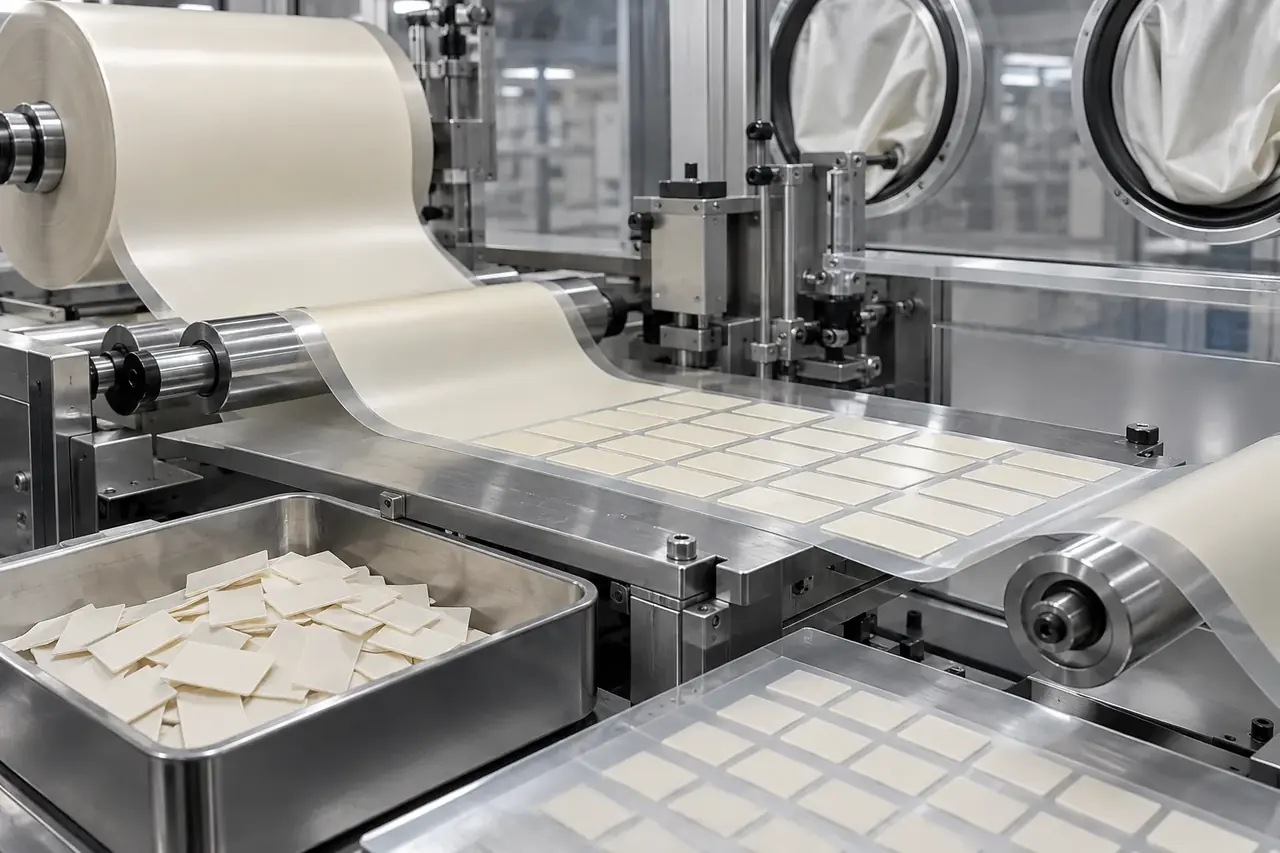
Solid-state battery electrolyte sheet cutting blades are reviewed for preparing electrolyte layers into test coupons, assembly sheets or defined profiles. Since electrolyte sheets can differ greatly in construction and handling behavior, the project should be based on the actual supplied sheet, any carrier or laminate, required geometry, environmental handling instructions and the customer's accepted cut sample.
Updated
Where This Cutting Application Appears
Electrolyte test coupon preparation
Small controlled shapes are prepared for material evaluation and process development using documented orientation and handling.
Cell-layer sheet sizing
Supplied electrolyte material is cut to the format required for stacking, lamination or another defined cell-building step.
Supported profile conversion
Electrolyte sheets carried on a liner or combined in a laminate are profiled while preserving the intended layer relationship.
Sheet Sizing And Profile Cutting process boundary
Sheet sizing and profile cutting for Solid-state battery electrolyte sheet is a linked sequence: the output condition and datum from each operation become the controlled input for the next. It should not be evaluated as one generic cut or accepted only by the final dimension.
Sheet Sizing And Profile Cutting setup checkpoint
For Solid-state battery electrolyte sheet, define the operation order, intermediate dimensions, registration transfer, material support, web or part handling and waste route for every stage of Sheet sizing and profile cutting.
Sheet Sizing And Profile Cutting acceptance checkpoint
Verify both intermediate and final results from Sheet sizing and profile cutting, including dimensions, registration, edge or feature quality, material damage, waste separation and stable transfer between stages.
Define the Required Cut Result
- Complete separation with no visible cracks extending from the intended cut boundary.
- Controlled geometry without chipped corners, broken narrow features or edge delamination.
- Flat, supported handling that avoids unintended bending or surface contact.
- Traceable trial results tied to the supplied construction and customer inspection method.
Problems to Diagnose Before Changing the Knife
Edge cracking extends into the usable sheet
- Confirm the exact supplied sheet construction and identify any carrier or reinforcing layer.
- Map crack origin and direction around straight edges, corners and profile transitions.
- Review support and handling before, during and after separation.
Corner chipping or local material loss
- Compare corner geometry with the material condition and drawing requirement.
- Inspect both faces to determine where the chip initiates.
- Check collection and transfer steps for secondary contact damage.
Carrier separation or layer lifting
- Document the complete layer order and the intended state after cutting.
- Identify whether lifting begins at cutting, release, inspection or packing.
- Confirm whether the carrier should remain continuous, be profiled or be removed.
Sheet fracture during unloading
- Observe how the finished part is released and supported after the cut.
- Record the location of fractures relative to grip points and narrow features.
- Compare manual trial handling with the intended production transfer sequence.
Knife Forms That May Be Considered
| Possible knife form | When it may be considered | What must be confirmed |
|---|---|---|
| Supported straight-cut arrangement | For sizing electrolyte sheet stock or preparing rectangular test coupons with continuous support. | Sheet construction, support face, cut direction, finished format and unloading method. |
| Custom profile cutting arrangement | When cell-layer geometry includes corners, openings or non-rectangular boundaries. | Controlled drawing, feature transitions, carrier state, registration and accepted edge sample. |
| Carrier-assisted sheet converting arrangement | When the electrolyte layer requires a carrier through cutting, inspection or transfer. | Layer order, carrier handling, required cut depth outcome, release sequence and contact restrictions. |
Information to Send for Technical Review
You do not need to know the exact blade name. Send the available workpiece, machine, current-knife and cut-result information so the application can be reviewed against a drawing or sample.
- Electrolyte sheet description, complete supplied construction and representative samples.
- Carrier, liner or laminate information and the intended layer state after cutting.
- Finished-part drawing, coupon layout or approved master sample.
- Sheet orientation, functional-face identification and handling instructions.
- Machine or laboratory cutting station, support surface and transfer sequence.
- Photographs of cracks, chips, lifting or fractures from both faces.
- Customer inspection method and definition of an acceptable edge.
- Trial quantity, packaging needs and any environmental handling restrictions supplied by the customer.
Questions About This Cutting Application
Can one cutting arrangement cover every solid electrolyte sheet?
Not by application name alone. Supplied constructions and handling behavior can differ, so each project needs samples and process information.
Why is support important during electrolyte sheet cutting?
Support conditions influence bending, release and transfer, all of which can contribute to cracks or breakage around the cut area.
What should a crack photograph include?
Show both faces, the full part orientation, the crack origin and its position relative to the intended cut boundary.
Should the carrier be removed before a trial?
Follow the intended production layer sequence and state clearly when the carrier is retained, cut or removed.
Can unknown electrolyte properties be estimated for blade selection?
No. Unknown properties should remain unconfirmed; use actual samples, supplier data and observed trial results.
Related product and service information
- Battery-Module Compression Pad Matrix-Trimming Blades - battery-module compression pad · matrix trimming
- Fuel Cell Proton Exchange Membrane Slitting Blades - Fuel cell proton exchange membrane · Roll slitting
- Fuel Cell Gas Diffusion Layer Cutting Blades - Fuel cell gas diffusion layer · Sheet cutting and edge trimming
Request a Custom Cutting-Knife Review
Send the workpiece details, machine or holder information, current knife photos or sample, required quantity and examples of the present cut problem. Final dimensions, material, edge geometry and tolerances are confirmed from the approved requirements.