
Blade Application Guides / Application Guide / refractory and high-temperature insulation
Ceramic Fiber Blanket Cutting
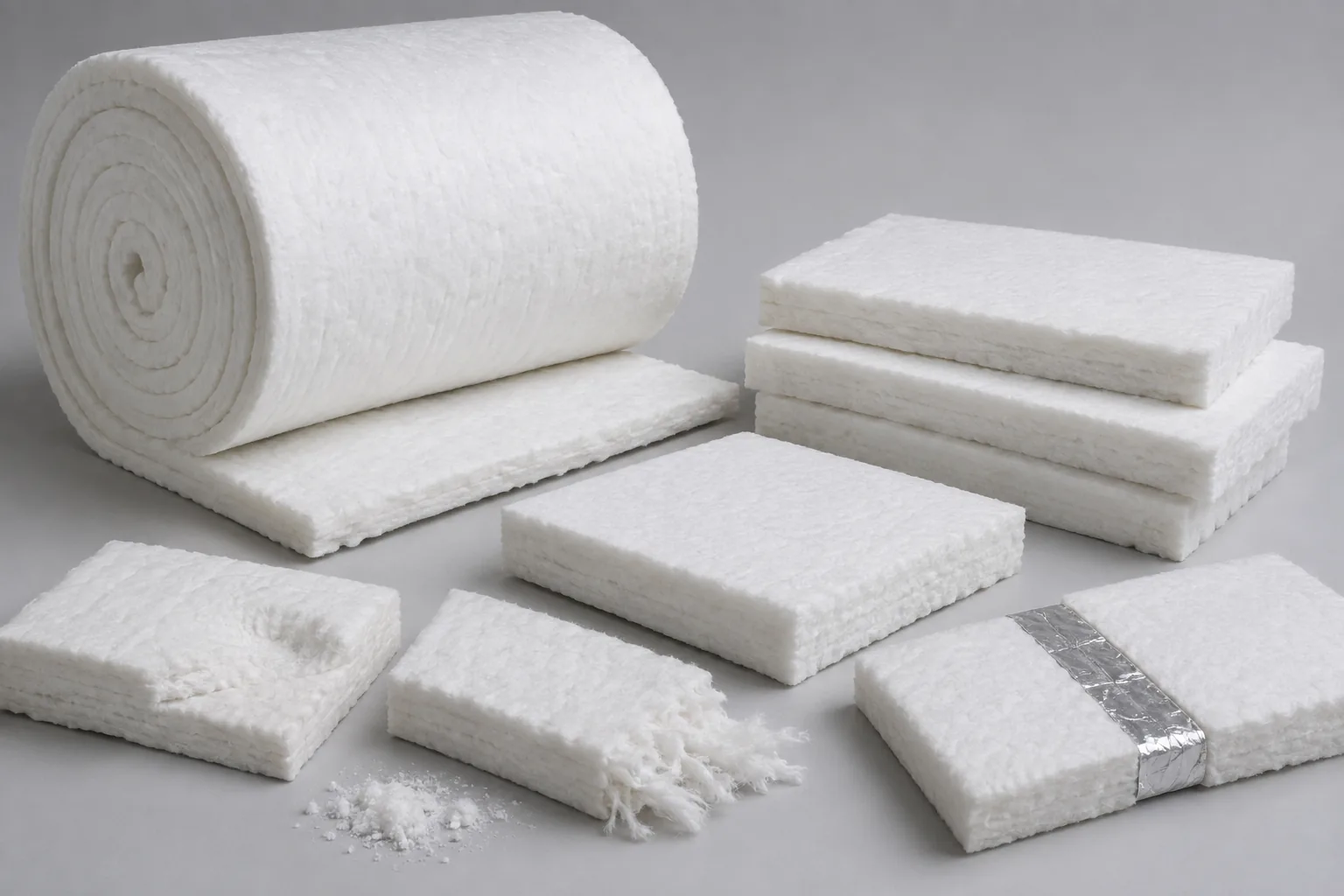
Ceramic fiber blanket is a low-density refractory insulation that compresses deeply before its entangled fibers separate. Thick grades can recover after the cut, while foil, paper or needled surface layers may shift independently, so size and edge quality must be judged after release from hold-down.
Updated
Where This Cutting Application Appears
Slitting refractory blanket rolls
Convert master rolls into narrower insulation strips for furnaces, kilns or thermal assemblies.
Cross-cutting blanket sections
Size flexible insulation pieces to length before fitting, laminating or fabrication.
Cutting foil- or paper-backed blanket
Separate the fibrous core and facing together without leaving connected backing tails.
Blanket Slitting And Sizing process boundary
blanket slitting and sizing for ceramic fiber insulation blankets is a linked sequence: the output condition and datum from each operation become the controlled input for the next. It should not be evaluated as one generic cut or accepted only by the final dimension.
Blanket Slitting And Sizing setup checkpoint
For ceramic fiber insulation blankets, define the operation order, intermediate dimensions, registration transfer, material support, web or part handling and waste route for every stage of blanket slitting and sizing.
Blanket Slitting And Sizing acceptance checkpoint
Verify both intermediate and final results from blanket slitting and sizing, including dimensions, registration, edge or feature quality, material damage, waste separation and stable transfer between stages.
Define the Required Cut Result
- Complete separation through the full recovered thickness
- Straight edges with limited fiber pullout
- Consistent dimensions after compression recovery
- Controlled loose fiber and dust at the cut
Problems to Diagnose Before Changing the Knife
The blanket compresses without fully separating
Check edge action, penetration, backing support, hold-down pressure and maximum compressed thickness.
Long fiber tufts pull from the edge
Review tooth or edge condition, cutting direction, blanket density and whether the knife drags during withdrawal.
Facing remains connected after the core cuts
Inspect facing orientation, edge continuity, support and relative movement between backing and fiber blanket.
Finished pieces recover oversize or out of square
Define when dimensions are measured, then check compression distribution, locating and material density variation.
Knife Forms That May Be Considered
| Possible knife form | When it may be considered | What must be confirmed |
|---|---|---|
| serrated straight knife | Progressive tooth engagement may help penetrate a thick, compressible blanket with less whole-width loading. | Confirm tooth pitch, depth and direction, blade stroke, hold-down, backing and accepted edge appearance on the actual blanket. |
| rotary cutoff knife | A rotary edge may suit continuous blanket conversion when feed compression and the counter-surface remain stable. | Confirm rotor diameter, mounting, cutting width, rotation, anvil or lower edge and maximum blanket build. |
Information to Send for Technical Review
You do not need to know the exact blade name. Send the available workpiece, machine, current-knife and cut-result information so the application can be reviewed against a drawing or sample.
- Ceramic fiber blanket composition and product grade
- Nominal density, thickness and permitted variation
- Needled, laminated, foil-backed or paper-backed construction
- Roll width, finished dimensions and recovery-based tolerance
- Single layer or stacked cutting and maximum build
- Feed, hold-down, backing and dust-control arrangement
- Current knife geometry, stroke or rotation and wear pattern
- Samples showing incomplete depth, tufts, facing tails or dimensional recovery
Questions About This Cutting Application
Why does a thick blanket look short while clamped but oversize after cutting?
Compression changes its apparent length and width. Define dimensions after a consistent recovery period.
Can a smooth edge replace a serrated knife?
Possibly, but thick entangled fibers may load the cut differently. Verify both with the actual holder and blanket grade.
What causes backing foil to remain attached?
A thin facing can deflect away after the core compresses. Check support, penetration and facing orientation.
How should cutting dust be evaluated?
Use the customer's established collection or visual method with the same blanket, cut length and extraction condition.
Is all ceramic fiber blanket cut with one geometry?
No. Density, thickness, needling and facings vary. Confirm the real material and machine interface before production.
Related product and service information
- Corrugated Board Scrap Cutting - corrugated board scrap · sheet shredding
- Discarded Carpet Roll Cutting - discarded carpet rolls · roll splitting and shredding
- Discarded Fishing Net Cutting - discarded fishing nets · net cutting and shredding
Request a Custom Cutting-Knife Review
Send the workpiece details, machine or holder information, current knife photos or sample, required quantity and examples of the present cut problem. Final dimensions, material, edge geometry and tolerances are confirmed from the approved requirements.