
Blade Application Guides / Application Guide / engineered wood panels
Sizing MDF and HDF Panels
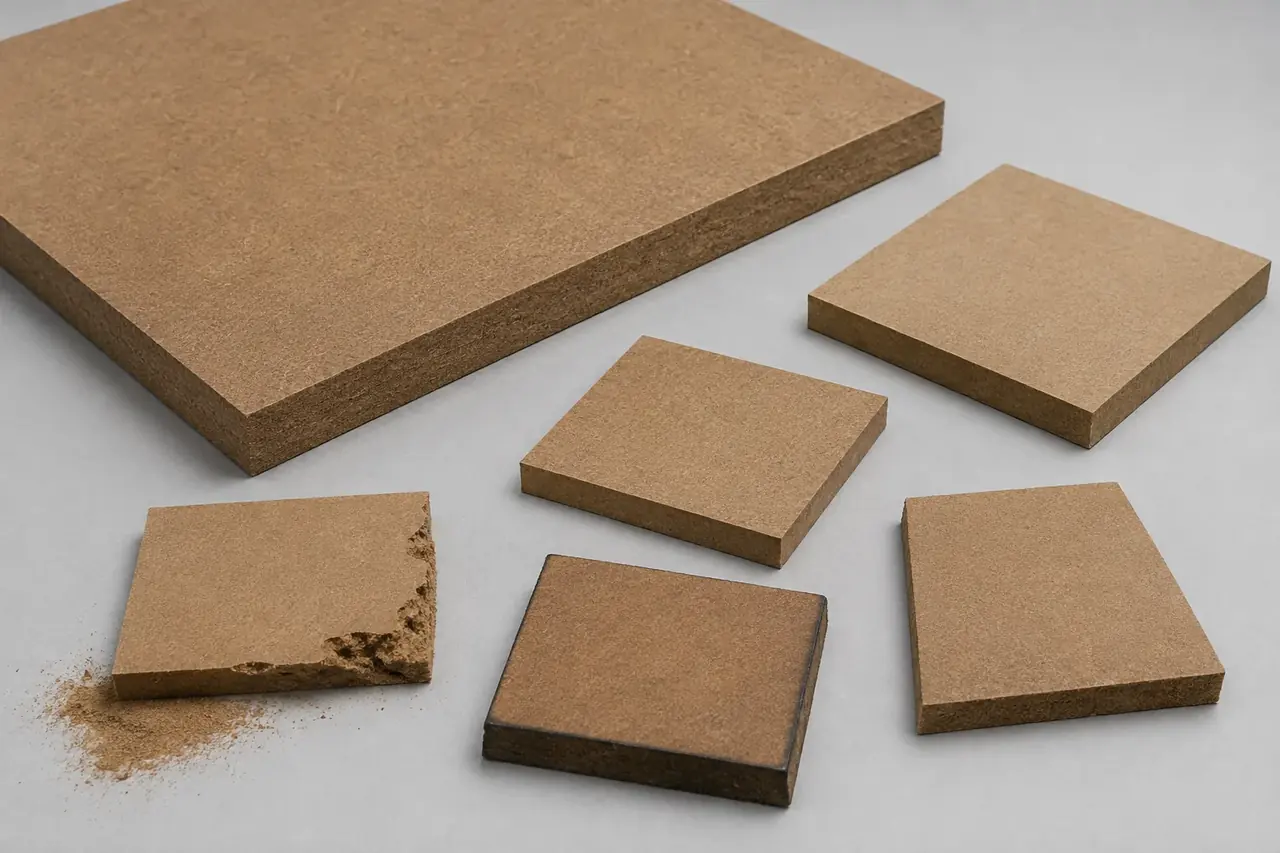
MDF and HDF are dense fiber-resin panels with no supporting grain, yet density can vary between the faces and core. Sizing quality depends on stable feed, effective dust removal and an edge geometry that cuts the resin-rich surface layers without rubbing the board hot.
Updated
Where This Cutting Application Appears
Furniture-panel blank sizing
Cuts MDF into repeatable cabinet, door or fixture blanks before machining and finishing.
Thin HDF component conversion
Sizes dense backer, skin or core panels that are sensitive to edge chips and stacking damage.
Coated fiberboard preparation
Cuts painted, foil-wrapped or melamine-faced stock while the surface and substrate defects are evaluated separately.
Panel Sizing process boundary
panel sizing for MDF and HDF panels is planned around establishment of final straight-sided dimensions or manageable sheet and panel formats from larger stock; it is not complex contour production, repeated roll slitting or narrow cosmetic trimming alone.
Panel Sizing setup checkpoint
For MDF and HDF panels, confirm finished dimensions, datum edges, cut sequence, squareness method, hold-down and support for both the part and offcut.
Panel Sizing acceptance checkpoint
For MDF and HDF panels, evaluate length, width, diagonal or squareness, corner integrity, edge compression, surface marking and dimensional recovery.
Define the Required Cut Result
- Square dimensions across the production batch
- Low face and edge chipping
- No dark heat-polished edge
- Controlled dust and predictable tool wear
Problems to Diagnose Before Changing the Knife
Fine edge breakout
- Compare face density and coating
- Inspect tooth or edge wear under magnification
- Check exit support and scoring condition
Dark or polished cut face
- Record feed rate and spindle speed
- Remove resin and fiber deposits
- Measure runout and side rubbing
Rapid loss of sharpness
- Identify mineral contamination and board recipe
- Check dust extraction near the cutting circle
- Map wear across the tool width
Panel-size drift
- Verify fence and stop calibration
- Check feed slip caused by dust
- Measure thermal and bearing changes during long runs
Knife Forms That May Be Considered
| Possible knife form | When it may be considered | What must be confirmed |
|---|---|---|
| toothed circular sizing cutter | A rigid circular tool suits panel sizing when tooth form, projection and feed match board density and surface layers. | Confirm final geometry and mounting from the MDF or HDF panel saw spindle, an unworn sample or an approved drawing before manufacture. |
| scoring and main cutter pair | A scoring unit can protect a coated exit face on machines that maintain alignment between the two cuts. | Confirm final geometry and mounting from the double-tool panel sizing line, an unworn sample or an approved drawing before manufacture. |
| wear-resistant tipped panel cutter | Carbide or other wear-resistant tips may be reviewed where fiber, resin and mineral content dominate wear, subject to impact control. | Confirm final geometry and mounting from the rigid fiberboard sizing station, an unworn sample or an approved drawing before manufacture. |
Information to Send for Technical Review
You do not need to know the exact blade name. Send the available workpiece, machine, current-knife and cut-result information so the application can be reviewed against a drawing or sample.
- Panel saw or sizing-line model
- MDF or HDF grade, density and board supplier
- Thickness and density profile if available
- Raw, painted, laminated or coated faces
- Panel sizes, tolerances and stack condition
- Spindle speed, feed rate and scoring setup
- Dust, burn, chip and wear samples
- Tool drawing, quantity and service interval
Questions About This Cutting Application
Why does MDF burn even when the cutter still feels sharp?
Resin buildup, side rubbing, feed reduction or runout can generate heat before gross edge dullness is obvious.
Is HDF cut with the same setup as standard MDF?
Higher density and different surface layers can change load and wear; test the actual board grade.
What causes a polished band on only one part of the edge?
Tool deflection, panel bow, uneven density or localized rubbing may affect one depth zone.
Can dust volume indicate cutter wear?
It is a useful trend only when extraction and board grade remain controlled; pair it with edge and load observations.
Which panel samples should be kept?
Retain full-thickness edges from the start and end of a run, marked with face, feed direction and operating data.
Related product and service information
- Clipping Natural Wood Veneer Sheets - natural wood veneer sheets · clipping and edge joint preparation
- Trimming Plywood Panel Edges - plywood panels · panel edge trimming
- Cutting Particleboard Panels to Size - particleboard panels · sizing and cross-cutting
Request a Custom Cutting-Knife Review
Send the workpiece details, machine or holder information, current knife photos or sample, required quantity and examples of the present cut problem. Final dimensions, material, edge geometry and tolerances are confirmed from the approved requirements.