
Blade Application Guides / Application Guide / Transport packaging
Plastic Strapping Cutoff Without Splitting or Tails
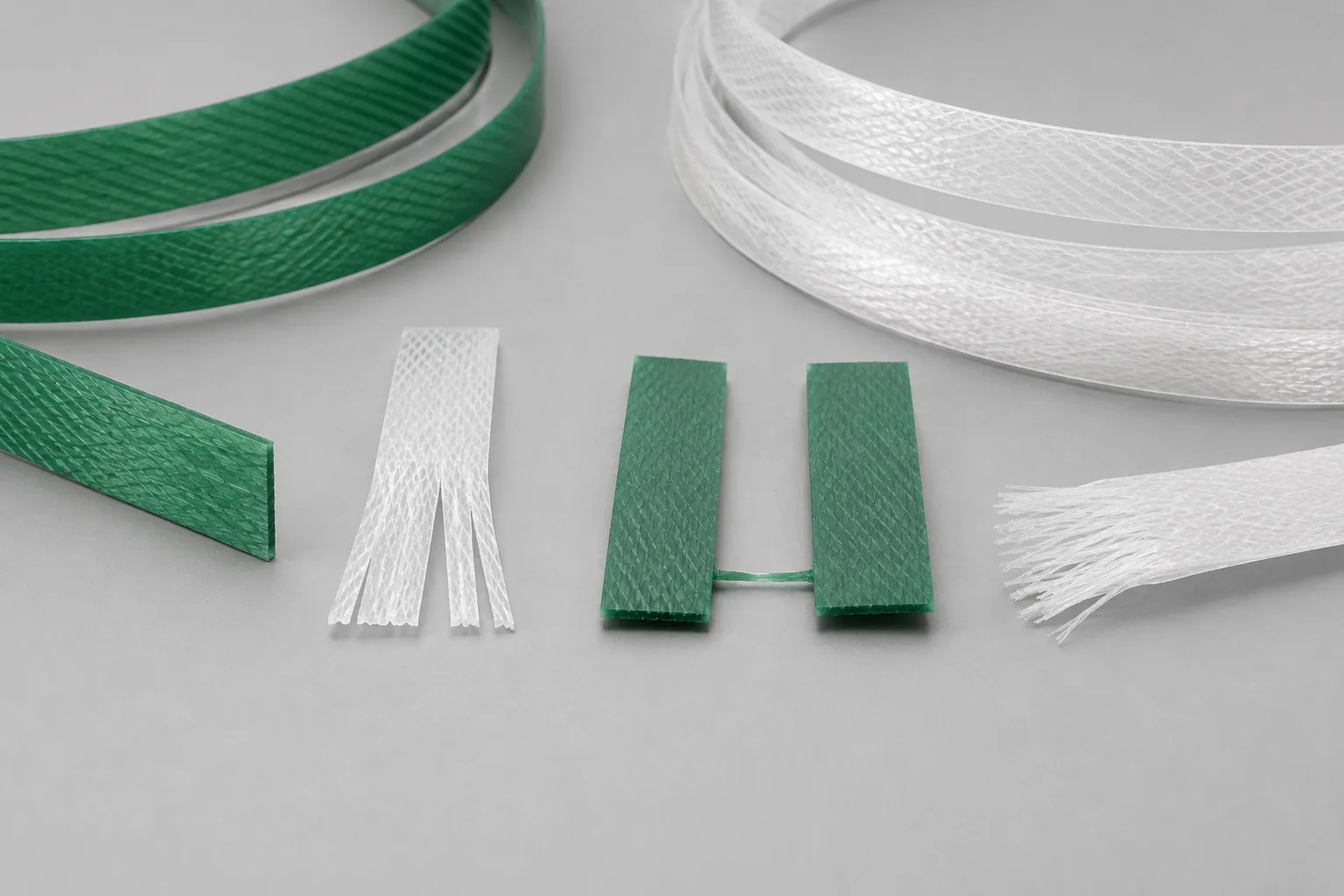
Packaging strap stores tensile energy and may be PET, polypropylene, embossed, smooth, or fiber-reinforced. Cutoff behavior must be considered with strap tension, seal sequence, support, motion, wear location, and the acceptable trailing end.
Updated
Where This Cutting Application Appears
Automatic pallet strapping
Tensioned strap is sealed and separated around unit loads, where a missed cut can interrupt the next feed cycle.
Carton and bundle strapping
Narrow polypropylene or PET strap is cut after sealing with a short controlled tail that will not catch during handling.
Heavy-duty transport strapping
Thicker or reinforced strap is separated under higher stored tension while split ends and component wear are monitored.
Cutoff process boundary
cutoff for plastic packaging strap is planned around separation across the material flow or part axis to establish a controlled repeat length or finished end; it is not longitudinal width conversion, shaped contour production or particle-size reduction.
Cutoff setup checkpoint
For plastic packaging strap, confirm target length, datum or registration reference, feed indexing, support on both sides, cut timing and post-cut transfer.
Cutoff acceptance checkpoint
For plastic packaging strap, evaluate length distribution, squareness or cutoff angle, both cut faces, deformation, registration drift and stacking or discharge consistency.
Define the Required Cut Result
- Complete separation within the strapping head's available stroke
- Prevent longitudinal splitting of PET or polypropylene strap
- Leave a controlled tail compatible with the seal and next feed
- Release stored tension without uncontrolled whipping or snagging
Problems to Diagnose Before Changing the Knife
Strap splits lengthwise from the cut end
Review polymer, extrusion orientation, embossing, edge damage before cutoff, tension, support, cut direction, and split length.
A thin web remains uncut across the strap
Map the bridge position against strap flatness, support wear, engagement, stroke, alignment, contamination, and material thickness.
Trailing tail is too long or inconsistent
Check seal position, strap feed, tension release, cutoff timing, slip, head reset, and measurement reference on successful cycles.
Frayed or melted-looking cutoff edge
Compare reinforced fibers, polymer temperature, friction, motion speed, residue, edge condition, and whether heat marks develop during a run.
Knife Forms That May Be Considered
| Possible knife form | When it may be considered | What must be confirmed |
|---|---|---|
| Straight shear cutoff form | Consider where the strapping head clamps the strap against a defined support for separation. | Confirm support, stroke, overlap, strap path, mounting, head revision, and approved equipment drawing. |
| Profiled or serrated cutoff form | Consider only where the installed mechanism uses penetration to initiate separation of thick or reinforced strap. | Confirm profile, direction, reinforcement, tension, cycle motion, and accepted cut-end samples. |
Information to Send for Technical Review
You do not need to know the exact blade name. Send the available workpiece, machine, current-knife and cut-result information so the application can be reviewed against a drawing or sample.
- Strap polymer: PET, polypropylene, or reinforced construction
- Strap width, thickness, embossing, color, and extrusion direction
- Tensile setting and residual tension at the cutoff event
- Seal type, seal position, tail requirement, and feed direction
- Strapping-head manufacturer, model, revision, and cycle sequence
- Current cutoff part, support part, mounting, stroke, and wear pattern
- Photos or video of bridges, splits, fray, tails, and residue
- Cycle frequency, cleaning, quantity, drawing status, and safety controls
Questions About This Cutting Application
Why does PET strap split from an otherwise complete cutoff?
Extrusion orientation, pre-existing edge damage, embossing, high tension, or the way separation starts can drive a longitudinal split. Retain the cut end and mark feed direction.
How can a long tail be separated from a cutoff failure?
Check whether full separation occurred, then compare seal position, feed length, tension release, timing, and head reset. A timing issue may leave a long but clean tail.
Do embossed and smooth straps need separate trials?
They may contact support differently and can vary in thickness, friction, and crack initiation. Test the actual grades at production tension.
What should be inspected with the current cutoff part?
Also inspect the mating support, alignment, travel, fasteners, deposits, and wear marks. One component alone may not explain a remaining bridge.
Can the strapping-head model confirm compatibility?
Not alone. Revisions, strap path, support, stroke, and mounting can differ. Use the current parts or an approved drawing and verify the cycle safely.
Related product and service information
- Label Kiss Cutting Without Damaging the Release Liner - self-adhesive labels · kiss cutting
- Folding Carton Die Cutting and Crease-Area Integrity - folding carton blanks · die cutting
- Solid Board Guillotine Cutting for Square Stacks - solid paperboard sheets · guillotine cutting
Request a Custom Cutting-Knife Review
Send the workpiece details, machine or holder information, current knife photos or sample, required quantity and examples of the present cut problem. Final dimensions, material, edge geometry and tolerances are confirmed from the approved requirements.